Session 9 · 303 hands · 2 tables · 30:41
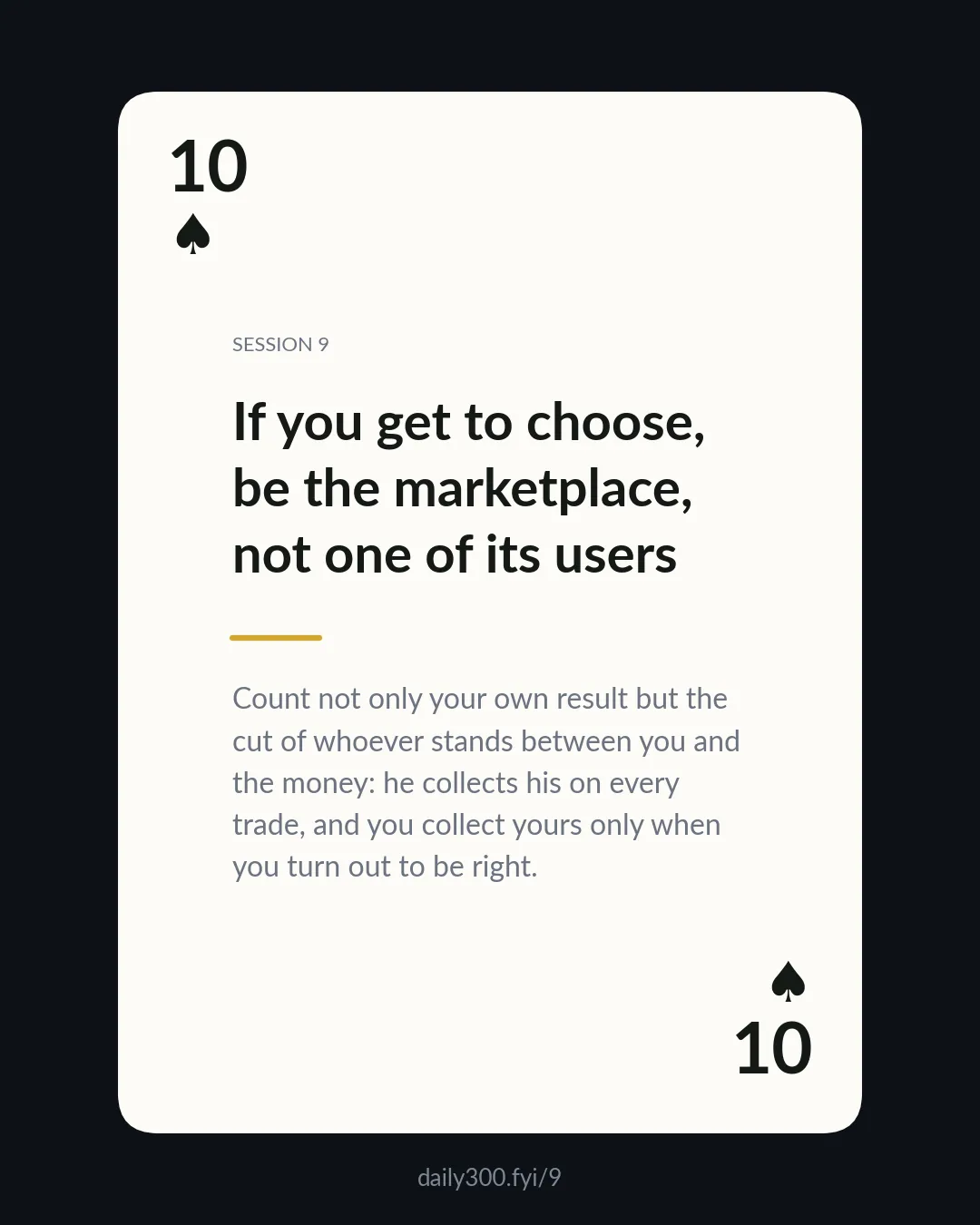
If you get to choose, be the marketplace, not one of its users

Mark Zavadsky. Launched Alibaba in Russia, ran Sberbank's ecosystem, headed the studio behind Smeshariki and Fixiki, now iGaming and investing.
The idea
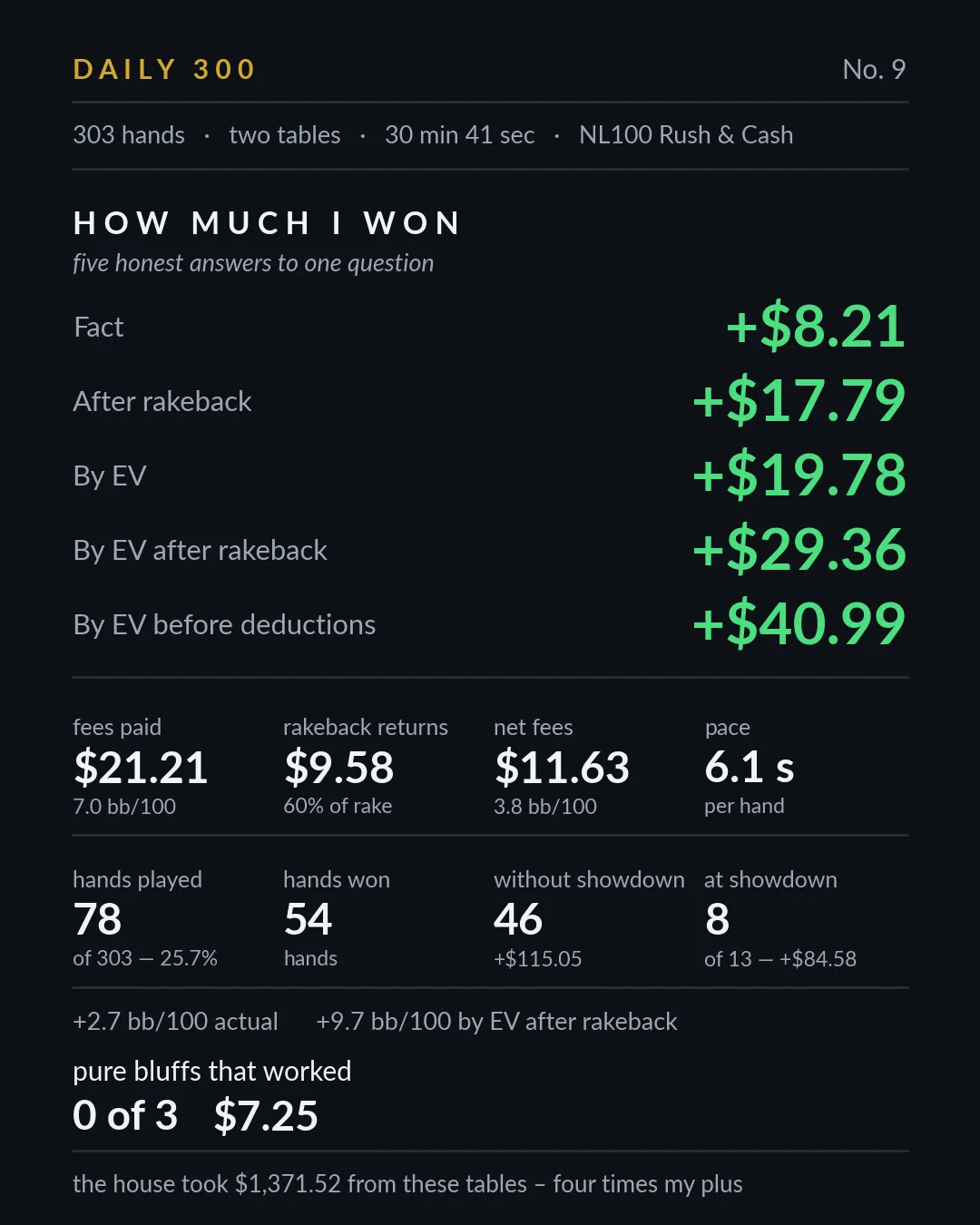
Breaking even for once, I counted somebody else's result instead of my own: how much did the house make over the same stretch? Across nine sessions, $28,567 has crossed my tables. It took $1,371.52 of that – $24.85 an hour from every seat, and the number has no margin of error, it is a line in the log. Over the same stretch I made $245.62, and my 2,742 hands do not yet prove I am even a winning player – thank you, variance.
A poker room runs on marketplace logic: the participants buy and sell each other's time, and it clips a commission off every transaction. And the size of that commission should change how you play: the bigger it is, the less often you should enter, to finish the session ahead – every entry already costs money, and a hand that is barely worth it before the commission is not worth it after. Count not only your own result but the cut of whoever stands between you and the money: he collects his on every trade, and you collect yours only when you turn out to be right.
Below: a case with the same mechanics, and the hands the idea grew out of, with the arithmetic. Poker words are underlined – hover to see what they mean.
The case
In 2000 two economists, Brad Barber and Terrance Odean, obtained from a large discount broker the full history of 66,465 private accounts over six years, 1991 to 1996: every stock purchase and sale, commissions included. The market rose 17.9 per cent a year over those years. The average account earned 16.4 – a point and a half less, and almost all of the gap went to the broker. Then they split the accounts into five groups by how often people traded. The most active fifth turned its portfolio over by more than 250 per cent a year – it sold and bought everything it held two and a half times over – and earned 11.4 per cent: six and a half points below the market.
What matters most, though, is what set the most active apart, and it was not the stocks: the shares they picked were, on average, no worse than anyone else's. What set them apart was frequency: every trade cost a commission, and the more often they entered the market, the larger the share of the result they handed to the middleman. The paper is titled, simply, “Trading Is Hazardous to Your Wealth”. The more an entry costs, the less often you should enter – and the weightier the reason has to be.
The analysis
Across nine analyzed sessions, $28,567 has crossed my tables: 2,742 hands and 4 hours 36 minutes of play. The room took $1,371.52 of it in rake and jackpot fees: 4.8% of the money that moved, $298 an hour from two tables, $24.85 an hour from each of the twelve seats, no matter who is sitting in it or how he plays. My own result over the same stretch is $245.62, or $53 an hour. But $53 an hour is not the rate at which it will keep arriving – it is what happened over 4 hours 36 minutes, no more. The rate is called a win rate, and it carries an enormous margin of error. The estimate is 8.96 big blinds per hundred hands, and on a sample this size the 95% interval around it runs from minus fourteen to plus thirty-one big blinds per hundred. Zero is inside it: my 2,742 hands do not yet prove I am even a winning player. Another fifteen thousand hands or so would be needed before that interval clears zero. The room's $24.85 an hour has no margin of error at all: it is not an estimate, it is a line in the log.
The commission net of the Cash Drop the house itself added to pots comes to $1,301.52, my $245.62 next to it. For every dollar of mine it took $5.30. I sit there reading opponents, counting combinations, making mistakes, and waiting for a hand; it takes its share out of every pot big enough to be raked, and there were 1,381 of those in 2,742 across the series.
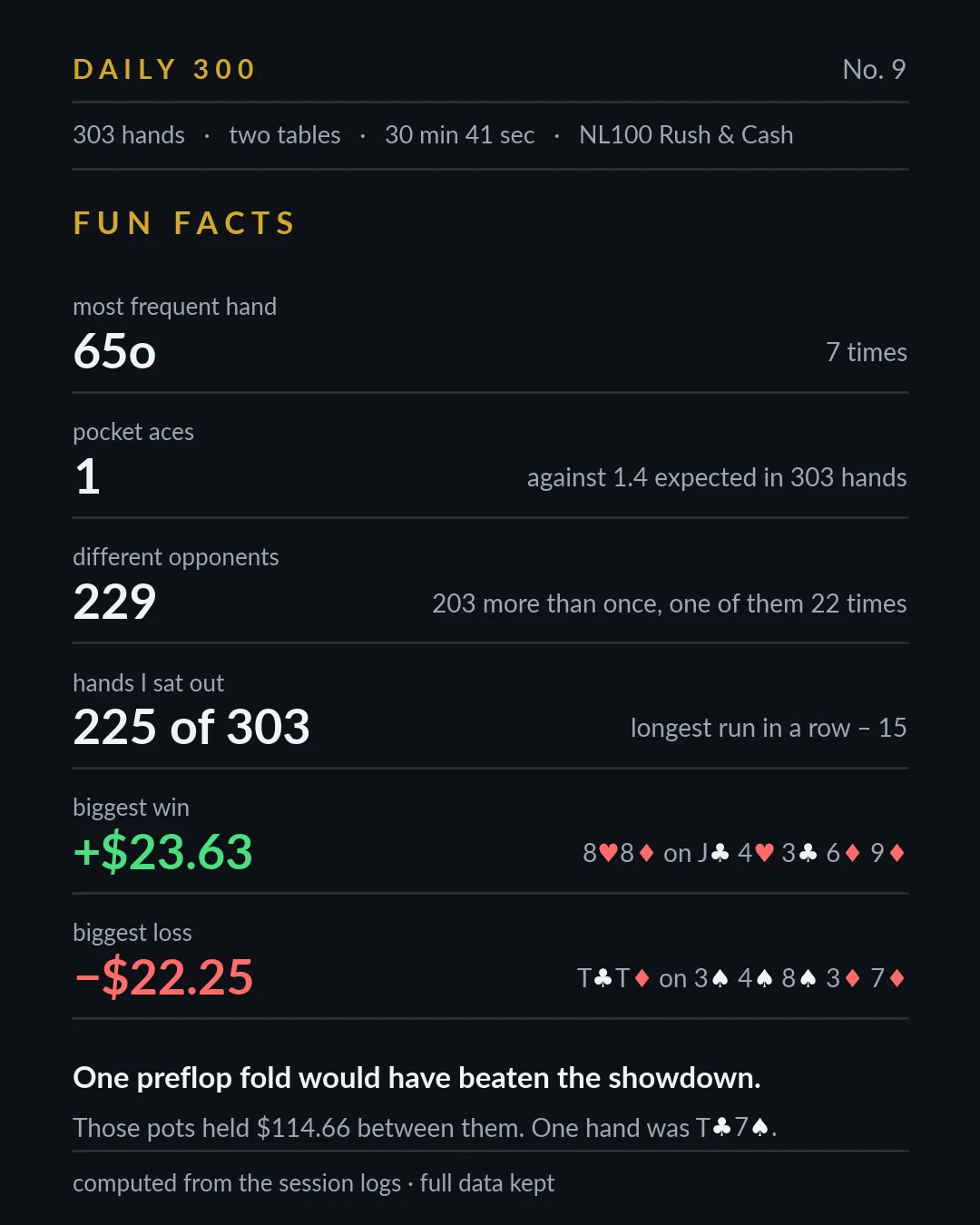
The commission does not arrive as an invoice at the end of the month, it comes out of every pot on the spot. Here is today's hand, the most expensive of the session, where that shows up as a single number.
Every bet right, still a loss
Preflop
I am in the cutoff (CO), one seat off the button, with T♣T♦, a pair of tens. I raise to $2.50 and only the big blind calls. $5.50 in the pot.
Flop
Pot $5.50Flop 3♠ 4♠ 8♠ – three spades, and I hold none of them: if he has two spades, his flush is already made and beats anything I can make. He checks, I bet $2.75, he calls.
Turn
Pot $11Turn 3♦ pairs the board. I now have two pair, tens and threes, and from here any three in his hand makes trips and beats me. I bet $11 into $11, a pot-sized bet, nearly half of all the money I put into this hand. He calls again.
River
Pot $33River 7♦, $33 in the pot. I bet $6: eighteen percent of the pot, deliberately small. The question is not who I beat but who pays six dollars: he is putting $6 into a $39 pot, so he needs to be right 13.3% of the time, and at that price everything with any pair at all calls. Among the hands that call, I beat 66 combinations against the 28 that beat me – better than two to one, and the bet makes $2.43 on average. The bulk of those callers hold an eight: they have two pair too, just below mine. His hands are my estimate, so I ran the bet across sixteen sets of assumptions, from the narrowest to the widest, and it stayed profitable in all sixteen. He calls and shows J♦J♥. A pair of jacks – a hand I had not given him: from the big blind, jacks are usually a re-raise rather than a flat call of $2.50, so I left them out of the count. The same two pair as mine, one rank higher. Minus $22.25 – the most expensive hand of the session, and by the arithmetic not one wrong decision in it.
The pot was $45. The winner collected $41.33. The house took the other $3.67, $2.17 in rake and $1.50 in jackpot fees, before the money ever reached him. I won nothing in this hand and still paid my share of the commission: it is taken from the pot before anyone's profit exists. Across the whole series I have won 453 pots worth $4,803.52, and the house took $231.03 out of them: 4.8%, exactly its share of the money that moved. That is 8.4 big blinds per hundred hands against my win rate of 8.96 – the commission I pay is almost equal to what I win. Before it the series made $476.65, after it $245.62: forty-eight per cent went to the house. And I did not enter all that often – voluntarily in 646 hands out of 2,742, 23.6% of the time; were the commission higher, I would have to enter rarer still.
Over 4 hours 36 minutes, $28,567 crossed those tables. The house took $1,371.52; I made $245.62. And here is the last asymmetry: nothing in the statistics proves I am the best player at this table, and nothing on a sample this size could, while the house's percentage is proven to the cent and does not depend on which of the six of us was right. Between a percentage and a result, take the percentage, and if the percentage is not yours, enter less often: the commission is taken on every trade, and the only way to pay less of it is to make fewer trades – only the ones where you are strongest.
Session cards
The best sessions in your inbox, once a week.