Session 10 · 304 hands · 2 tables · 30:04
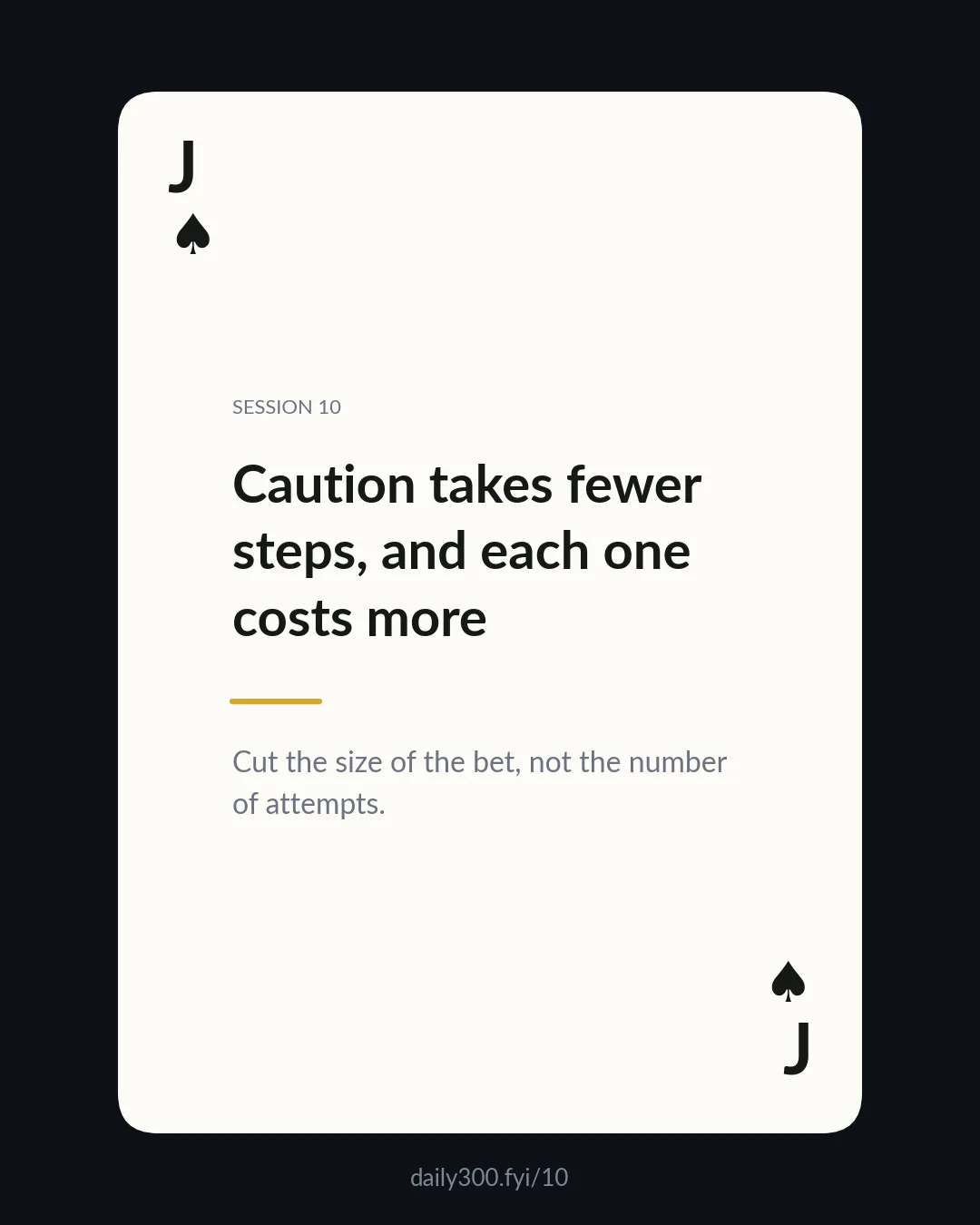
Caution takes fewer steps, and each one costs more

Mark Zavadsky. Launched Alibaba in Russia, ran Sberbank's ecosystem, headed the studio behind Smeshariki and Fixiki, now iGaming and investing.
The idea
After a big loss I started acting half as often: in the most careful stretch of the day I made 10.5 percent of the moves I could have made, against 21.7 across the session. But the average I committed each time doubled, $21.43 against $11.22: the small commitments fell by two thirds, from nine to three, the large ones by two, from five to three.
Caution has two dials, and only one of them ever gets turned: what gets cut is whatever is easy to stop, the small, the optional, the thing nobody owns, while large commitments carry on, because getting out of them costs more than seeing them through. And what happened to the risk? It went nowhere; it settled on fewer decisions. Cut the size of the bet, not the number of attempts.
Below: a case with the same mechanics, and the hands the idea grew out of, with the arithmetic. Poker words are underlined – hover to see what they mean.
The case
In the summer of 2010 the British government was cutting spending. Advertising was frozen within a month: £6.5 million saved in the first four weeks, half the same month a year before. In those same months the defence review was working out whether the two aircraft carriers under construction could be cancelled.
Cancelling one would save £200 million, cancelling both £1.2 billion against a £6.24 billion programme, because £2.4 billion would still be owed to the shipyards under existing commitments. The advertising stopped in four weeks. The ships were finished. The cuts fell not where being wrong cost the most, but where stopping was easiest – and the biggest risk was left untouched.
The analysis
The session divides into four equal stretches of 76 hands. The share I played across them: 27.6 percent, 21.1, 10.5, then 27.6 again. The collapse in the third stretch is not a trick of the sample: eight hands played out of 76, against 58 out of 228 in the other three, and such a gap turns up by chance six times in a thousand. Look instead at the ten hands right after each big loss and the direction is the same (I entered 10 percent of the time against 22.3, raised 5 percent against 15.4, never bet after the flop), but there were only four such losses in the session, and on a sample that small each of those gaps turns up by chance at least nine times in a hundred. The stretches are what prove the caution; the window after a loss only shows where it came from.
In the third and most careful stretch I played eight hands out of 76, and the stretch as a whole cost $89.87, almost as much as the first, where I played twenty-one. The average amount I committed to a single played hand rose from $11.22 across the session to $21.43. Cheap hands, where I put in three dollars or less, ran 9, 10, 3, 11 across the four stretches. Expensive ones, over ten dollars: 5, 4, 3, 4. The cheap ones fell by two thirds, from nine to three; the expensive ones by two, from five to three. What I was cutting was almost entirely the cheap end.
This is tilt, just not the version people talk about. The word has come to stand for one picture: a man loses, snaps and starts chasing – entering every hand, betting bigger, and forcing every spot. But the acute stress response has three settings: fight, flight, or freeze. The first is visible at every table, and it is what the word came to mean. Mine is the third. I did not start playing wider – I folded everything, and my longest unbroken streak of folds was twenty-three hands. That is my account of myself, not a measurement: the log records the action, and the reason is mine to guess. What it does record is the price, and it is the same price rage pays. Freezing is just as much a departure from your normal game, except nobody will ever call it a mistake: from the outside and from the inside it looks like sensible caution. The difference is that what I cut was chosen by how easy it was to stop, not by what being wrong would cost – and those two are different things that almost always point the same way.
Folding before the flop costs nothing, so it is the first thing to go. Walking away from a hand with twenty dollars already in it costs twenty dollars, so it is the last thing you will give up. Cheap to stop and cheap to be wrong in are very nearly the same set; expensive to stop and expensive to be wrong in are too. So if you cut by what is easiest to stop, you strip out exactly the part where being wrong is safe and keep the part where it isn't. The third stretch shows it plainly: eight hands instead of twenty-one, and the same loss. I will not hang the whole loss on it, though: 92 percent of that stretch's damage came from two hands, one of them the all-in against aces: anyone would have been unlucky against those, but the size of the bet was my choice.
The two most expensive hands of the day are built the same way, though I was in a different frame of mind each time: the first on hand six of the session, before any caution at all, the second in the middle of the most careful stretch. Neither was cautious – I put more money into each of them than into any other hand of the day. Together they came to $116.21: forty-eight percent of the day's loss in two hands out of 304.
The biggest bet at the worst possible point
Preflop
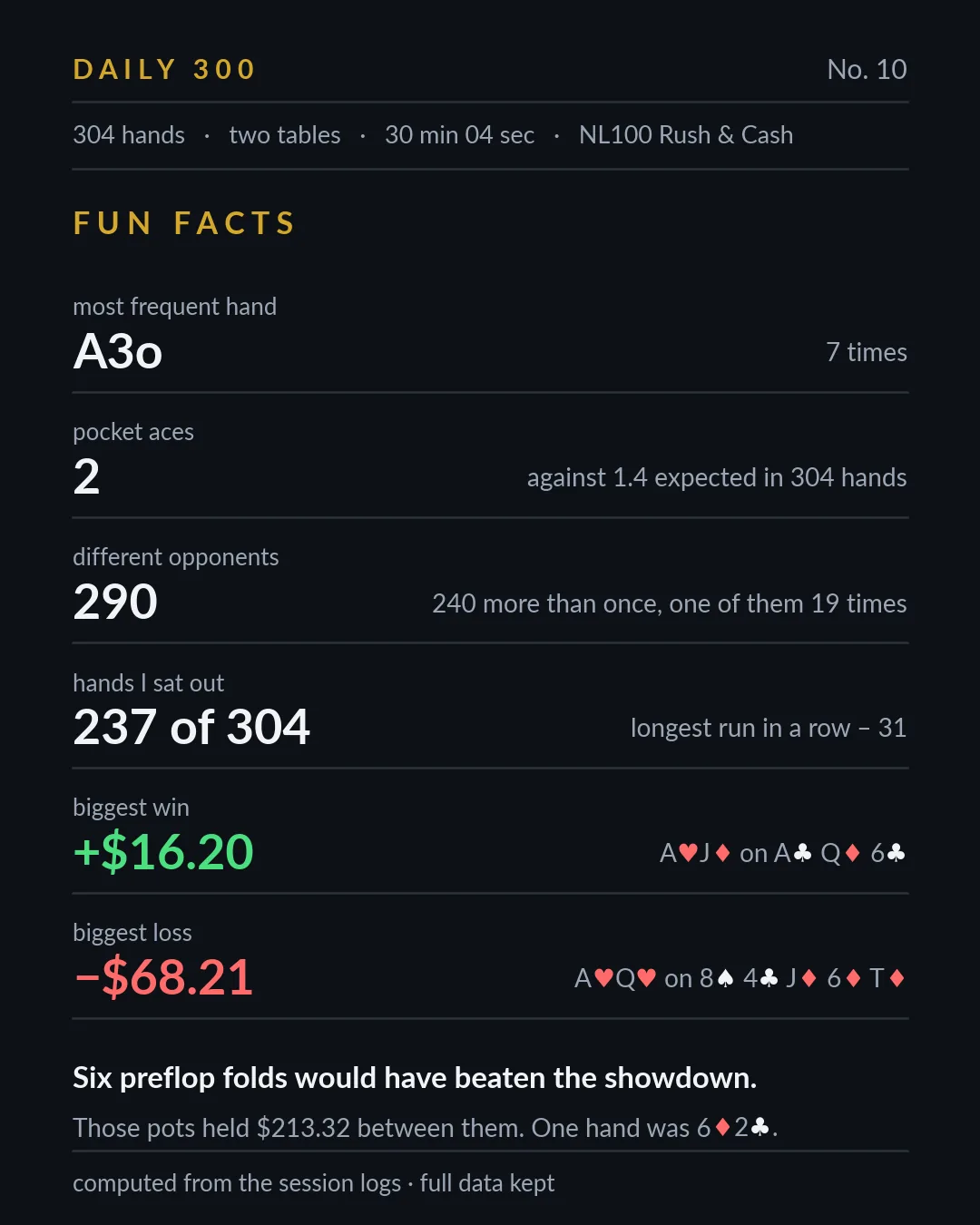
The first is the sixth hand of the session, seventeen seconds after play began. I am on the button with A♥Q♥ and raise to $2.50. The small blind re-raises to $8.50, I raise again to $22.50, he calls. $46 in the pot, and he has $45.71 left.
Flop
Pot $46Flop 8♠ 4♣ J♦ – a complete miss: no pair, no third heart, and nothing lining up toward a straight. I have ace high and nothing else. He checks, I move all-in. Look at the price: I am risking $45.71 to take $46, so the bet pays for itself on folds only if he gives it up about half the time. And he almost never gives it up: calling asks him to be right 33.3 percent of the time, and in the range he arrived with, by my estimate, hands that re-raise before the flop and then call when I raise again and then fold are hardly there. I put more money into this hand than into any other that day, and I chose for it the one point where he could hardly fold. He shows A♠K♥. The same ace, a king instead of my queen: my hand was behind before the flop and stays behind. Running all 990 combinations of the two remaining cards gives me 15.1 percent – 136 wins, 827 losses, and 27 ties. After that there were no decisions left: 6♦ and T♦. Minus $68.21 – and this is sixteen minutes before I started protecting myself.
The same arithmetic, only worse
Preflop
The second comes twenty minutes later, in the middle of the quietest stretch. I am in the cutoff (CO) with 9♣8♣. A player opens for $2, I raise to $7, he folds, the small blind re-raises to $19.75, I call. $42.50 in the pot.
Flop
Pot $42.50Flop 2♠ 6♣ Q♥ – another miss. He checks, I check behind him, and that is the only decision in either hand that I would make again.
Turn
Pot $42.50Turn 9♠ – I have a pair of nines, and on a board of 2♠ 6♣ Q♥ 9♠ only the queen is above it. He bets $14.03 and I raise all-in to $80.25 – far more than he can call, since he has only $14.22 behind. The same price problem as in the first hand, only worse: by the time he decides there is $84.78 in the pot and he owes $14.22, which asks him to be right 14.4 percent of the time. And he has just bet into me with the range he re-raised me with before the flop. The price will not let him fold; almost everything he holds can call. He has A♦A♠. Aces – higher than my nines, and by just enough that only five of the 44 possible rivers save me: 11.4 percent.
River
Pot $99River J♠. Minus $48.00. His range in both hands is my estimate; but both prices, 33.3 and 14.4 percent, come from the size of the pot and do not depend on his range at all.
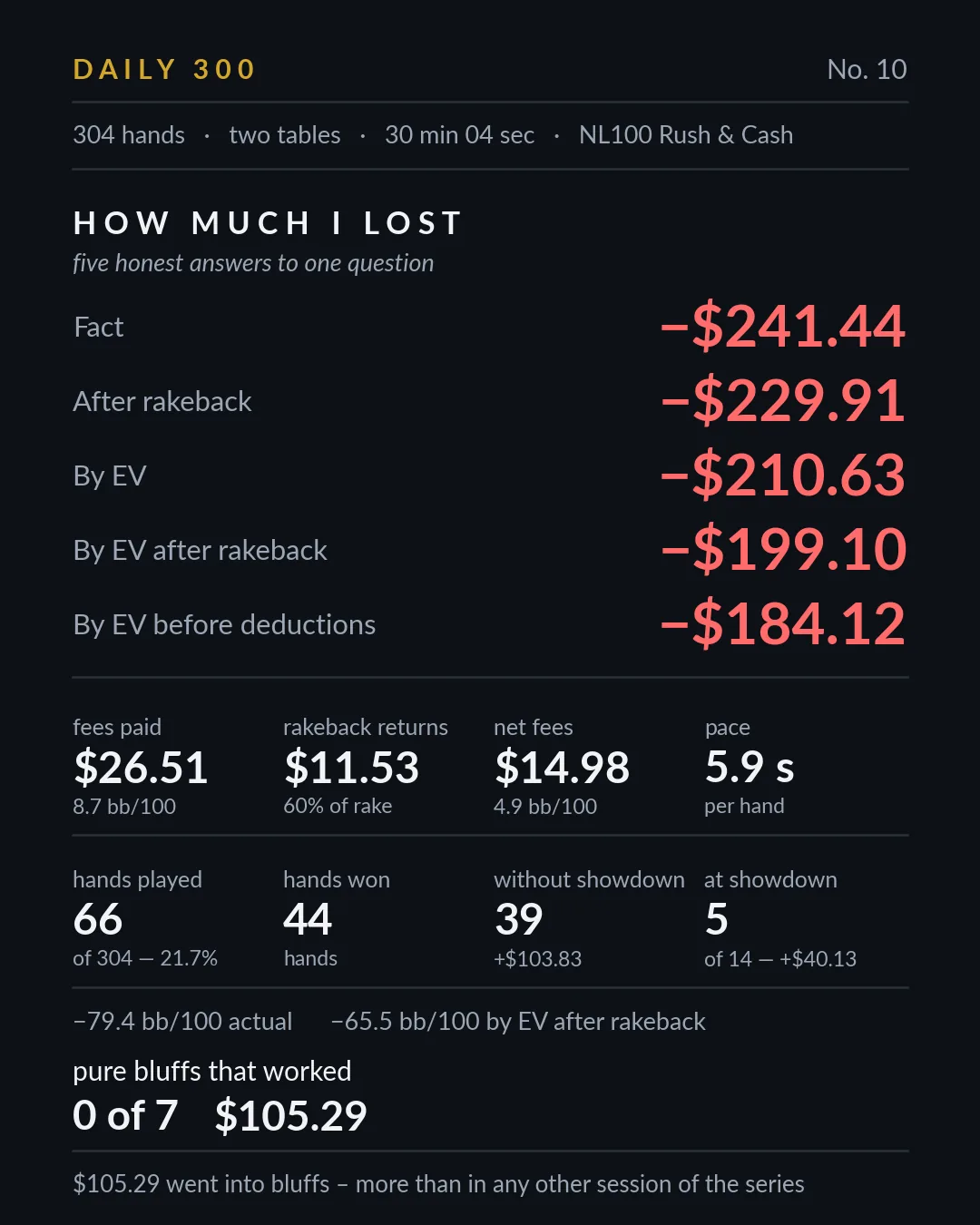
In half an hour I made seven pure bluffs, bets with air, no pair and no draw at the moment the money went in, and put $105.29 into them, more than in any other session of the series. Not one of them won the pot outright, against a rate of 31.8 percent for such bets across the previous nine sessions: 14 of 44. Zero out of seven at that rate is not yet an anomaly; it turns up about once in fifteen sessions. But the money in them was not ordinary money: I kept cutting the number of attempts and never touched their size, until each one that was left cost twice what it used to. Caution that trims only the count does not reduce risk – it moves the same risk onto fewer decisions. And in doing so it takes away your right to be wrong on precisely the day you are wrong most often.
Session cards
The best sessions in your inbox, once a week.