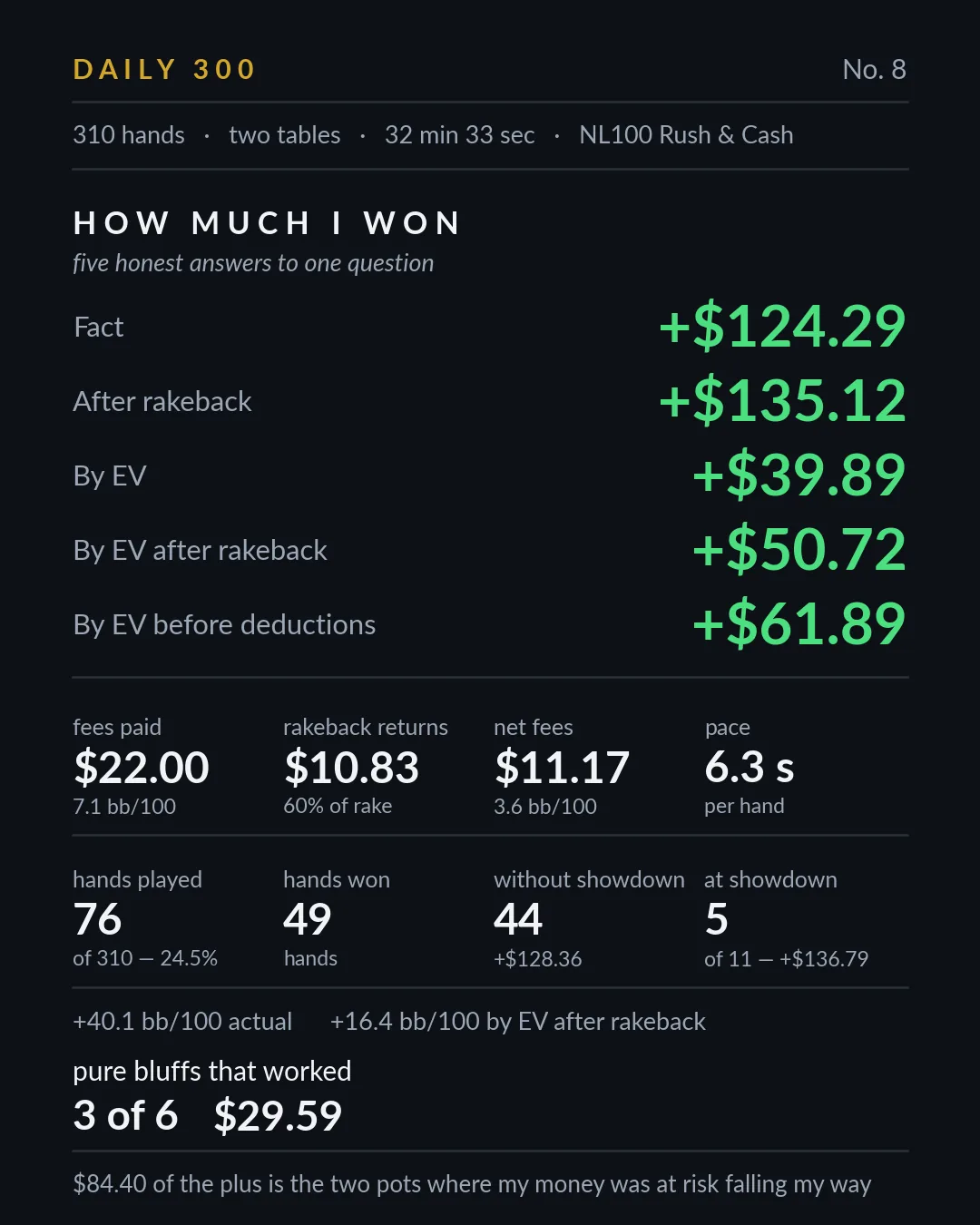
Session 8 · 310 hands · 2 tables · 32:33
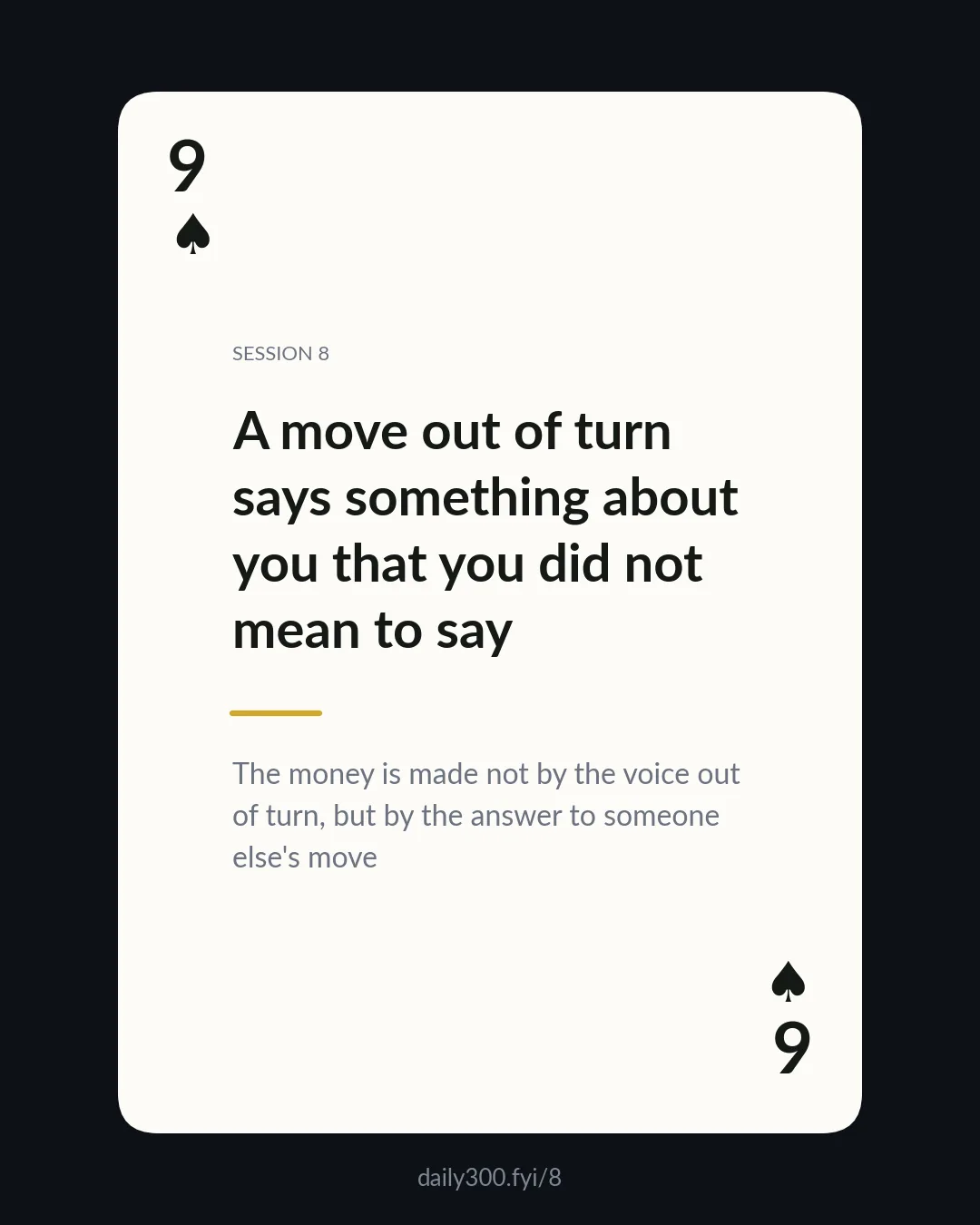
A move out of turn says something about you that you did not mean to say

Mark Zavadsky. Launched Alibaba in Russia, ran Sberbank's ecosystem, headed the studio behind Smeshariki and Fixiki, now iGaming and investing.
The idea
The lesson of the day cost twenty-eight dollars and brought in ninety-seven. In the two strongest hands of the day I played the opposite ways: with one I spoke first, without waiting for his bet, and by the end of the hand had lost both my voice and my money; with the other I stayed quiet, let him bet, and raised in answer. In eight sessions I have spoken first in such spots three times out of a hundred and three, only with a made hand, and lost all three; I have answered someone else's bet with a raise ten times – and won all ten.
In business a move out of turn is read before it is heard: if you only speak out of turn when you are completely sure, the fact of speaking, in truth, says all you meant to hide. And someone else's move out of turn? All the more a signal: it is only done from a position of strength. The money is made not by the voice out of turn, but by the answer to someone else's move: let the other side speak first, and its words become your information, its money yours.
Below: a case with the same mechanics, and the hands the idea grew out of, with the arithmetic. Poker words are underlined – hover to see what they mean.
The case
The Federal Reserve changes the price of money at its meetings, eight times a year on a schedule. On the third of March 2020, for the first time since the 2008 crisis, it did so off schedule – cutting the key rate by half a point at once, to 1–1.25. The market rose for a minute and closed down almost three per cent: the fact of an unscheduled move told investors more than its content. If the regulator would not wait for the meeting, it must be seeing something we do not.
Twelve days later, on Sunday the fifteenth of March, the rate was cut off schedule to zero and a seven-hundred-billion-dollar bond purchase was announced. On Monday trading was halted minutes after the open, and the day closed almost twelve per cent down – the worst since 1987. Every word out of turn was read the same way: if they are speaking now, things are worse than we thought.
The analysis
I spoke first
Preflop
Here is the hand. I am in the big blind with K♠J♠, the button raises to $2.50, the small blind folds, I put in another dollar fifty to call.
Flop
Pot $5.50Flop J♣ 8♠ 8♥, $5.50 in the pot. I have two pair, jacks and eights, and when two players hold the same two pair, the fifth card settles it – mine is a king. The small blind is out, so I act first on every street from here. And I speak: I bet $2.75 myself, without waiting for his bet. By the theory this hand does that about half the time and checks the rest: the board is paired and middling, and part of it is on my side. He calls.
Turn
Pot $11Turn 9♥, $11 in the pot. Again I speak first, $5.50, and he calls. By now I have put in $10.75, and on both streets I was well ahead: on the flop my hand beat 319 of the 373 two-card combinations the field opens with from the button – 85.5% – and on the turn 294 of 373, or 78.8%. But both bets are half the pot, and both come with a made hand: in eight sessions I have never bet out of turn with anything else, and I am not the only one who can see that.
River
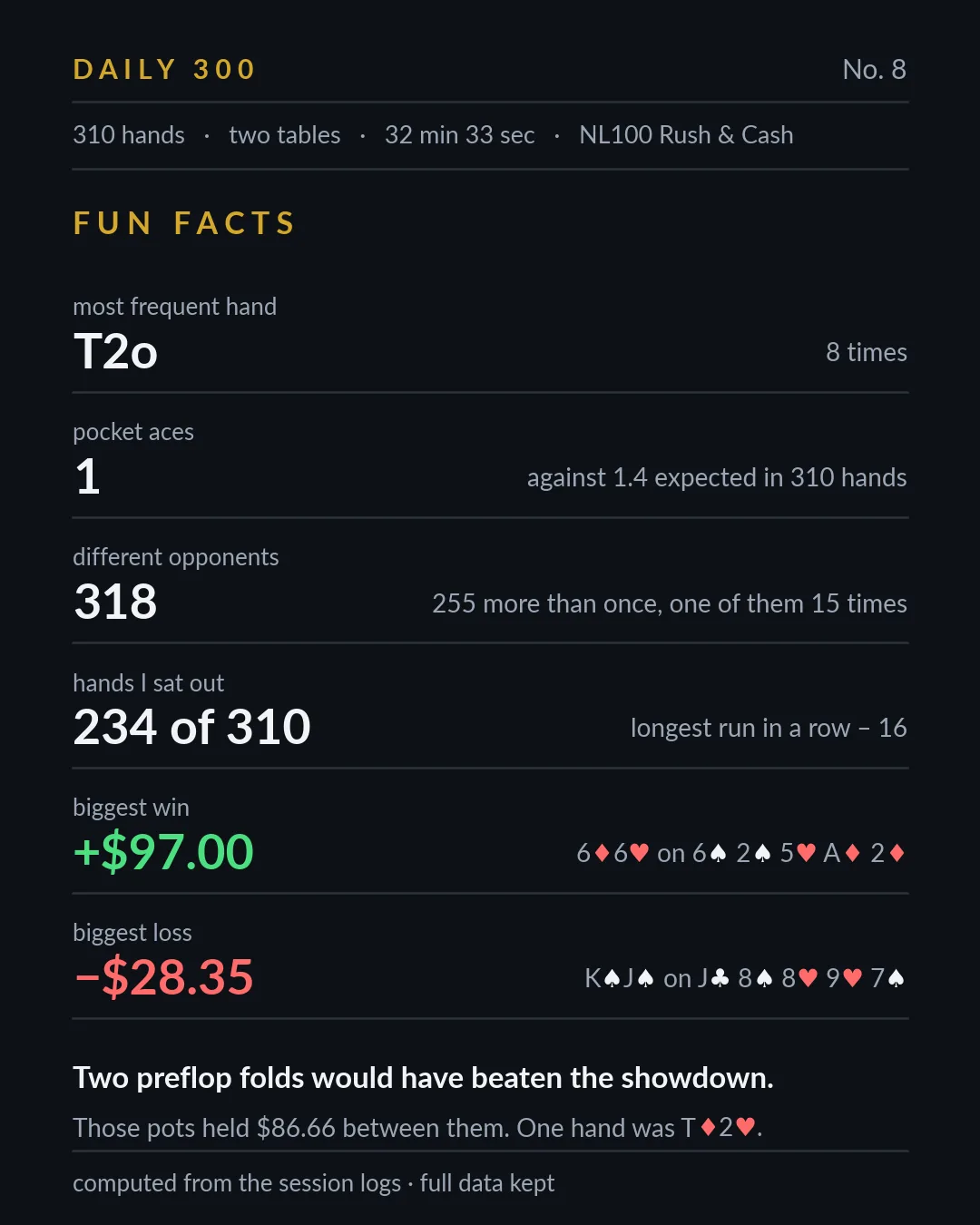
Pot $22River 7♠, $22 in the pot. Nobody can have a flush on this board: two spades, two hearts, one club – no suit gets past two cards. There is no straight on the board itself either – seven, eight, nine, and a jack with no ten. But now any ten in his hand completes one, and the button's opening range holds sixty-one such combinations. Of the 373 hands the field opens from the button, by my estimate I now beat 246, or 66%. And here, for the first time in the hand, I went quiet: I check. Now he spoke – $17.60, the largest bet in the hand – and I call. He shows A♠J♥. The same two pair, jacks and eights, and again the fifth card settles it – his is an ace. Minus $28.35. I know exactly what the call cost: putting $17.60 into a $22 pot means being right 30.8% of the time. And in his bet, by my estimate, exactly three hands in ten are bluffs: at that price a call and a fold are worth the same, and by the theory this hand calls about half the time. The call is not a mistake, but not a win either – zero. What my two voices out of turn did buy is plain enough: $8.25 into a pot I did not win, and an opponent who reached the river knowing as much about my hand as I did.
I let him speak first
Preflop
The day's other big pot, eighteen minutes earlier, is the mirror image. From the cutoff (CO) with 6♦6♥ I raise to $2.50, the button makes it $6, I call.
Flop
Pot $13.50Flop 6♠ 2♠ 5♥ – trip sixes, and on this board not one of the hundred combinations the field re-raises with beats me.
Turn
Pot $51The turn to speak is his – he re-raised before the flop – and I do not take it from him: I check, he bets $6, I raise to $18.75, he calls. Turn A♦ – I check again, again he bets, $16.83, and I answer with all-in for $75.25. He calls with 9♠7♠: no pair, an unfinished spade flush draw, and a gutshot – an inside straight draw needing exactly one card, an eight. He needed to be right 29% of the time; his hand wins 22.7%. The 2♦ river changed nothing – the money was already in from the turn. Three quarters of my money in this hand, $75.25 of the hundred I had, went in on the turn, where I beat 97 of the hundred combinations he could hold. Plus $97.00.
River
Pot $201.50The only candidate for a mistake
Preflop
By the arithmetic there is no mistake today. The one candidate was a $12 bet into a $12 pot on the turn, holding T♦9♦ on a board of A♠ 2♦ 7♦ K♠ with an unfinished diamond flush draw: he folds too rarely for the bet to pay for itself on folds alone. But by the theory that hand bets there nine times out of ten, more often for half the pot than for the whole of it, so there is no verdict; the range I open from the small blind is an assumption there, not a measurement.
Twenty-eight dollars and ninety-seven. In both hands, on the flop, I beat almost everything my opponent could hold, and in both he put money in. The difference is who spoke first. With the jacks it was me: two bets out of turn bought $8.25 into a pot, an opponent who had been reading me since the flop, and a river on which he was the one betting. With the sixes it was him, and every word he said turned into my money: $6, then $16.83, then a call for $75.25. In eight sessions I have raised in answer to someone else's bet ten times and won ten; I have spoken first three times and lost three. The field does the same: it bet into me out of turn twice, both times with a hand, and both times I paid. People speak out of turn not when they are sure of themselves, but where the context strengthens what they say – and then not only with a made hand.
Session cards
The best sessions in your inbox, once a week.