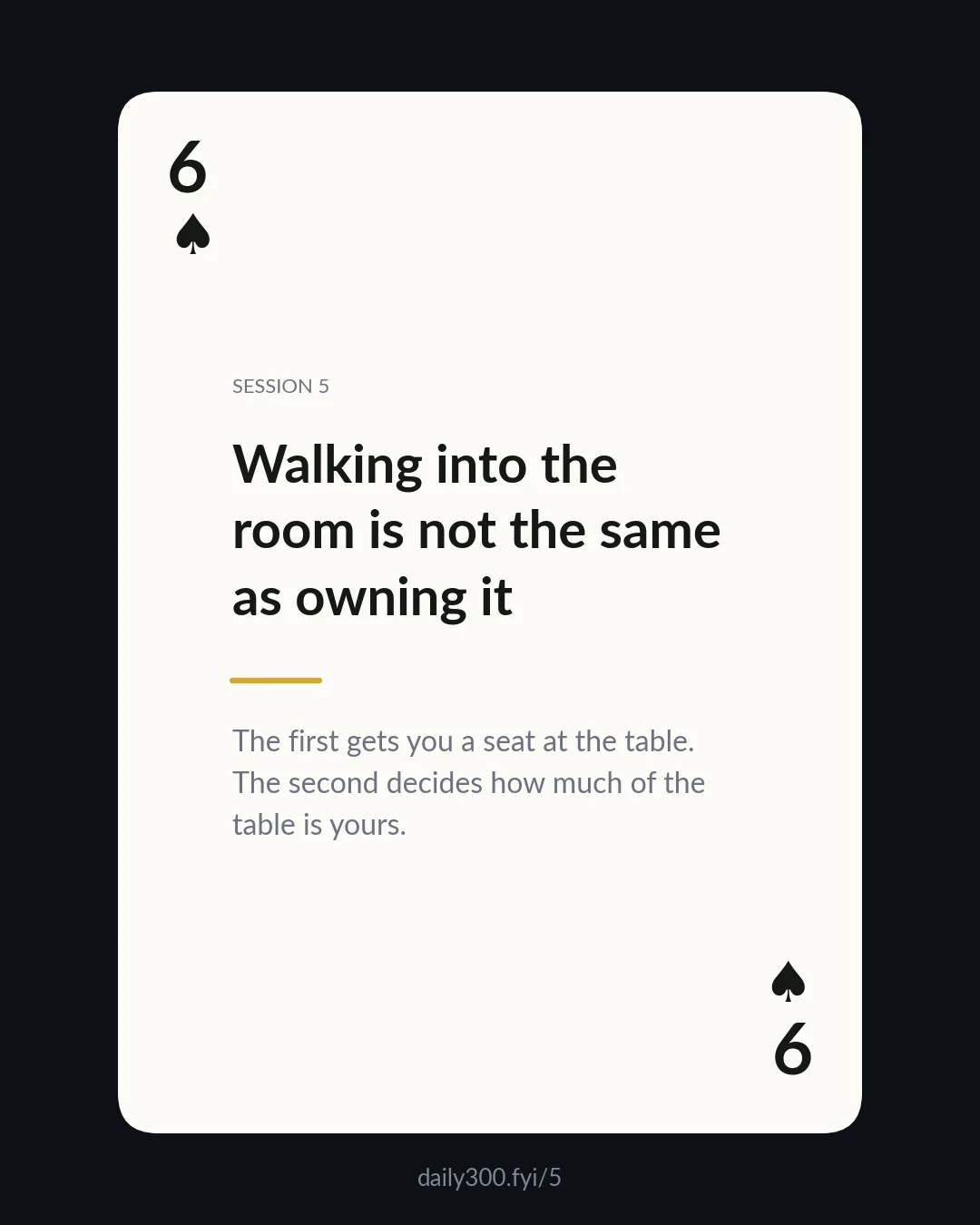
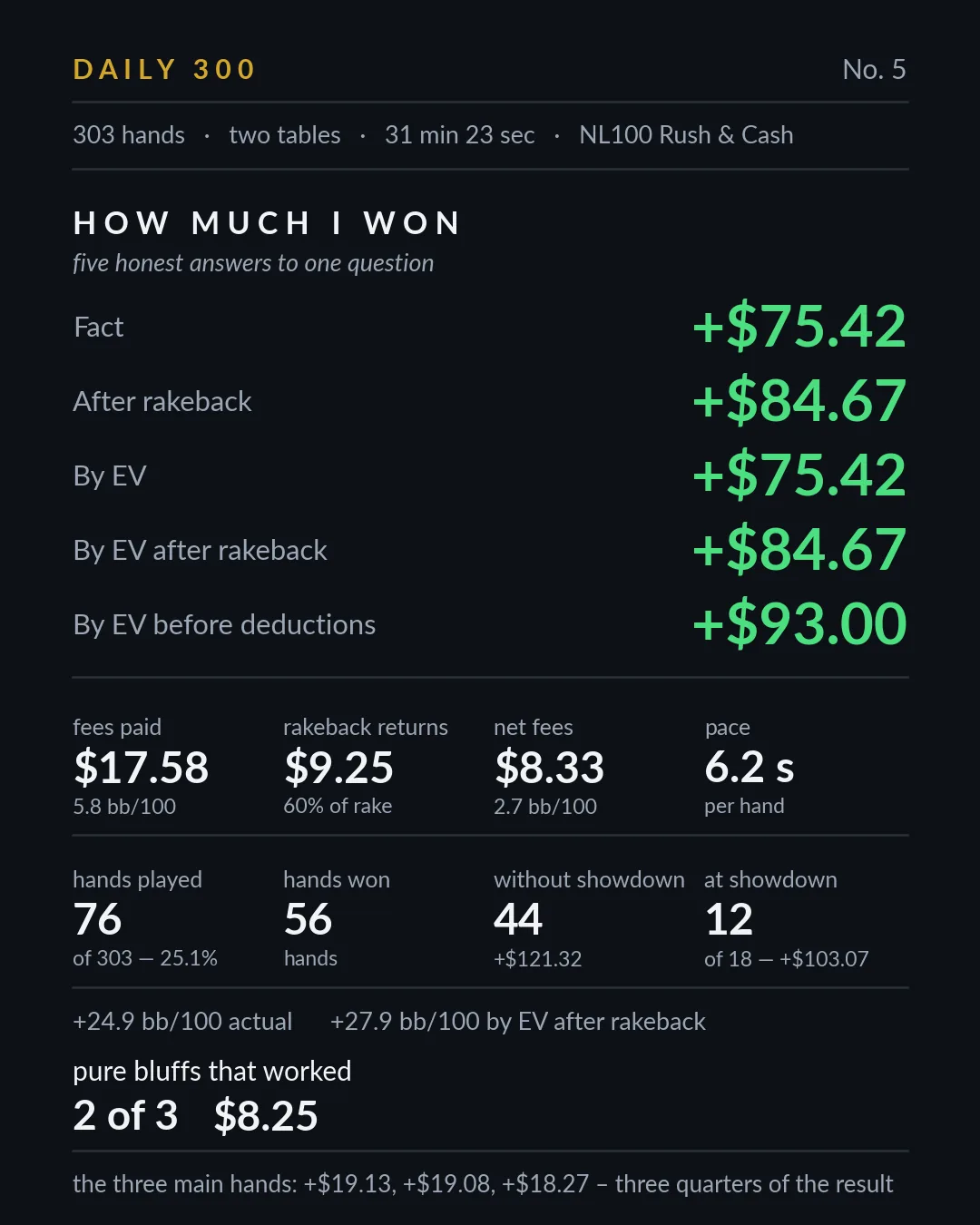
Session 5 · 303 hands · 2 tables · 31:23
Walking into the room is not the same as owning it

Mark Zavadsky. Launched Alibaba in Russia, ran Sberbank's ecosystem, headed the studio behind Smeshariki and Fixiki, now iGaming and investing.
The idea
Three quarters of the day's profit came from answering other people's offers, and the one time I named a price myself, I named the wrong one. And that is, in fact, no accident: where someone has to name the number first, I do it twenty-three times out of a hundred, everyone else thirty-seven.
In business these are two different things and they get confused constantly: getting into the negotiation, the tender, the deal is one thing; running it is another. The first gets you a seat at the table. The second decides how much of the table is yours. And where would the second come from, if at the table you speak less often than anyone?
Below: a case with the same mechanics, and the hands the idea grew out of, with the arithmetic. Poker words are underlined – hover to see what they mean.
The case
A hospital in Norwich signed a thirty-year contract: a private consortium builds and runs the building, and the hospital pays it a fixed sum every year. A once-in-a-career deal for the hospital, the day job for the consortium. Six years later, with the building up and the building risk gone, the consortium swapped its expensive loans for cheap ones and took £116 million out of the project at once. The hospital's payments did not change by a pound.
The contract said nothing about sharing that gain: the hospital had not foreseen it, the consortium had known from day one, and the £34 million, twenty-nine per cent, the hospital got under a code adopted later. Investors’ return went from nineteen per cent to sixty, and leaving the contract early became a quarter of a billion more expensive. Getting into the deal the hospital managed; running it against people who do this every day, it did not.
The analysis
This is not a feeling, it is measured. When a bet is already in front of me I answer like everyone else: I raise 8.4% of the time on the flop against the field's 9.8%, 7.5 against 7.6 on the turn, 7.0 against 6.9 on the river, almost no difference at all. When there is no bet yet and the number is mine to name, the picture is nothing like it: I bet 31.8% of the time on the flop against 37.3%, 29.6% against 36.7% on the turn, 23.4% against 37.3% on the river.
The gap widens street by street: five and a half points on the flop, seven on the turn, fourteen on the river. The bigger the pot and the fewer the cards left, the less often I speak first. Betting less often is, admittedly, not the same as betting wrongly, and a frequency alone cannot say what it cost me, but it does say what I almost never do.
And here the conclusion is easy to get backwards: being like the field is not the goal, because the field is an average of hundreds of different people, nobody can play "like an average", and you beat it precisely by differing from it. The question is not how to catch up to someone else's frequency but which direction to differ in, and the answer sits in the same logs: the field folds too much on the last card. Against a pot-sized bet heads-up it folds 69.4% of the time, though such a bet already breaks even at 50%. Against bets between half the pot and nine tenths of it, the field folds 55.9% of the time, when 33 to 47% would be enough, and against anything smaller than half the pot, 43.4%, when 33% or less would do. At every size, a margin of ten to twenty points.
This needs reading the right way. It is an average across hundreds of opponents: it shows how big the opportunity is, not whether a particular person folds in a particular hand. And part of the difference is explainable: I reach the last card more often by answering other people's bets than by making my own, so by then I hold fewer strong hands, and checking more often is indeed right for me – but not twice as often. The best-known weakness of these opponents sits on exactly the street where I stay quiet.
Answering someone else's price
Preflop
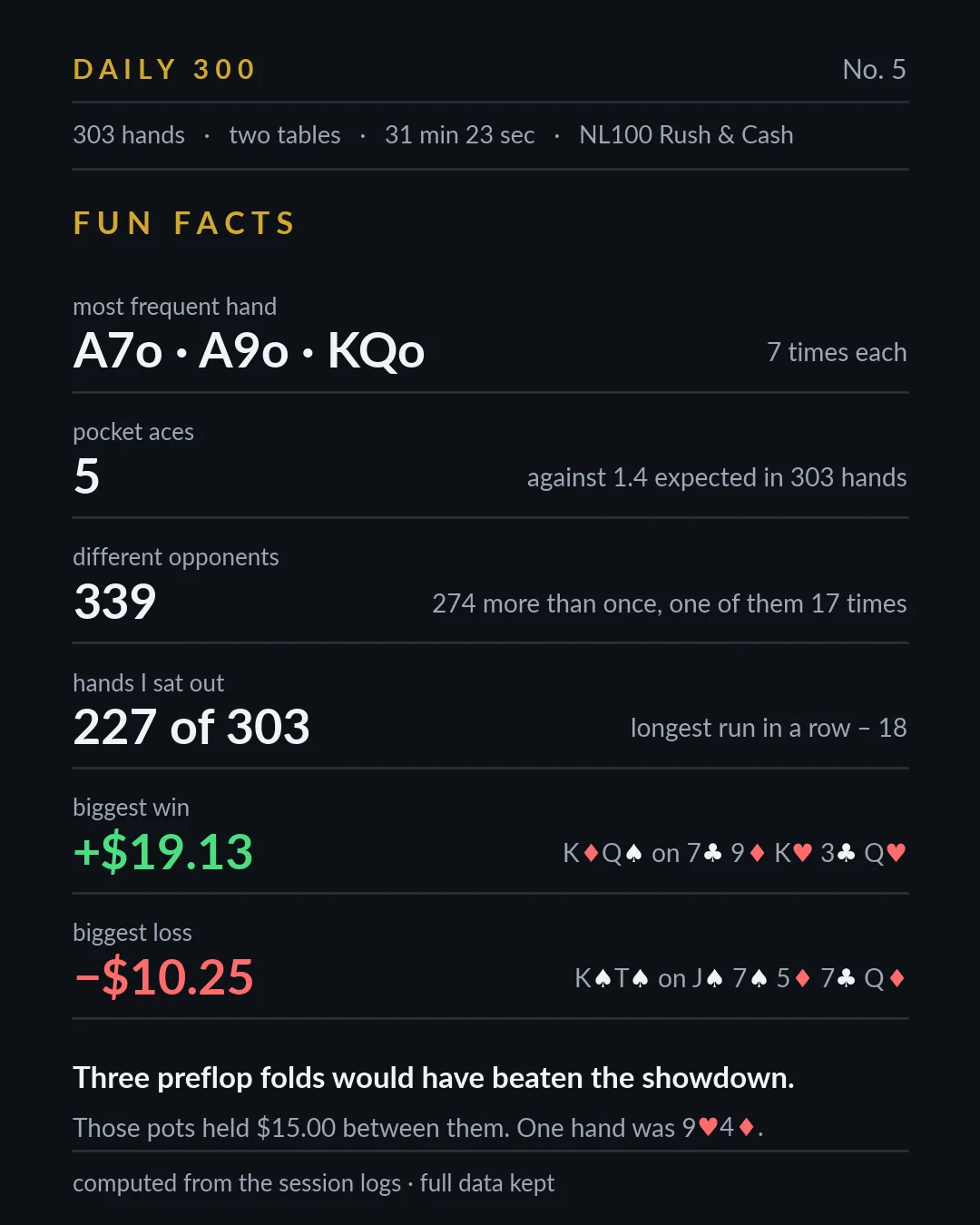
Here is what that looks like in hands. K♦Q♠, under the gun (UTG). I open for $2, the button raises to $4.75, I call.
Flop
Pot $11Flop 7♣ 9♦ K♥ – a pair of kings with a queen kicker, and nothing else. I check, he bets $5.50 into $11, I call.
Turn
Pot $22Turn 3♣ – I check again, he bets $11 into $22, I call again. Both calls carry the same price: half the pot, so I need to be right one time in four. Both were correct: by my estimate, his betting range holds too many hands weaker than mine. But here is what I never did after the flop: I never named a number. My $2 open is the last figure I named in this hand; from there he set the price and I agreed or I didn't.
River
Pot $44River Q♥ – a queen, and now I have two pair. I check, he checks behind and shows A♦J♠: nothing at all. +$19.13. I won the session's largest pot without naming a single number after the flop.
Half the pot, and I got paid
Preflop
The second hand is five cents behind the first. 8♥8♦ on the button, three of us to the flop.
Flop
Pot $7.50Flop 5♣ 7♣ 2♥ – my pair is higher than anything on the board, and again I only call, $3.75.
Turn
Pot $18.75Turn 4♦ – three checks.
River
Pot $18.75River 6♦: the board reads 2-4-5-6-7, and my eight completes the straight from four to eight. Exactly one hand beats me – nine-eight. Here I do set the price, half the pot, $9.38, into two players: at that size one pair still calls. One paid with J♠J♦, the other folded. +$19.08.
The one time I named the price
Preflop
The third is the only hand of the session in which I named a large price. A♣J♥ in the big blind, he opens for $2 from middle position (MP), I call.
Flop
Pot $4.50Flop 9♣ 2♠ J♦ – a pair of jacks; I check, he bets $1.35, I call.
Turn
Pot $7.20Turn A♠ – now I have two pair, aces and jacks. I check, he bets $7.20 into $7.20, and I raise to $18. He calls. The pot is $43.20.
River
Pot $43.20River 8♦, and it completes two runs at once: seven to jack, and eight to queen. Forty-three combinations now beat me – those two runs and five sets of trips. Nearly all of them sit in the range he bet the turn and called my raise with. I bet the whole pot, $43.20 – my largest bet across all 303 hands, more than twice the next one. And the price is wrong. A pot-sized bet asks him to be right one time in three; half the pot, one time in four. At the first price the hands that call are almost exactly the hands that beat me: anything weaker cannot afford it, and those forty-three can. Half the pot is $21.60, and at that price, by my estimate, hands weaker than mine can pay too. Had he called, the hand would have been worth $21.60 more, and though he never showed his cards, that is exactly the chance I gave up by naming a price only hands stronger than mine can answer.
The three biggest hands, $19.13, $19.08 and $18.27, 86 cents from the largest to the smallest, made three quarters of the result. In the first I never named a number after the flop and won anyway: he built the pot himself and gave up on the last card. In the second I named half the pot, and got paid; in the third I named the whole pot, and did not. Some people are let into the room and others run it, and the second does not come on its own: on the last card, with the action on me and no bet in front of me, I name a number twenty-three times in a hundred, and everybody else names one thirty-seven times. Nobody gets good at what they do less often than everyone around them.
Session cards
The best sessions in your inbox, once a week.