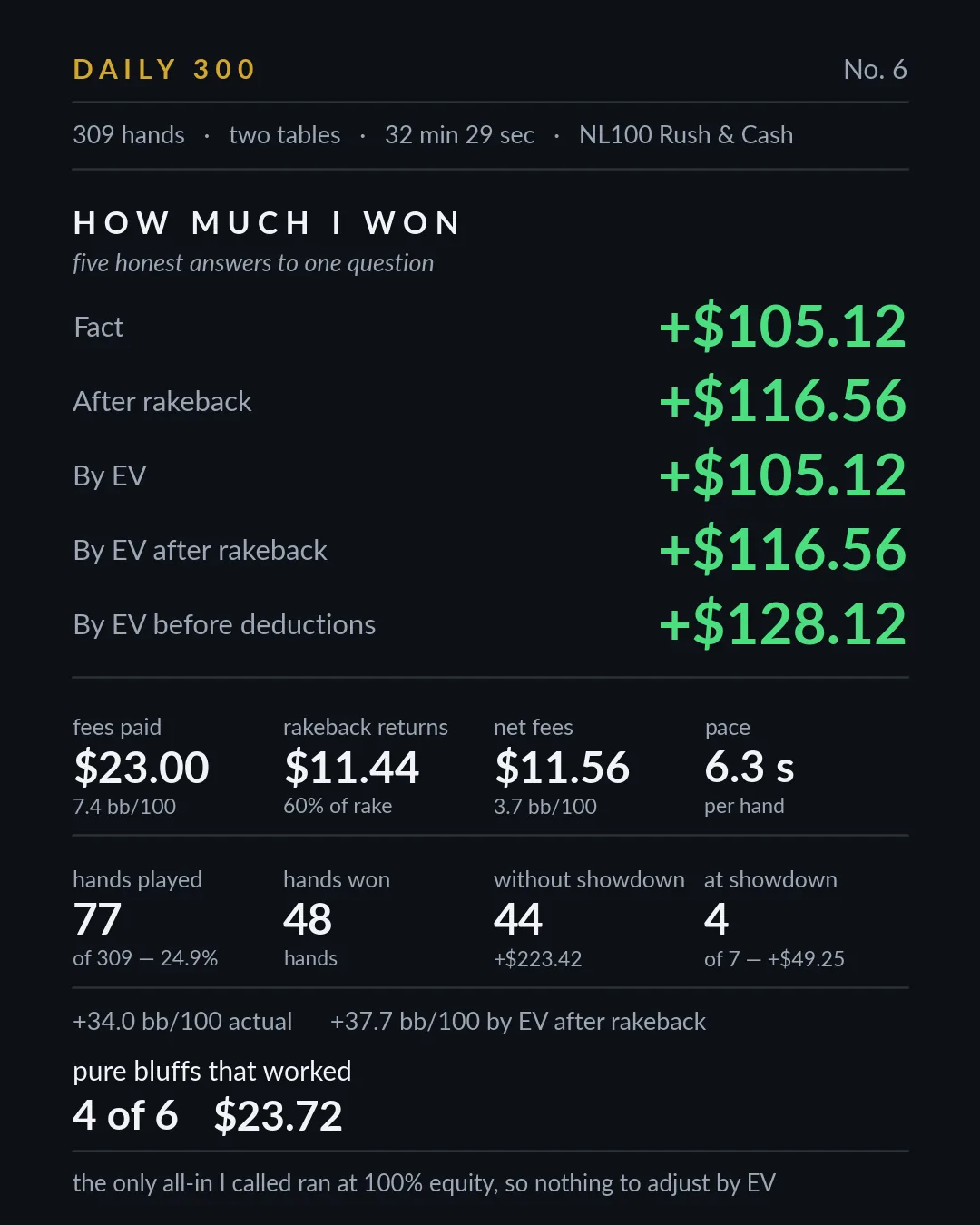
Session 6 · 309 hands · 2 tables · 32:29
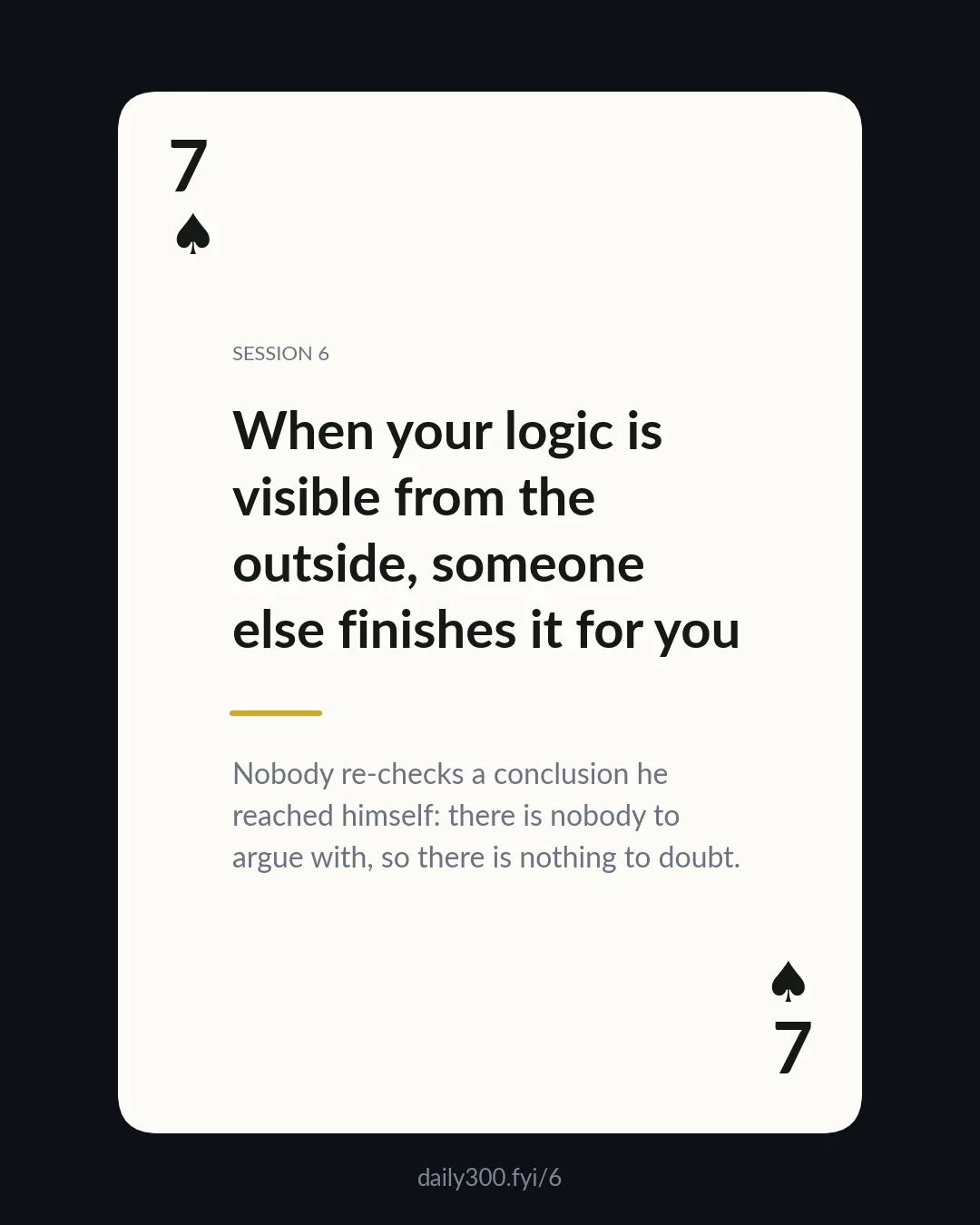
When your logic is visible from the outside, someone else finishes it for you

Mark Zavadsky. Launched Alibaba in Russia, ran Sberbank's ecosystem, headed the studio behind Smeshariki and Fixiki, now iGaming and investing.
The idea
This idea brought in $50. I used to think the talker drives the deal, but here I went quiet halfway, and my opponent put in 84% of his money on his own, finishing my logic for me until he reached a version he could no longer let go of.
Nobody re-checks a conclusion he reached himself: there is nobody to argue with, so there is nothing to doubt. That is why he pays more for it than for the most convincing argument anyone else could make, especially when your own actions keep telling him that he is right. And what if your logic is visible from the outside? Then someone else finishes it for you: often that is the best thing that can happen, sometimes it is the most expensive.
Below: a case with the same mechanics, and the hands the idea grew out of, with the arithmetic. Poker words are underlined – hover to see what they mean.
The case
In California in the sixties, housewives were asked to put a large, ugly sign reading “Drive Carefully” in their front yard. Seventeen per cent agreed. Another group had been asked two weeks earlier for a small favour – a little sticker in the window saying “Be a safe driver” – and almost all had said yes. Of them, seventy-six per cent put up the big sign.
Everyone was asked the same way, and the sign was the same. The difference was that the second group had already said yes to the small sticker and then finished the thought themselves: I am a person who cares about road safety. Such people no longer need persuading – they carry on the logic that was started, and pay for its continuation with their own front lawn.
The analysis
The silence he finished himself
Preflop
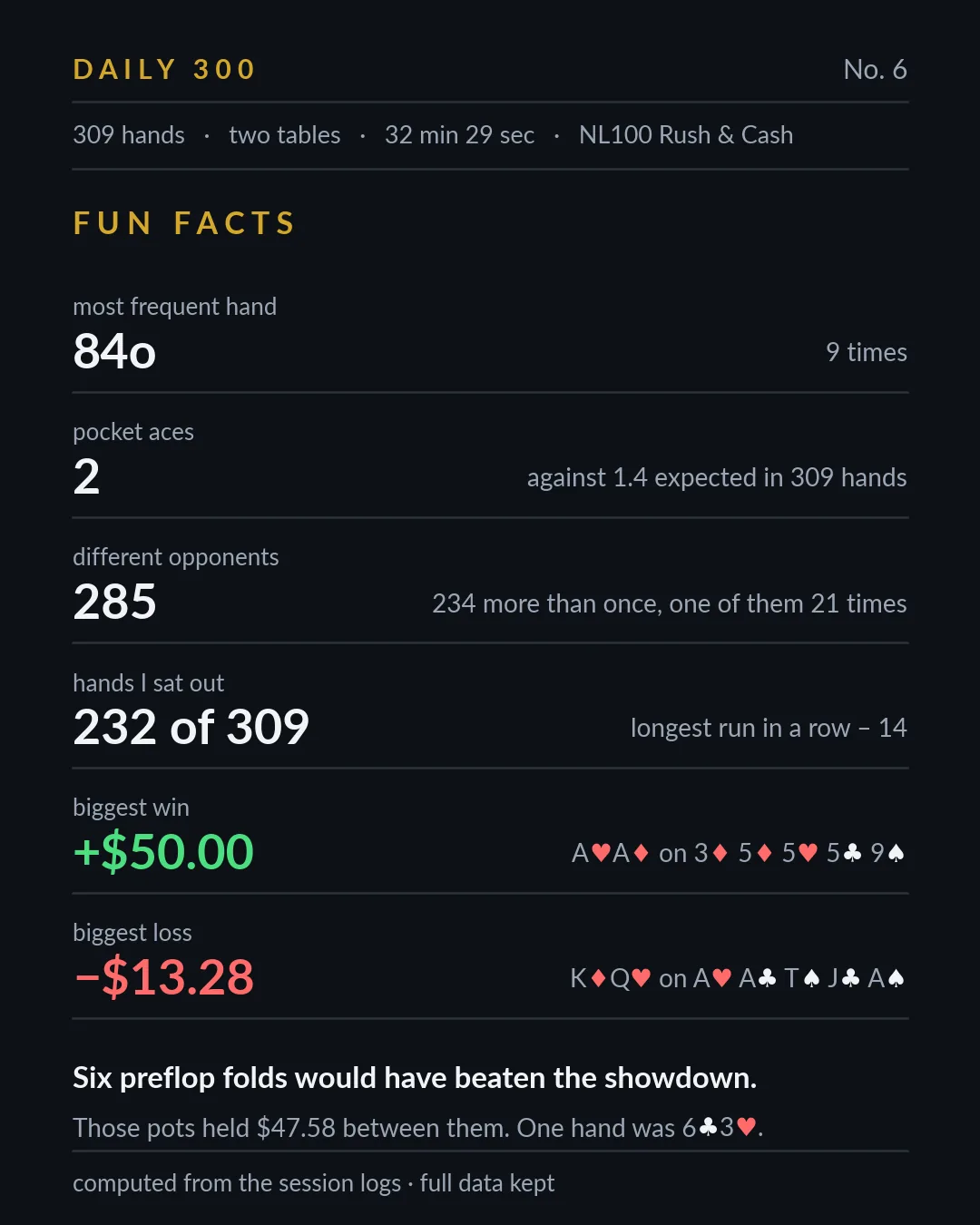
Here is the hand. A♥A♦ in the small blind. He is on the button – the best seat at the table – and enters the pot by just calling the big blind instead of raising. Across the 23,708 hands where the button could have entered the pot first, the button limped 198 times: eight in a thousand. I read that one way only – amateur. I raise to $4 – small, not to scare him off and to leave the big blind room to raise behind me: with aces that would have been a gift. The big blind folds; the amateur calls.
Flop
Pot $9Flop 3♦ 5♦ 5♥, I bet $4.50, he calls.
Turn
Pot $18The turn is 5♣ – a third five; my aces make a full house, and only 5♠ beats me. And I stop betting. After that the pot grew without me. He bet $9, I called. On the river, 9♠, $36. Of his $53.50, $45 came in after my check. The pot went from $18 to $108. I raised all in. Not for free: the extra $45.50 goes in against 5♠ and pocket nines, so the raise only beats a call if he folds 39% of the time. He folded. What he saw cannot be checked, but by my estimate an amateur reads a small raise from the blind narrowly: pairs from jacks up and big aces, where ace-king and ace-queen make up 57% and there is not a single five. To him, my check on the turn was the ace-king and ace-queen that had missed, and he finished the story himself.
The same read, the opposite sign
Preflop
Three minutes earlier the same reading ran the other way. K♦Q♥ in the cutoff (CO), I opened for $2.50, the button raised to $7.70, I called.
Flop
Pot $16.90Flop A♥ A♣ T♠ – two checks.
Turn
Pot $16.90Turn J♣ – ace, king, queen, jack, ten: a straight. I bet $5.58, small and deliberately so: at that price everything weaker than me pays, everything stronger raises, and then I am gone. He called. He was telling me no story at all; he was simply afraid of the two aces and playing his pair carefully. His check on the flop and his call on the turn say exactly that: he does not have a full house yet, or he would have raised. In his range, by my estimate, about 14% beat me.
River
Pot $28.06River A♠. Neither his cards nor mine changed, but the third ace handed a full house to every pocket pair at once, and pocket pairs are the largest part of his range. Now 83% beat me, six times as many as a minute earlier. I checked, he bet $14.03, I folded. He had queens.
Neither hand was decided by what we held. Both were decided by a line of logic, and both times it was mine. In the first, he finished it for me: I went quiet on the turn, he built the rest himself, brought $45 into the pot, and then folded to the all-in, so he had been betting and calling without a hand. In the second I carried it myself, exactly as far as the card that changed everything: I did not bet, and I did not pay for a straight that had stopped being the best hand. The first cost him fifty dollars; the second saved me fourteen. In poker, as in business, the money you did not lose spends exactly the same.
Session cards
The best sessions in your inbox, once a week.