Session 4 · 303 hands · 2 tables · 30:35
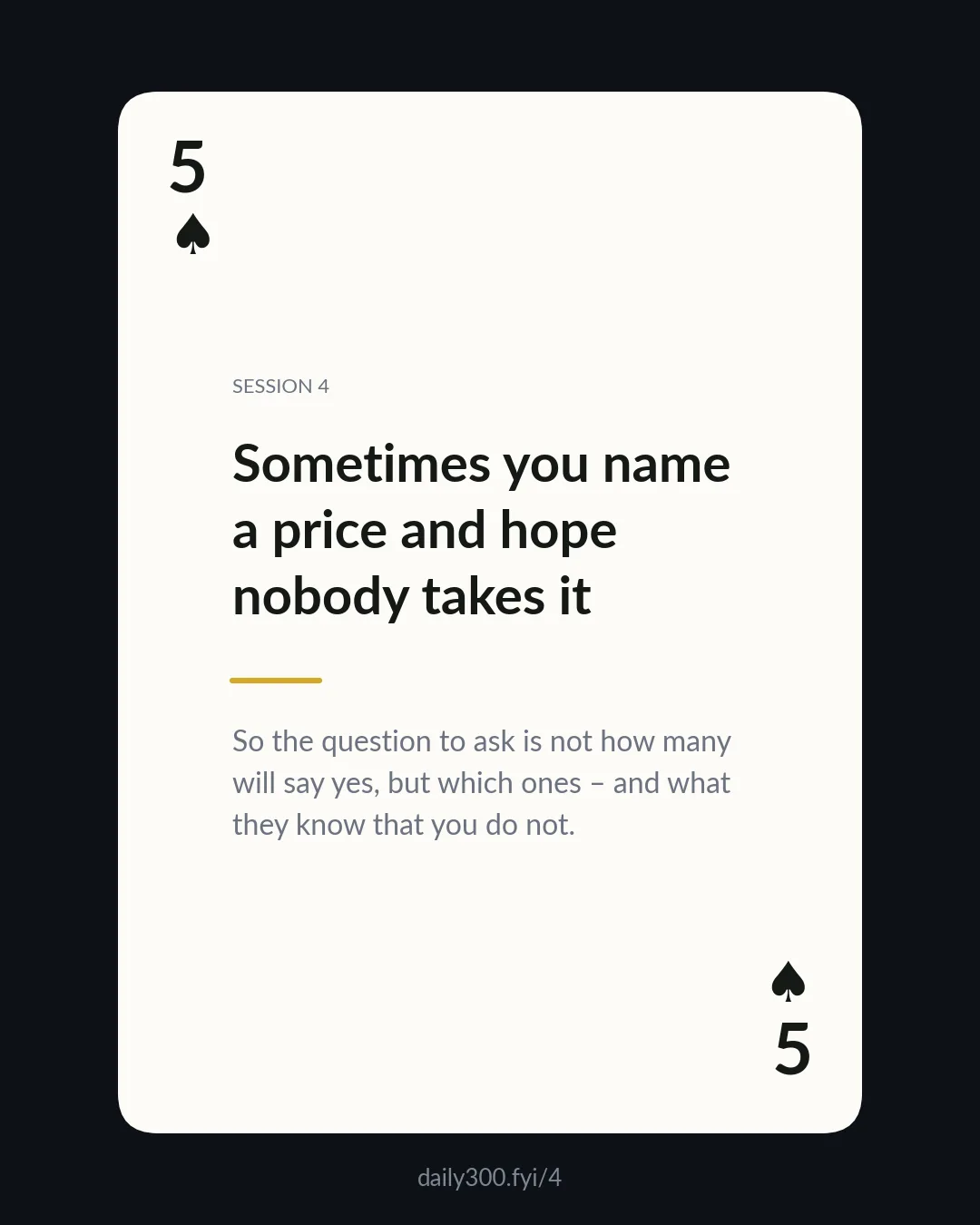
Sometimes you name a price and hope nobody takes it

Mark Zavadsky. Launched Alibaba in Russia, ran Sberbank's ecosystem, headed the studio behind Smeshariki and Fixiki, now iGaming and investing.
The idea
This idea cost about fourteen dollars – the profit a price nobody took never made. I set it so high that only people who knew more about the deal than I did could agree. Nobody, as it happens, did.
Everyone sees the price, but it is taken by the people it suits. Procurement has a name for it, the winner's curse: the tender goes to whoever underestimated the work by the widest margin, and winning is the first sign that you counted worse than the people you beat. And how is selling a stake any different? A buyer who takes your price without haggling usually knows something about the asset that you do not. So the question to ask is not how many will say yes, but which ones – and what they know that you do not.
Below: a case with the same mechanics, and the hands the idea grew out of, with the arithmetic. Poker words are underlined – hover to see what they mean.
The case
In 2014 Stagecoach and Virgin won the right to run trains on England’s east coast main line. They promised the government £3.3 billion over eight years, on a bid built around revenue growing by about ten per cent a year. It grew by about three. Three years later the franchise was taken back; about eight hundred million of the promise had been paid.
The price was set by the bidder whose forecast was furthest from life, which is precisely why he won it. Parliament put the other half of the blame on the government: it understood the risk and took the best number anyway. Whoever accepts your price without haggling has a view about that price too.
The analysis
A bet only the strong can accept
Preflop
Here is the bet. A♥A♦ in the big blind – the best hand in the deck. The cutoff (CO) opens for $2, the button calls, I raise to $15, and both of them call. The pot is $45.50.
Flop
Pot $45.50Flop K♠ T♦ 4♠. I bet half the pot, $22.75. The cutoff folds, the button calls. The pot is $91.
Turn
Pot $91Turn T♥ – a second ten. I have two pair, aces and tens, and very little beats me: a ten in his hand, pocket fours, or two kings. I bet my whole remaining stack – $91.28 into $91. He folds and I take $86.50. Now to the question of who could have taken that bet. The range that cold-calls $2, then calls my raise to $15, then calls half the pot on K♠ T♦ 4♠, I put at 70 combinations. I beat 54 of them; 16 beat me. A pot-sized bet asks him to be right one time in three. The best hands among the ones I beat are the ace-high spade draws with a queen or a jack: nine spades would fill the flush and three more cards would make the straight. The ten of spades does not count – it puts a third ten on the board and gives me the full house. That leaves eleven cards out of forty-four, exactly a quarter. The worst hand among the ones that beat me is pocket fours, right nine times out of ten. Between a quarter and nine tenths this range holds nothing at all. So the one-in-three threshold cuts the range along exactly the line that separates the hands beating me from the hands I beat. All 16 hands that beat me have the odds to call, and not one of the 54 I beat does. I named a price at which a yes can only be bad news for me. And from his seat it looks the same. To pay with top pair he needs me to be bluffing at least a third of the time. My whole line – a raise from the blind against two players, half the pot on the flop, all-in on the second ten – allows, by my estimate, twenty-three made hands and only five unfinished spade flushes: A♠Q♠, A♠5♠, A♠3♠, A♠2♠ and Q♠J♠. Eighteen per cent where a third is needed, and four of those five bluffs rest on a single card, the ace of spades. He did not fold out of fear: on this card I have almost nothing to bluff with, and he could count that as well as I could. What that cost. Had I bet $20, twenty-six combinations would have had the odds to pay, and I beat ten of them. At $30 it is nineteen, at half the pot eighteen, at the full pot the same sixteen. On a model where he calls whenever the pot odds are there, the $20 bet is worth about $66, $30 about $65, half the pot about $62, and the whole pot about $52. A check is worth about $66 in the same model, and that is a floor: the model gives it no river betting at all. From $20 upward it only goes down, and the worst of the sizes I checked is the one I chose. The gap to the best is those fourteen dollars.
The same threshold from the other side
Preflop
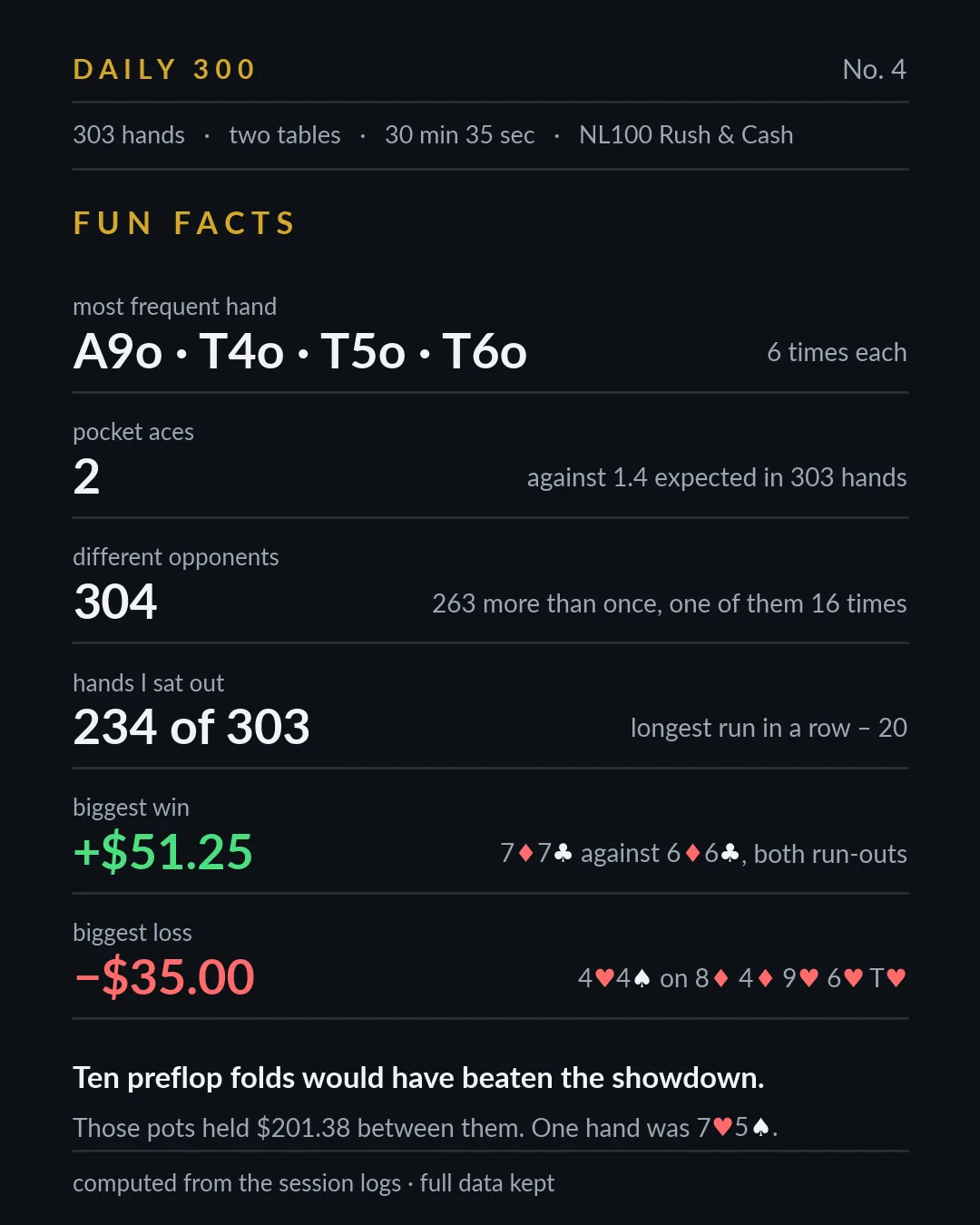
The biggest loss, −$35, came from another hand. 4♥4♠ and trip fours on the flop 8♦ 4♦ 9♥. I bet $3 and both opponents call.
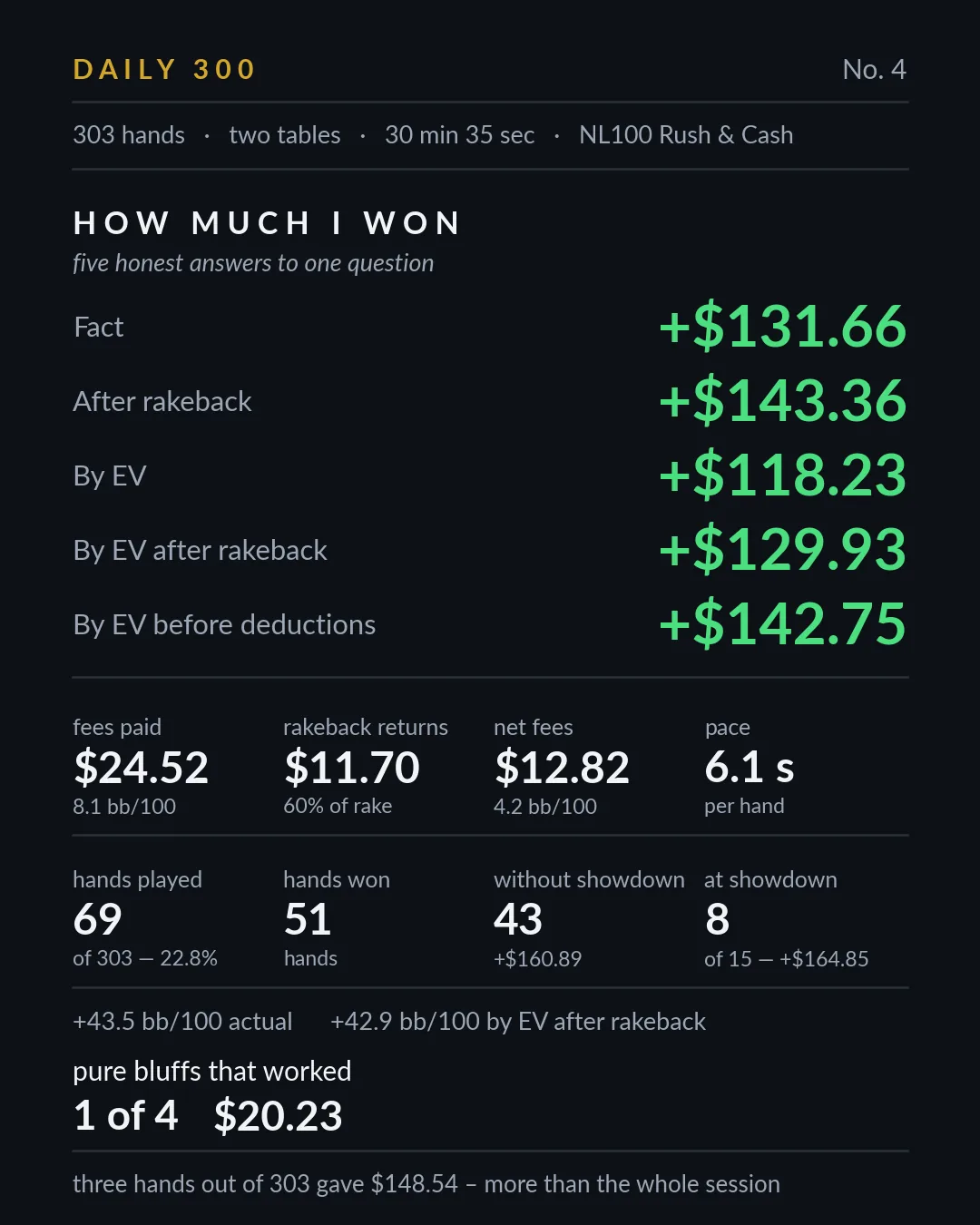
The three biggest hands made $148.54; the other three hundred lost $16.88 between them. But my day was made by two others, and the question in both was the same. With the aces I named a price that only the hands beating me could take: I won the pot and left fourteen dollars of profit behind. With the fours I was about to name it again and stopped myself, and on the same arithmetic that saved me twenty-seven, in a hand I went on to lose. Neither figure shows up in the day's result. The price to fear is not the one that gets a no. It is the one only the people you would rather not hear from can say yes to.
Session cards
The best sessions in your inbox, once a week.