Session 3 · 308 hands · 2 tables · 30:27
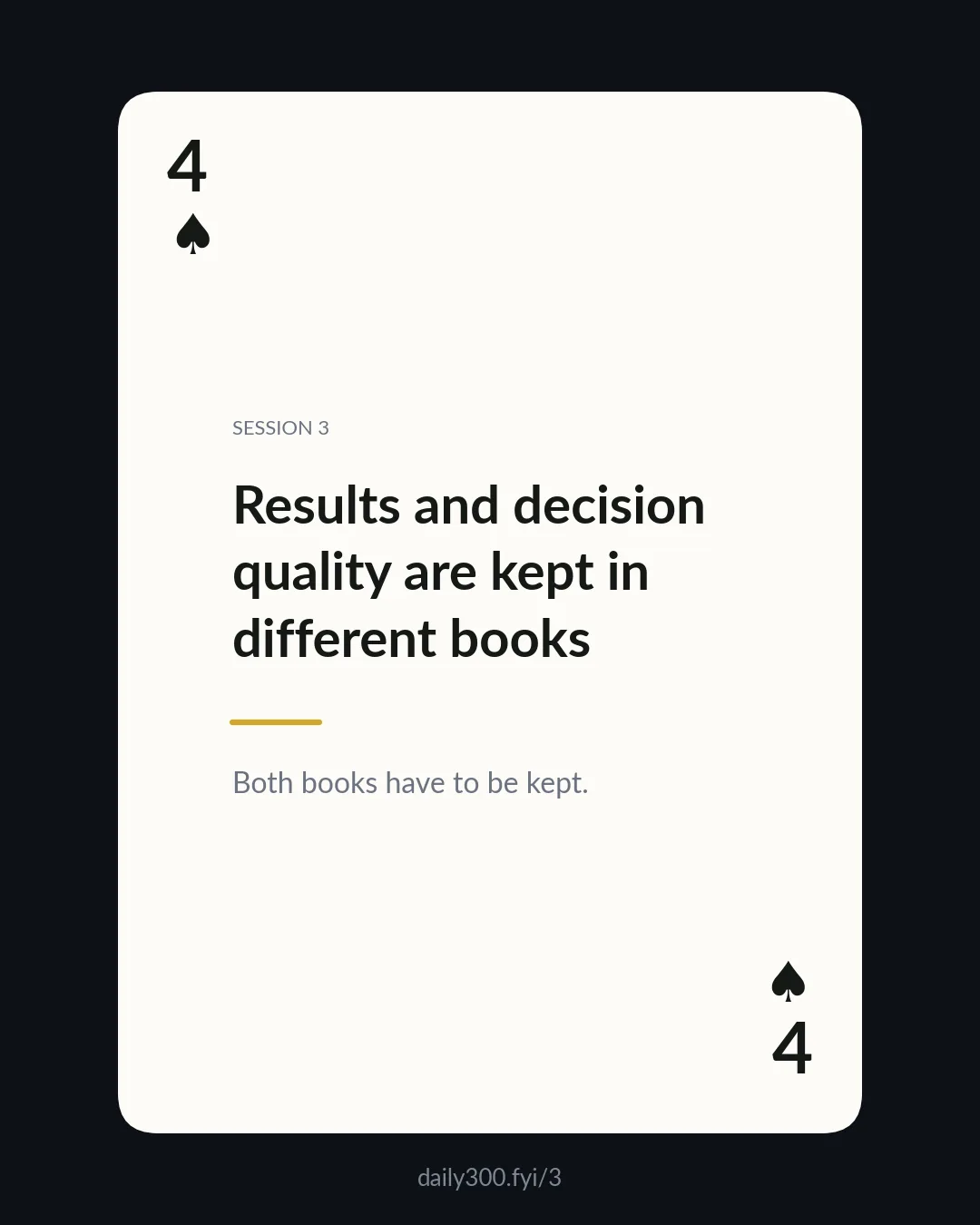
Results and decision quality are kept in different books

Mark Zavadsky. Launched Alibaba in Russia, ran Sberbank's ecosystem, headed the studio behind Smeshariki and Fixiki, now iGaming and investing.
The idea
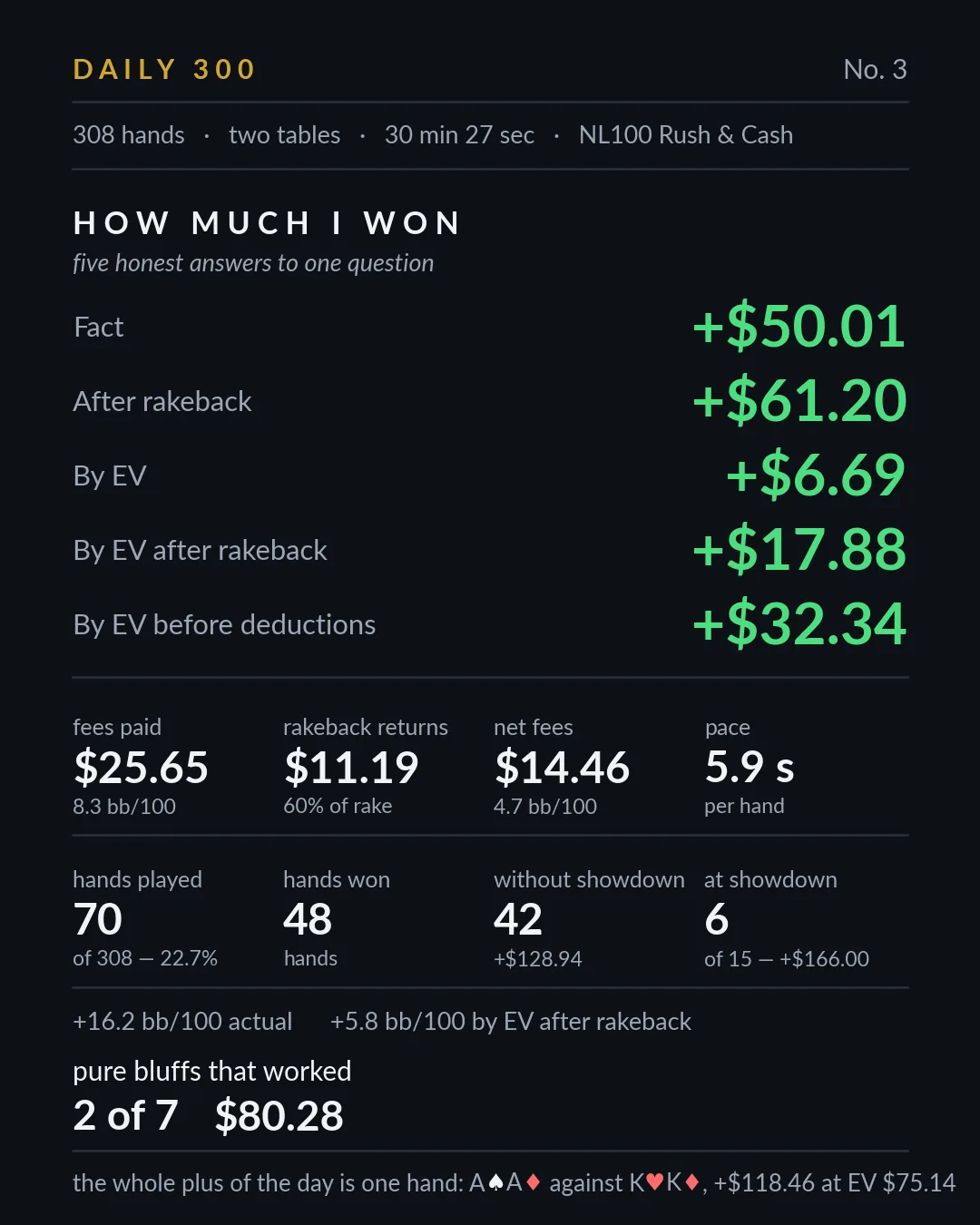
The day's profit, fifty dollars, came from one situation that required almost no thinking: I held the best hand there is, and the cards fell the right way. The two real decisions of the day fit into 72 seconds and came to seven dollars between them.
Results and decision quality are kept in different books, and business works the same way: a quarter is carried by one deal you did not control, and the team is judged on it afterward. And what would be left of the quarter without it? Both books have to be kept.
Below: a case with the same mechanics, and the hands the idea grew out of, with the arithmetic. Poker words are underlined – hover to see what they mean.
The case
Bessemer Venture Partners keeps a page on its own site called the Anti-Portfolio – a list of the companies it passed on. Apple, Google, eBay, Intel, PayPal, Tesla, Airbnb, Zoom. The Google entry records a partner asking the owner of the house whether he could get out without going anywhere near the garage, where two students were working. The FedEx entry says the firm managed seven refusals in a row.
Without that page the firm would look better, and with it the firm is easier to read: the portfolio shows how things ended, the anti-portfolio shows how they were decided. Everyone keeps the first book, almost nobody keeps the second, though only the second teaches anything.
The analysis
The best hand there is
Preflop
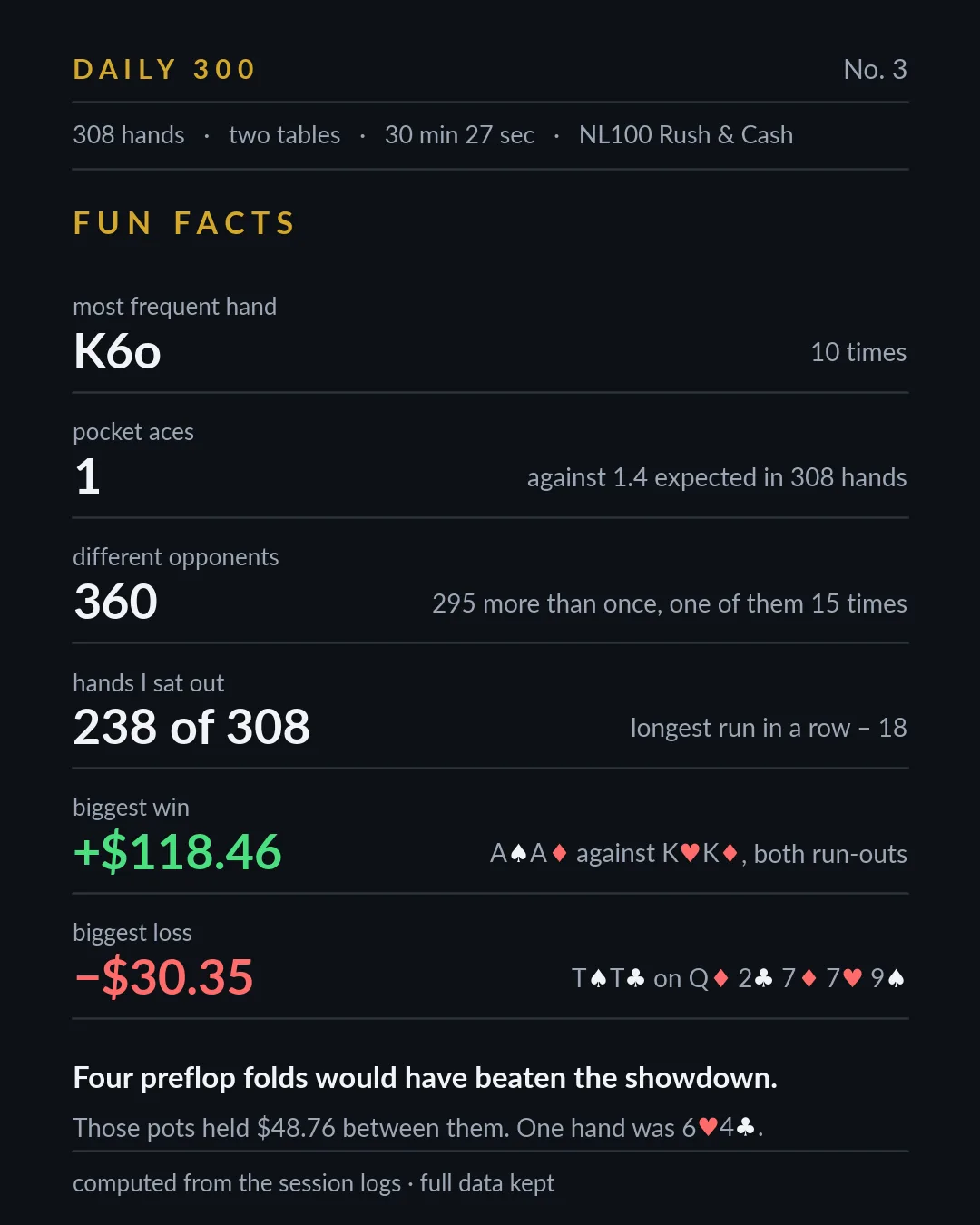
That hand first. A♠A♦ in middle position (MP). I open for $2, the button raises to $8, I re-raise to $22, he moves all in, and I call for my last $99.46 – $121.46 from me in total. He has K♥K♦. Across all 1,712,304 ways the board can run, aces win 81.71% of the time and chop another 0.46%. We ran it twice and both boards were mine. +$118.46. Three decisions, all three correct, only what made them correct was not any calculation at the table: with the best pair in the deck facing a re-raise there is almost nothing to think about. By equity the hand was worth $75.14; the remaining 43 dollars were a gift from the deck.
The real work had happened seven minutes earlier.
Decision one: a price fair from one side
Preflop
Decision one, 18:56:20. A♦J♥ in the big blind. The cutoff (CO) opens for $2.30 and I call.
Flop
Pot $5.10Flop Q♥ 7♦ Q♠ – I check, he bets $1.50, I call.
Turn
Pot $8.10Turn 4♦ – both check.
River
Pot $8.10River 8♦. On the board Q♥ 7♦ Q♠ 4♦ 8♦ the pair of queens is shared, and with three diamonds out there and one in my hand, all I really hold is an ace. He bets $3.50 into $8.10 – small, and I read the size as weakness. I raise to $18.83, representing a flush (my ace of diamonds is a good blocker here), hoping to fold out his sevens, fours and eights. The price is fair on one side only: I risk $18.83 to win $11.60, so he has to fold more than six times in ten, while he puts $15.33 into a pot of $30.43 and needs to be right one time in three. The ratio is against me. And it still is not a mistake. By the theory, a raise here is right with roughly one hand in five, and if he opens only strong hands, with one in three. The reason sits in my own cards: with the ace of diamonds in my hand he has fewer aces and fewer diamond flushes, exactly the hands that answer here. He called with A♥7♠, two pair. −$22.63. I lost the hand, but the decision was right.
Decision two, 72 seconds later
Preflop
Decision two, 72 seconds later. A♦Q♦ in middle position, I open for $2, both blinds call.
Flop
Pot $6Flop A♣ Q♥ 5♠ – two pair, aces and queens. I bet $1.98, the small blind calls, the big blind folds.
Turn
Pot $9.96Turn J♣ – I bet $7.47, the small blind raises to $28. Calling costs $20.53 into a pot of $45.43: the price asks me to be right 31.1% of the time. The range that raises this card holds 181 combinations, and by my estimate 154 of them are behind me – 121 draws that still need a card, and only 23 hands that are ahead. Two pair holds about three times in four. I call.
Two decisions, seventy-two seconds, minus twenty-two and plus twenty-nine – seven dollars between them. The aces brought a hundred and eighteen, the other 305 hands came to minus seventy-five, and the day ends at plus fifty, of which one line in a report will survive. In the results book it was a good day, in the decisions book it was seven dollars and one arguable river bet. The first book is the pleasant one to be judged by; the second is the only one you can learn from.
Session cards
The best sessions in your inbox, once a week.