Session 24 · 302 hands · 2 tables · 34:25
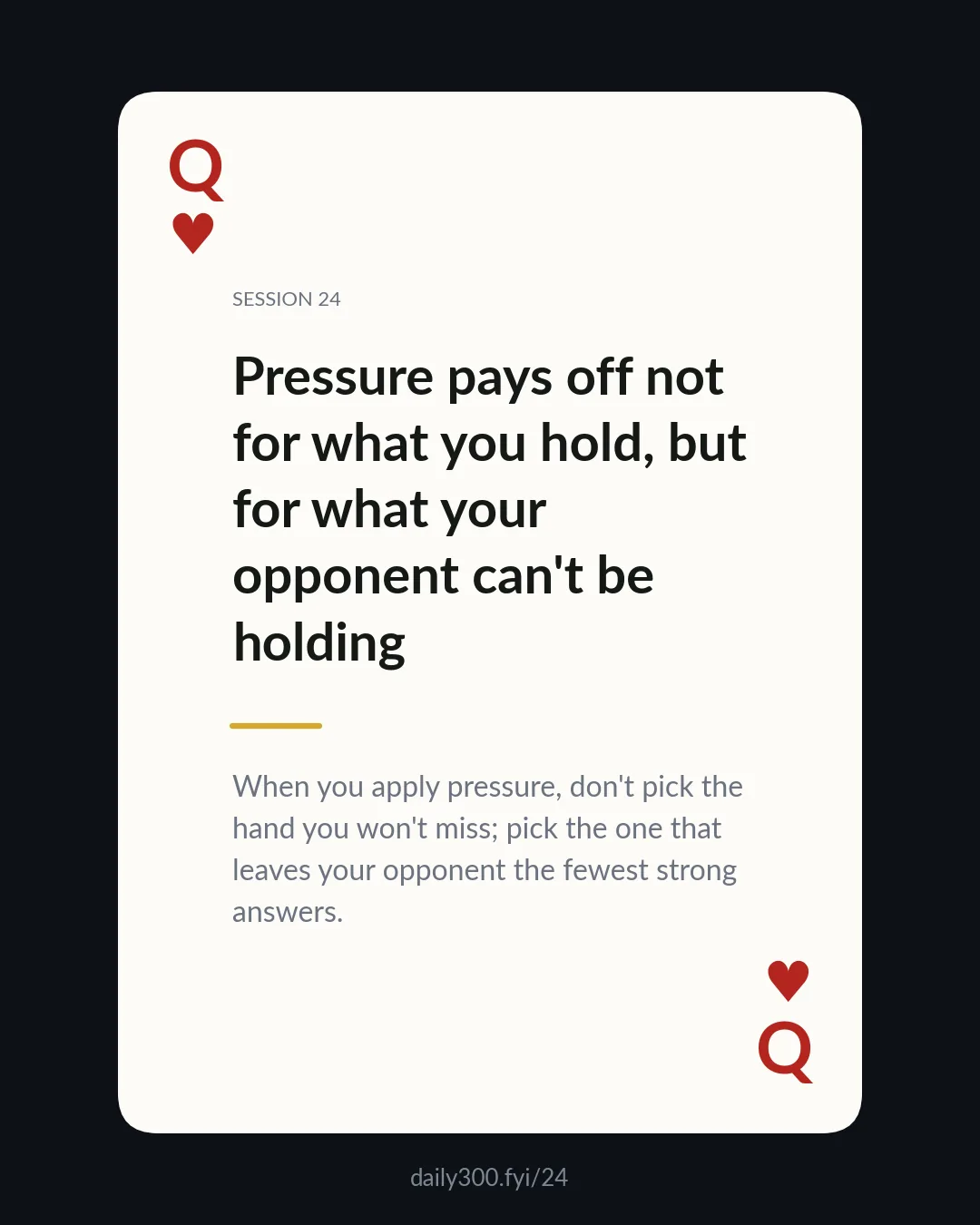
Pressure pays off not for what you hold, but for what your opponent can't be holding

Mark Zavadsky. Launched AliExpress in Russia, ran Sberbank's ecosystem, headed the studio behind Smeshariki and Fixiki, now iGaming and investing.
The idea
Twice in five minutes I raised big with nothing: $15 with A♦4♥ against two players, $25 with A♠6♣ over a reraise. Both lost, −$53 between them. The hand I pick is always the same: in 2026 I've reraised an open 20 times with an ace and a low card of another suit, −$156 in total; the same cards suited, 34 times, +$136. In theory both moves are folds: each gives up about 22 cents against a fold. Pennies – but with these cards the move simply isn't made.
You can apply pressure with anything, but it only works where the other side has no strong answer, so one question matters: how many strong answers has he got left? With an ace and a queen I remove almost a quarter of my opponent's strong answers; with an ace and a six, about a seventh. I risk the same amount either way. When you apply pressure, don't pick the hand you won't miss; pick the one that leaves your opponent the fewest strong answers. A cheap argument only looks safe: it costs you nothing and takes nothing from him.
Below: a case with the same mechanics, and the hands the idea grew out of, with the arithmetic. Poker words are underlined – hover to see what they mean.
The case
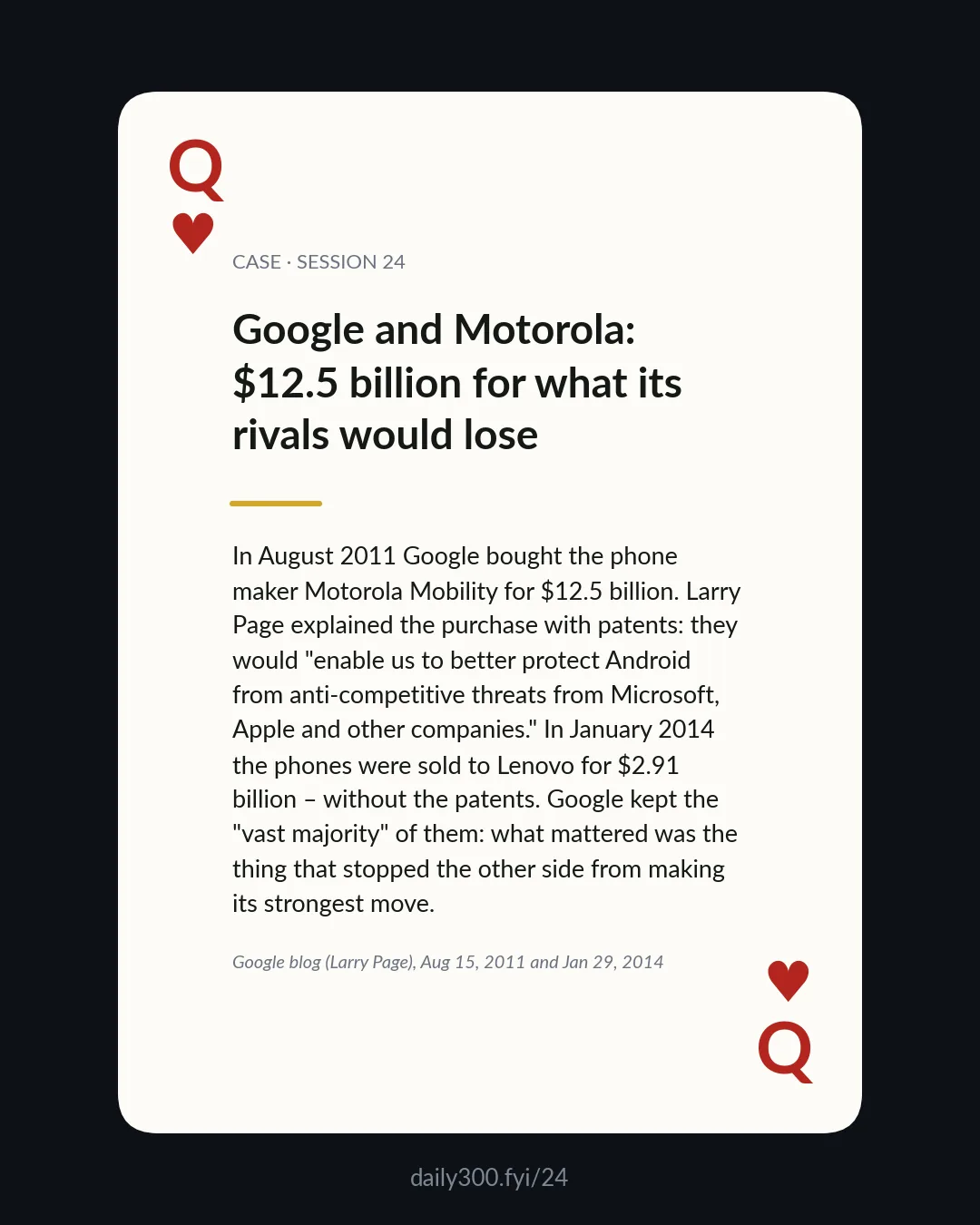
In August 2011 Google announced it was buying the phone maker Motorola Mobility for $12.5 billion. Larry Page's explanation was patents: they would "enable us to better protect Android from anti-competitive threats from Microsoft, Apple and other companies," which, he wrote, were banding together in patent attacks on Android. Google was buying what its rivals stood to lose: suing Android had just gotten more expensive for them.
In January 2014 Google sold Motorola to Lenovo for $2.91 billion – without the patents. Google kept the "vast majority" of them so that, as Page put it, it could go on using them to defend the whole Android ecosystem. The phones turned out to be beside the point. What mattered was the thing that stopped the other side from making its strongest move.
The analysis
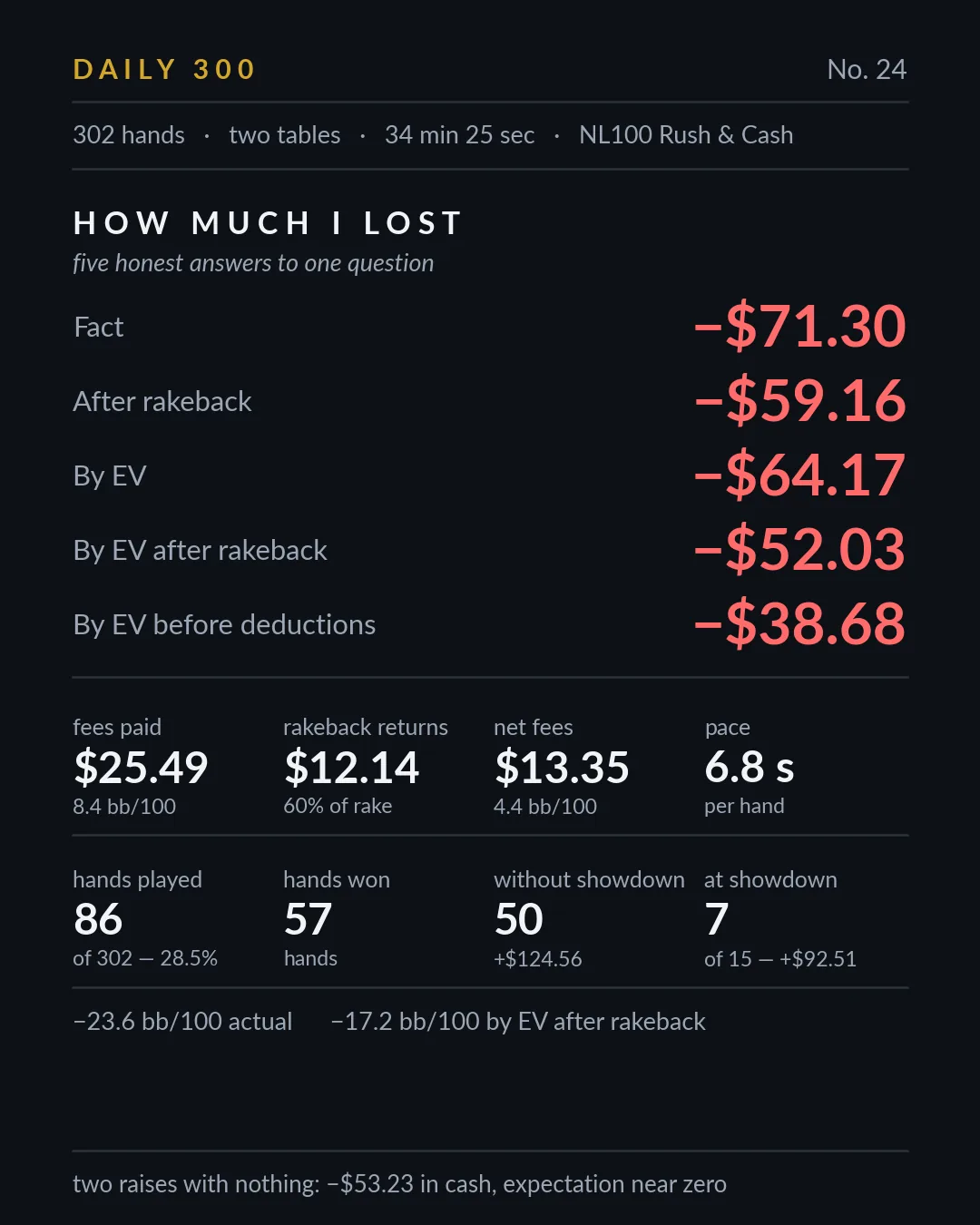
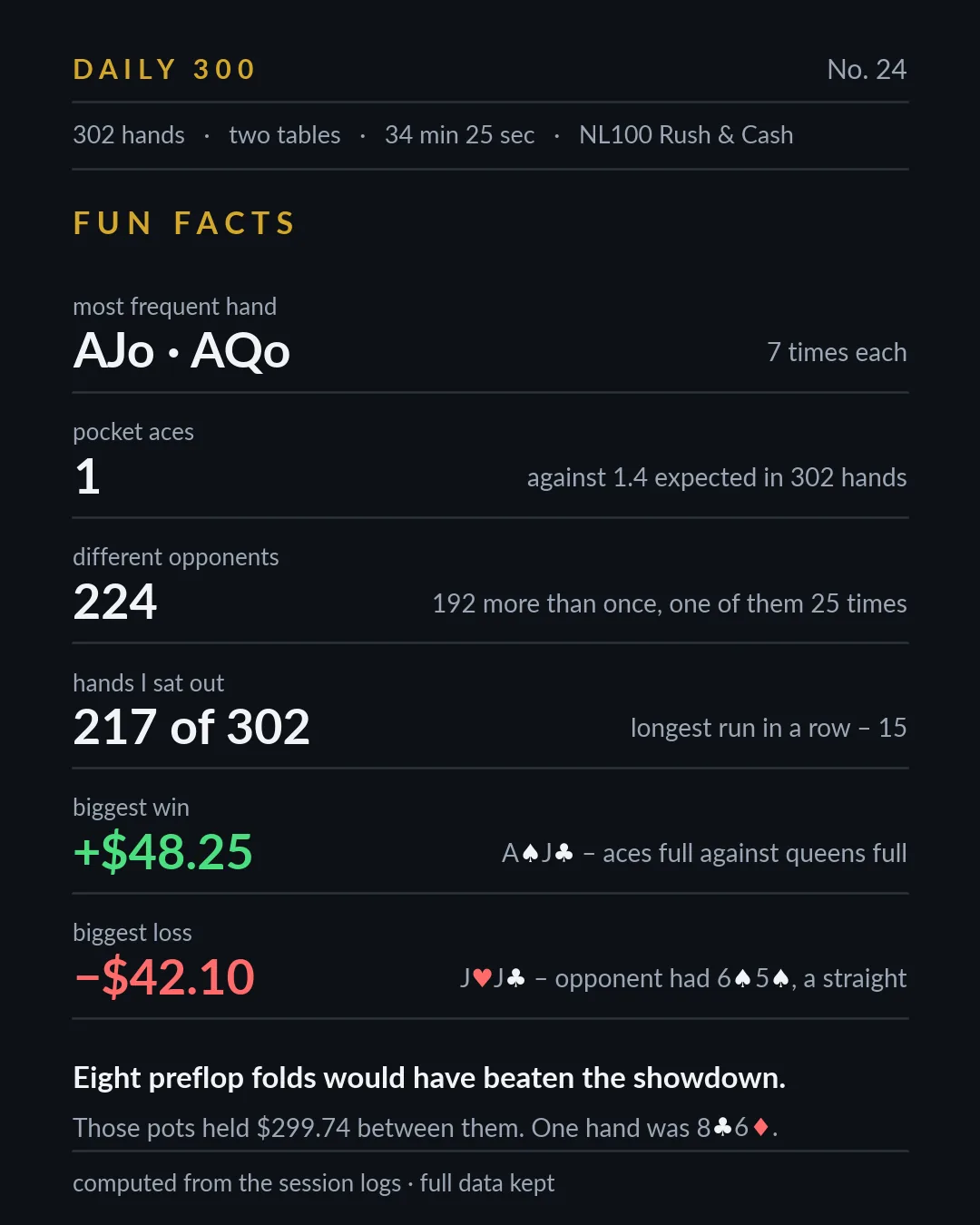
Of 302 hands I played 86 and reached showdown 15 times. The curve never rose above zero in the whole half hour – the second time that has happened in 24 sessions; the bottom was −$109.03 on hand 169. The two hands at issue came in the first five minutes and cost $53.23 between them; in both I raised without so much as a pair, holding an ace and a low offsuit card.
A♠6♣: a 4-bet with nothing, folded to the shove
Preflop
- under the gun fold
- middle position fold
- cutoff fold
- I raise to $2.50
- small blind raise to $11 · ×4.4
- big blind fold
- I raise to $24.50 · ×2.2
- small blind raise to $103.62 · ×4.2
- I fold
A♠6♣ on the button. Everyone folds to me; I open to $2.50. The small blind reraises to $11, the big blind folds. I raise again, to $24.50 – the fourth bet of the hand, nothing paired, nothing suited, one idea: he folds. He moves all-in for $103.62; I fold. −$24.50. What was that idea resting on? For the raise to pay off on its own – with no help from the cards – he has to fold 60% of the time: I'm risking $22 to win $14.50. The field – everyone I've recorded in this spot – folds to a button 4-bet 52% of the time (104 cases in the archive), calls 31%, and goes all-in 17%. So as pure pressure the move loses, and the only thing holding it up is the ace: when he calls, I'm about 28% to win against the range of hands I estimate for him, and the expected value of the whole play is close to zero, from −$4.47 to +$0.92 depending on the model of his range. In equilibrium the move with A♠6♣ gives up 0.22 of a big blind – the 22 cents from above: not a clear mistake, but not a move that appears in theory's mix either. From the button, against this reraise, theory 4-bets 16% of the time – with suited aces down to the lowest and with ace-jack offsuit – and folds A♠6♣ every time. Now for the blockers – the cards in my hand that rule out hands in his – which is the reason this hand is in the post. I know the range he reraises with from the small blind not from theory but from 564 showdowns in the field: 126 weighted combinations, 46 of them strong – the ones that continue against a 4-bet: pairs from tens up, ace-king, ace-queen suited. Because I hold an ace, seven of those 46 are impossible for him: three combinations of pocket aces, a little over three of ace-king, and a slice of ace-queen. A♠Q♣ would remove almost 11: three combinations of pocket queens on top, and the slice of ace-queen grows to half; A♠J♣, 10. The share of strong answers in what he has left: 36% with the six, 35% with the queen. A point and a half on one move is not much, but by my estimate that is exactly the line between a hand theory 4-bets with and a hand it folds: in equilibrium, with A♠J♣ the 4-bet and the fold are worth the same, with A♠Q♣ the 4-bet is already better, and with A♠6♣ it never is. With a jack or a queen alongside the ace I take more strong answers away from him, and when he does answer, a jack or a queen is worth far more than a six as my second card.
A♦4♥: a squeeze against two and one flop bet
Preflop
- under the gun fold
- middle position raise to $2
- cutoff fold
- button call $2
- small blind fold
- I raise to $15 · ×7.5
- middle position fold
- button call $13
A♦4♥ in the big blind. A middle-position player opens to $2, the button calls, the small blind folds – and I raise to $15 into both of them, a squeeze in poker terms. For that to pay off on its own, both have to fold 72% of the time; in the field, both fold 44% of the time (831 cases in the archive), and in exactly this spot, 13 times out of 33. The opener folded, the button called.
Flop
Pot $32.50- I bet $13.73 · 42% pot
- button raise to $35 · ×2.5
- I fold
The flop came 6♥ 8♦ 3♠: ace high, no pair. I bet $13.73 (42% of the pot), he raises to $35, I fold. −$28.73. According to the solver, run on two models of his range as I estimate it, this hand checks here 54% of the time in one and 84% in the other, the bet is part of the mix, and folding to his raise is the only move. In equilibrium the squeeze itself gives up the same 0.22 of a big blind as the 4-bet did: ace-four offsuit is a fold there; the raises come from ace-five suited and ace-jack – again the hands that take more away from him.
The day ends at −$71.30 in actual results and −$64.17 by EV. My only all-in, a pair of jacks against pocket aces, left me five winning cards in a deck of 44 and cost $33.38; the rest came from small decisions. The two raises with nothing cost $53.23, although in every model their expectation is close to zero: that $53 is variance, not the price of the decision. The lesson isn't that the pressure is wrong. The pressure is fine; the hand chosen for it is the worst one available: the same move with ace-jack or ace-queen is no longer a loser in equilibrium; it removes half again as many strong answers from my opponent, and when he does call, I'm 37–42% to win against the range I estimate for him instead of 28%. Pressure works exactly to the extent that you've cut down your opponent's strong answers. A cheap hand takes nothing away from him – which is the very reason you don't mind losing it.
Session cards
The best sessions in your inbox, once a week.