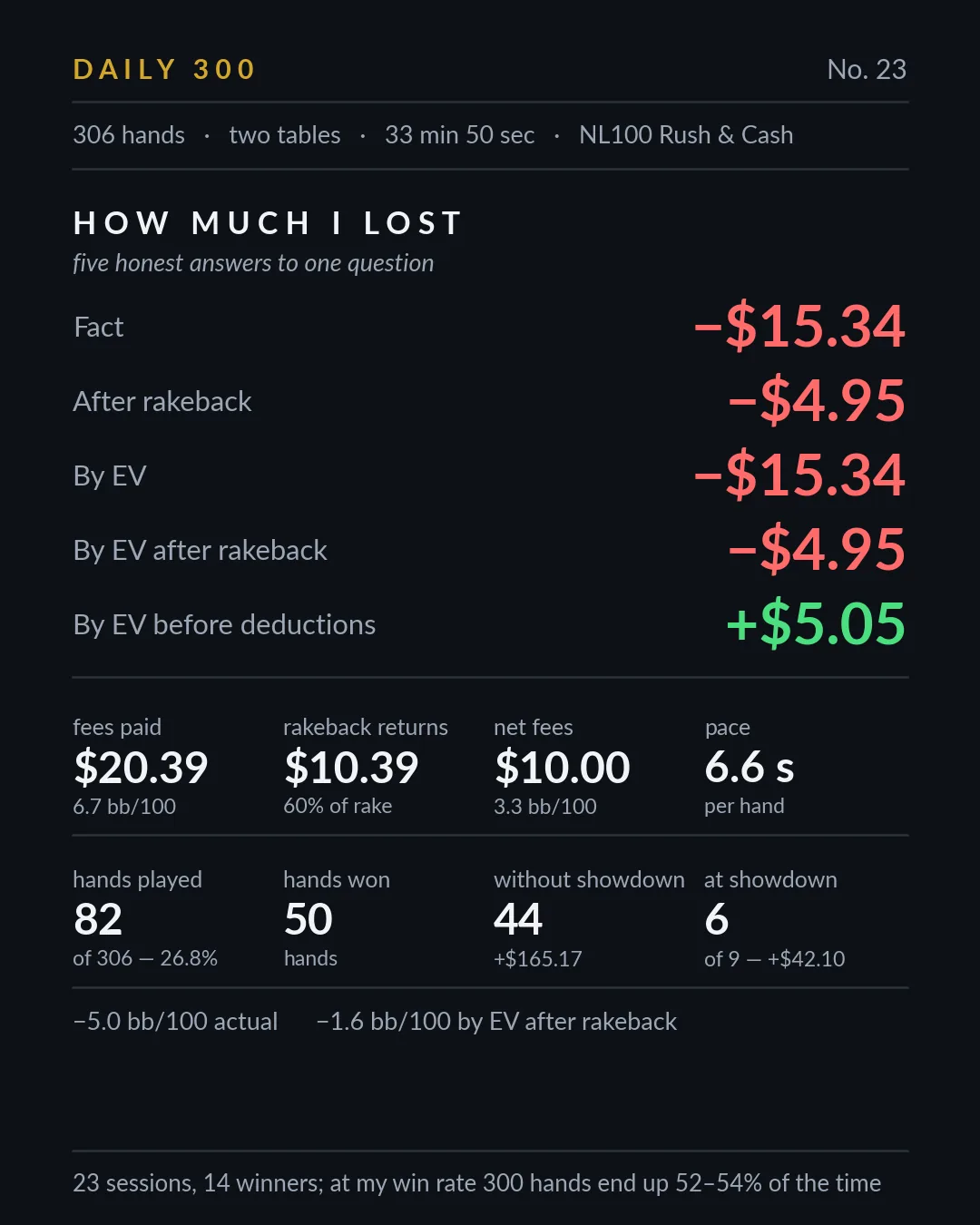
Session 23 · 306 hands · 2 tables · 33:50
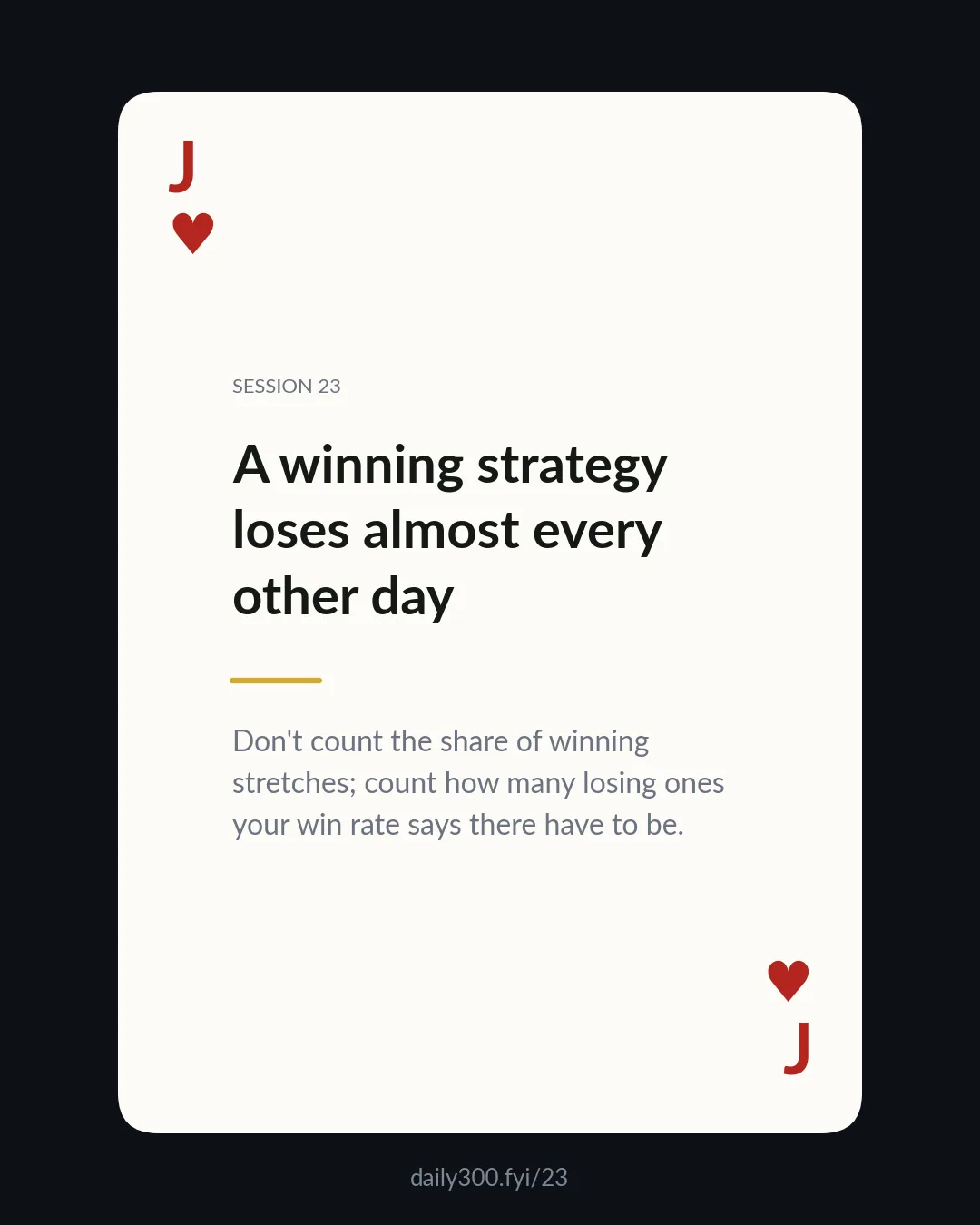
A winning strategy loses almost every other day

Mark Zavadsky. Launched AliExpress in Russia, ran Sberbank's ecosystem, headed the studio behind Smeshariki and Fixiki, now iGaming and investing.
The idea
Half an hour, −$15, and a session in which nothing happened: not one moment where all the money went in and got called, not one loss above $19. That's how it should be. Over 23 sessions I'm up $180, and at my average win rate half an hour of play ends in the black, by my estimate, 52 to 54 times in a hundred: a coin flip. Nine of my 23 half-hours are losses. For three out of four to be winners, my win rate would have to be, by the same estimate, 9 to 11 times what it is.
A sound strategy has to lose often, and the share of losing stretches says nothing about its quality. The question is how many it has to produce. If there are noticeably fewer than that, what you're looking at is an edited version of the result. Don't count the share of winning stretches; count how many losing ones your win rate says there have to be. Look hard at the run that's too smooth before the one with holes in it.
Below: a case with the same mechanics, and the hands the idea grew out of, with the arithmetic. Poker words are underlined – hover to see what they mean.
The case
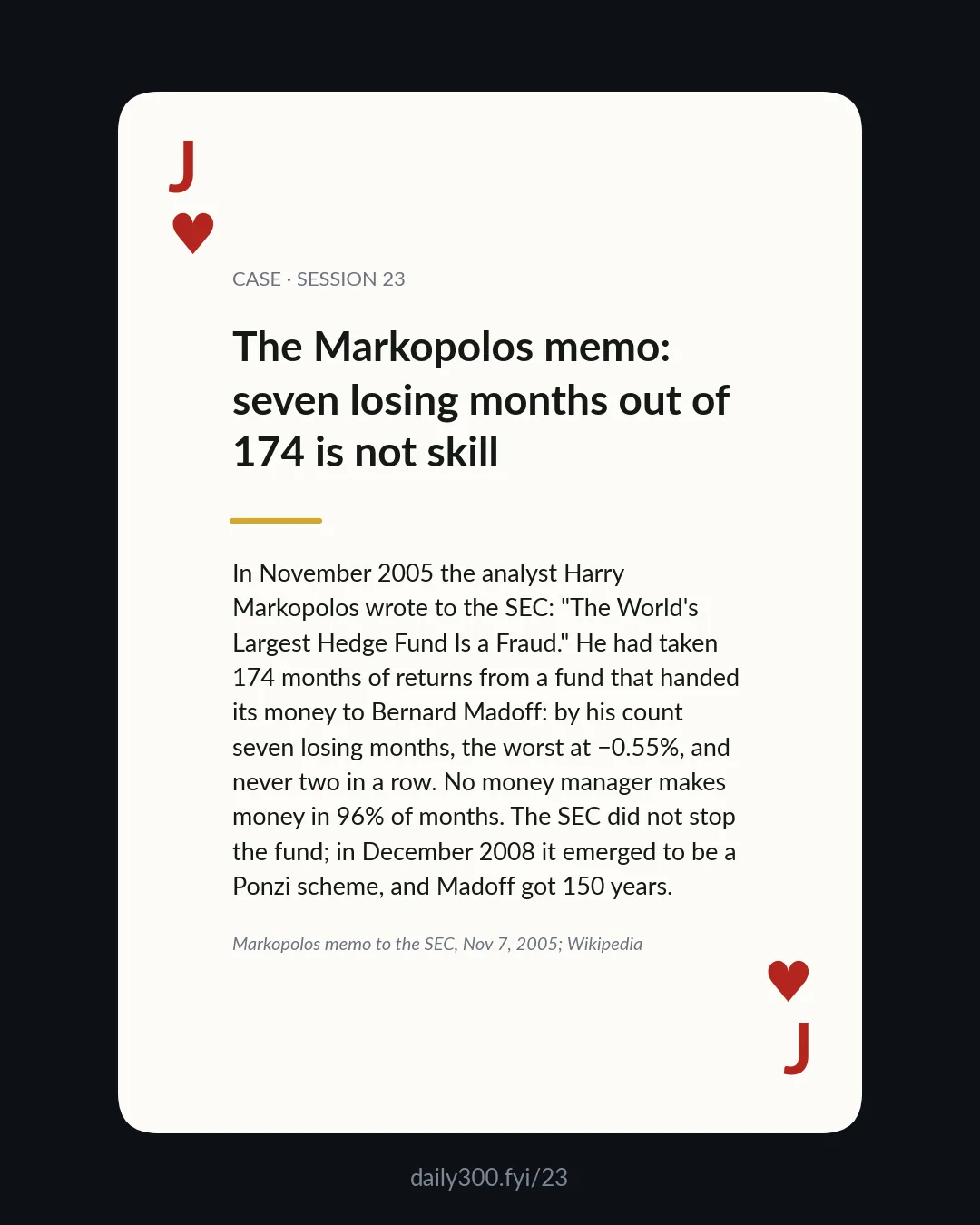
In November 2005 the analyst Harry Markopolos sent the U.S. Securities and Exchange Commission (SEC) a memo titled "The World's Largest Hedge Fund Is a Fraud." He had taken 174 months of reported returns, from December 1990 on, for Fairfield Sentry, a fund that handed its money to Bernard Madoff to manage. By his count only seven of the 174 months were losses, the worst month was −0.55%, and there were never two losing months in a row. He could not reproduce that performance with any strategy, and the memo's conclusion was plain: no money manager makes money in 96% of months.
The SEC did not stop the fund. In December 2008 it emerged that the fund was a Ponzi scheme: old clients were paid with new clients' money. Madoff admitted it and was sentenced to 150 years. The smooth line of returns turned out to be the tell: they had nothing to do with the market.
The analysis
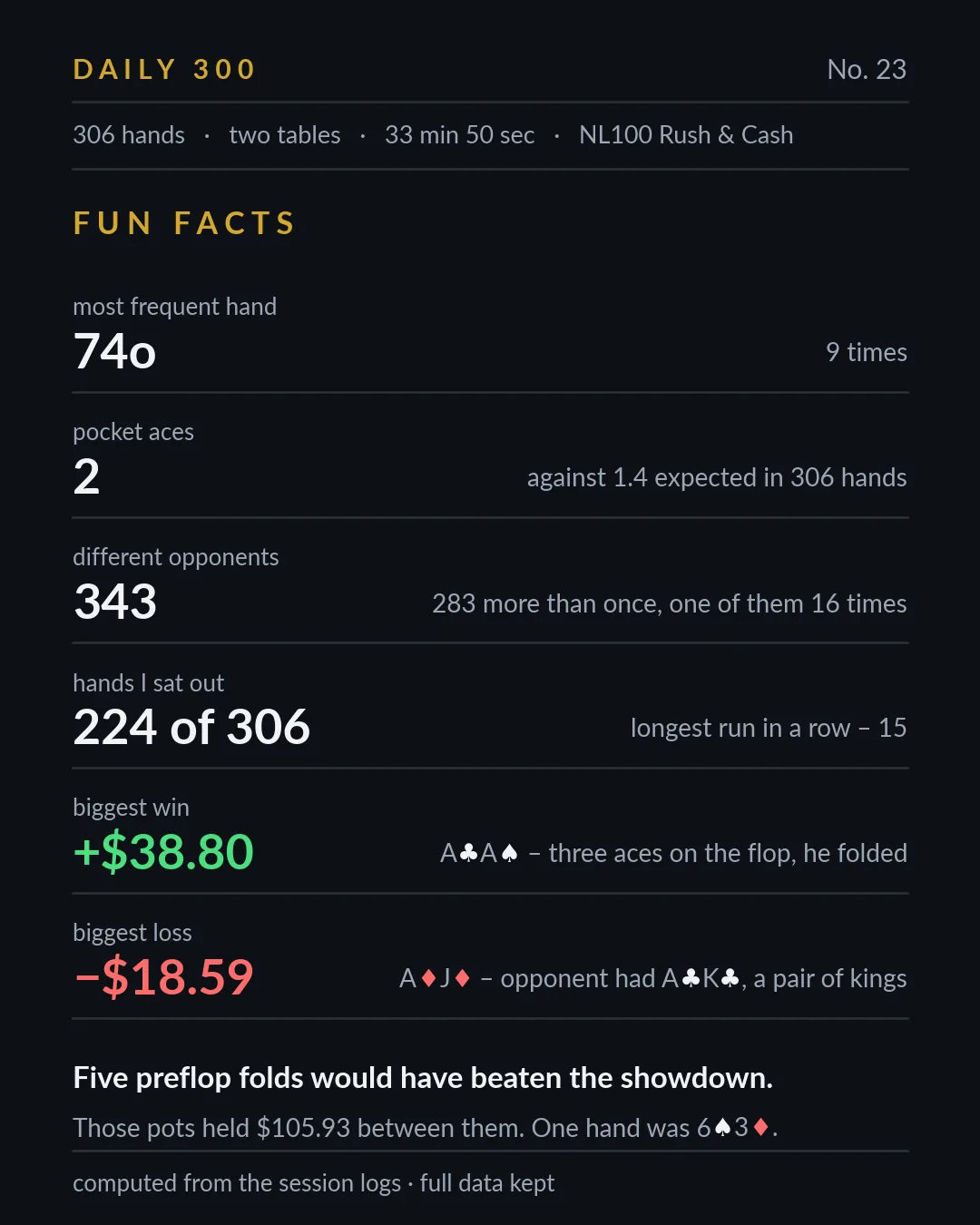
Of 306 hands I played 82 and went to showdown nine times. My only all-in, with three aces on the flop, was not called. Twenty-four times after the flop I folded to a bet or a raise; I checked eighteen of the nineteen heads-up folds against the price: thirteen are right by my model, four have no verdict, and the one mistake was a fold to a $1.38 bet. The two most expensive hands of the day cost $36 between them, and they have the same shape: a reraise before the flop, one bet, two checks, a showdown.
A♦J♦: one flop bet, then two checks in a 3-bet pot
Preflop
- under the gun fold
- middle position raise to $2
- cutoff fold
- button fold
- I raise to $11 · ×5.5
- big blind fold
- middle position call $9
A♦J♦ in the small blind. Middle position (MP) opens to $2, I reraise to $11, he calls.
Flop
Pot $23- I bet $7.59 · 33% pot
- middle position call $7.59
Three spades; for me, a pair of jacks just below the king, with an ace as my second card, and not a spade in my hand. I bet $7.59 (33% of the pot). By the solver, in two models of his range as I estimate it, a hand like mine checks here 94% and 100% of the time; a bet of a third of the pot is one of the solver's plays in the first model and not in the second. He calls.
Turn
Pot $38.18- I check
- middle position check
The turn is the 7♠, a fourth spade. Any spade in his hand is now a flush; I still have a pair of jacks. I check: by the solver, this hand checks here 96% of the time. He checks behind, and that tells me nothing: after my check the solver has him betting about half the time with a spade and without one.
River
Pot $38.18- I check
- middle position check
The river is the 9♥, and I check. By the solver, after his two checks this hand bets half the pot 62% of the time and checks 25%: both plays are in the mix. He checks and shows A♣K♣ – a pair of kings, the highest card on the board, and no spade. −$18.59. The money in this hand went in before the flop and with one bet; after that I did not add a cent. Against his actual hand, of the 990 ways the last two cards could come on the flop, 83 won for me and 60 split the pot; after the turn, two of 44 – the two remaining jacks – plus nine splits if a fifth spade lands. The only thing to do differently here was not to bet the flop, and that is what theory would do; I won't call it a clear mistake, because in one of the two models the bet is part of the mix. The hand cost the least it could with these cards.
K♣Q♣: the same shape, with an ace on board
Preflop
- under the gun fold
- middle position raise to $3
- I raise to $9 · ×3
- button fold
- small blind fold
- big blind fold
- middle position call $6
K♣Q♣ in the cutoff (CO). Middle position opens to $3, I reraise to $9, he calls.
Flop
Pot $19.50- middle position check
- I bet $8 · 41% pot
- middle position call $8
An ace on the board; two clubs there, which with mine make four to a flush; a king and a queen below the ace; and no pair. He checks, I bet $8 (41% of the pot), he calls: by the solver, in two models of his range as I estimate it, this hand bets here 30% of the time and checks 70%, and in the other model it always checks.
Turn
Pot $35.50- middle position check
- I check
The turn is the K♦: a pair of kings for me, still below the ace on the board. Check, check – by the solver a check 100% of the time.
River
Pot $35.50- middle position check
- I check
The river is the 8♦: check, check. He has A♣4♣ – a pair of aces, plus four to a flush already on the flop: against that hand, 24 of the 990 runouts on the flop were mine. −$17.00.
The day ends at −$15.34 in cash and the same by EV. The two most expensive hands, $36 between them, were lost at showdown with the smallest possible investment, and in both, theory would rather not have bet the flop at all. The rest is 70 folded blinds for −$49.50 and 32 hands that ended before the flop for +$33.57: 27 of those pots went uncontested. A half hour like this says nothing about the strategy, and a sound strategy has to produce one almost every other day. What deserves suspicion is a run with no losses in it at all.
Session cards
The best sessions in your inbox, once a week.