Session 1 · 302 hands · 2 tables · 29:36
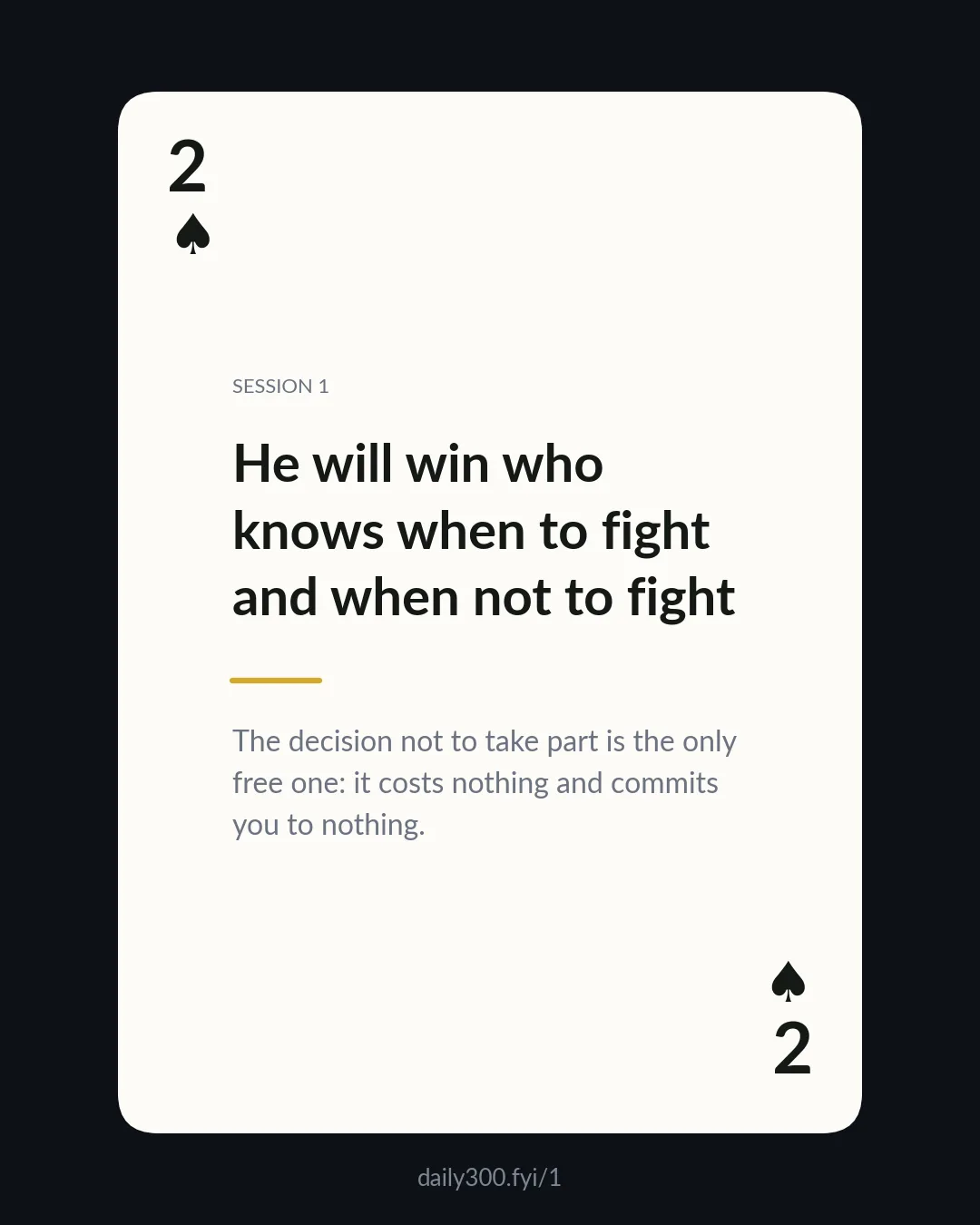
He will win who knows when to fight and when not to fight

Mark Zavadsky. Launched Alibaba in Russia, ran Sberbank's ecosystem, headed the studio behind Smeshariki and Fixiki, now iGaming and investing.
The idea
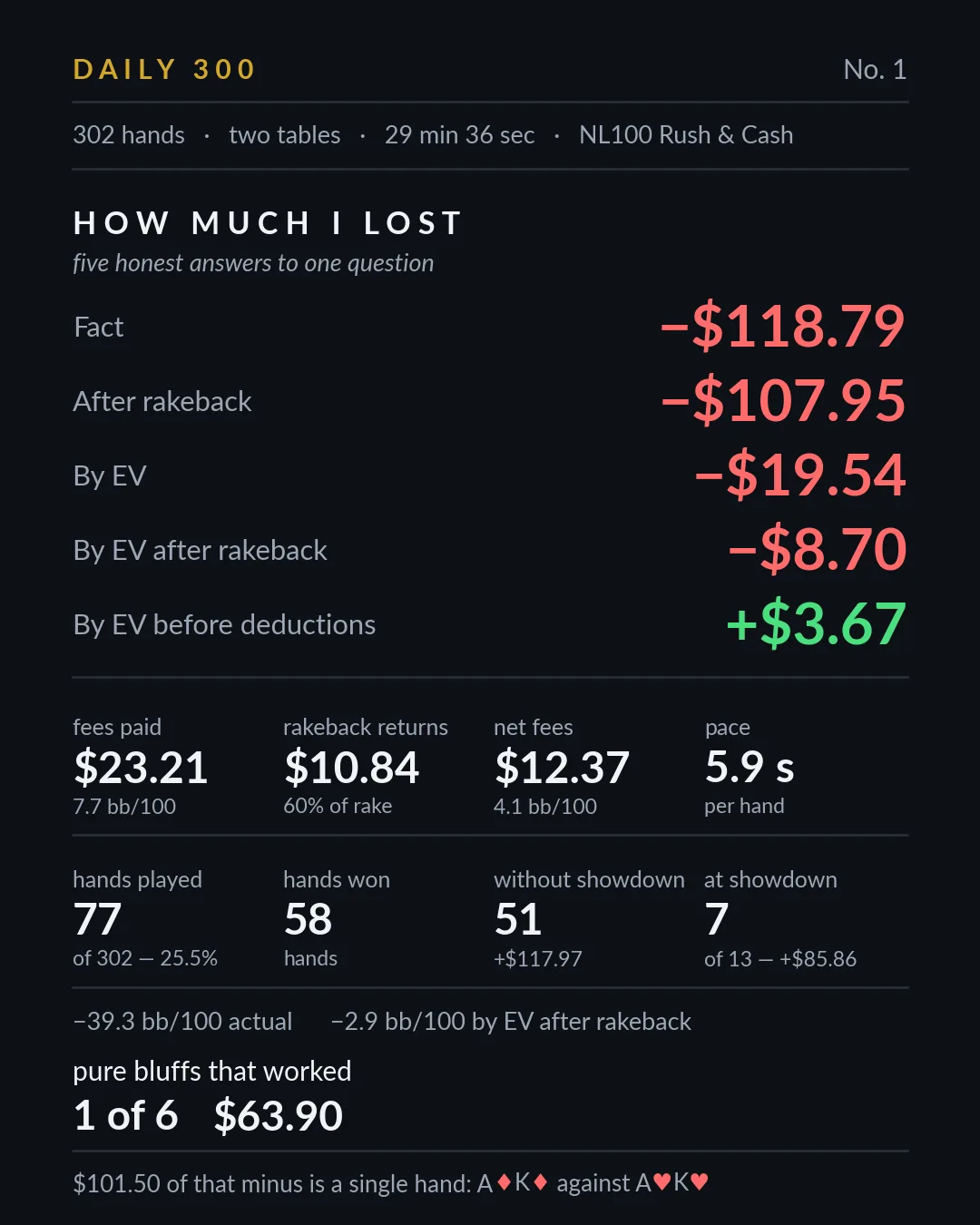
I lost twenty dollars trying to win an argument I should never have entered: the odds were less than one in ten, and I paid full price. Another hundred went in an argument where I was right and lost anyway, and that one, oddly enough, was no mistake at all.
Sun Tzu lists five essentials for victory, and the first of them, knowing when to fight and when not to, happens to be the cheapest as well. The decision not to take part is the only free one: it costs nothing and commits you to nothing. Every decision after it, though, is made inside a story that did not have to exist, and one way or another each of them gets paid for. So the cheapest question in any deal is asked before it. Do I need to be here at all?
Below: a case with the same mechanics, and the hands the idea grew out of, with the arithmetic. Poker words are underlined – hover to see what they mean.
The case
In 1962 London and Paris signed the Concorde agreement without providing any way out of it. Two years later a new British government wanted to stop – and could not: Paris refused to discuss it at all, and the Attorney General put a unilateral withdrawal at around a hundred million pounds. The 1959 estimate for the whole venture was a hundred and seventy-five. Walking away cost the same order as the thing itself, and in January 1965 London confirmed its obligations.
Britain closed its Concorde account only in 1987. In all that time no order came from anyone but the two state airlines – seven aircraft each. The signature, mind you, was free exactly once, and the same thing happens at the second meeting about a deal you should not have gone to the first time.
The analysis
Here is the hand. First to act (UTG): I move first of six, and all five answer already knowing what I did. A♣9♥ – an ace and a nine of different suits. The ace looks imposing, but the nine beside it is a stranger: they make no pair, they make no straight, they share no suit. A hand like that wins pennies and loses in bulk: when the ace hits the board, the weak hands leave without any help from me, and the one who stays to the end is holding a better ace – and I am the one paying him.
Hands like that I lay down almost every time from first position. Offsuit aces with a ten or worse alongside came to me 395 times in that seat, and I folded 385 of them. The ten hands I did play fall unevenly: eight of those hands account for five opens across 349 deals, and one hand – ace-nine – accounts for the other five across 46. This was one of those five.
The hand I should not have entered
Preflop
After that it played itself. I raise to $2, both blinds call.
Flop
Pot $6Flop 4♠ K♠ 2♥ – nothing for me. Both check, I bet $3: not for what I hold, but because I was the one who raised before the flop, and the king was likelier to be mine. Both call – and right there the hand had told me everything worth knowing.
Turn
Pot $15Turn J♥, nothing again, three checks.
River
Pot $15River 2♠ – a third spade. I have a pair of deuces off the board, which is to say nothing: everyone holds that pair. There is $15 in the pot and I bet $15, counting on both to fold. It pays off only if both fold at least half the time. That "half" was a number I never checked – I assumed it. The real count goes like this: both called my bet on a king-high flop, so a king sits in about half their hands, if not more, and the third spade on the river completed the flush draws. By my estimate, both fold under ten percent of the time. And I hold no spade, so I block none of those flushes. The small blind called with Q♠J♠ and took the pot. The hand cost me $20.
He did not bet it himself, and that makes sense. The second deuce paired the board, and a full house beats a flush. Betting there earns only from the hands that beat you; calling earns from every hand that doesn't – and his flush beats every bluff I can hold and every flush built on smaller spades. He took the second option, and he was right.
Fifteen of those twenty were the river bet, three the flop bet; entering cost two. But folding at the start would have cost nothing at all, and then there is no river bet and no twenty dollars.
The same hand on both sides
Preflop
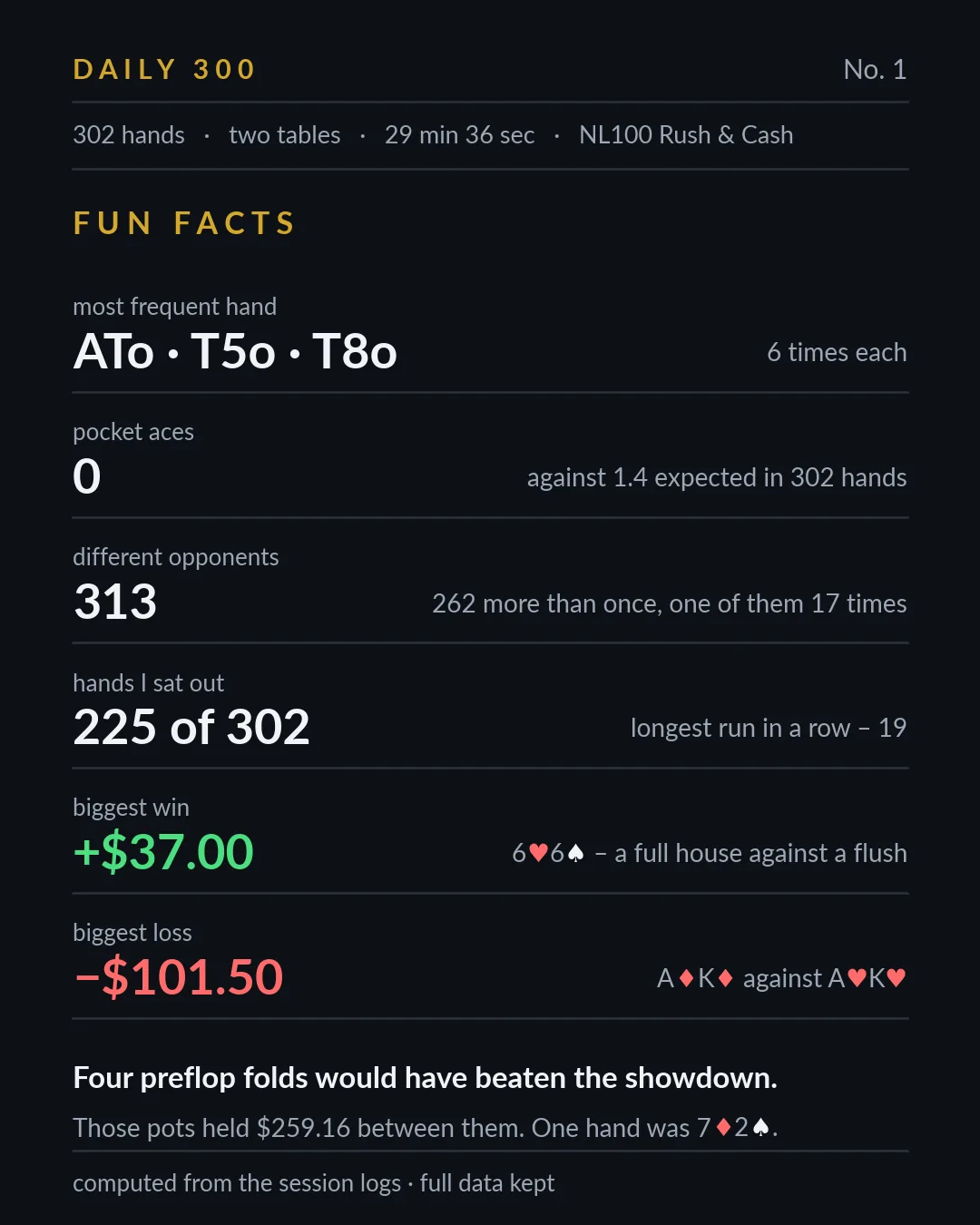
There was another hand that day, worth $101.50. The other 301 came to −$17.29 – the whole day fits inside one hand. I was dealt an ace and a king, and so was my opponent, and with identical hands a pot like that splits 85.7% of the time. The suits, though, differed: A♦K♦ for me, A♥K♥ for him, and the board ran out 7♥ T♥ T♠ 6♠ J♥, three hearts. The rest needs no explaining. There was a decision there, and more than one: he raised, I raised back, he raised again, and I moved all in. I played it right, because ace-king suited is never a fold, calling is worse, and the solver shoves it two times out of three.
That is the other half of the same rule: knowing when not to fight cost me twenty dollars, knowing when to fight ran to a hundred, and of the two only the first was a mistake.
Session cards
The best sessions in your inbox, once a week.