Session 22 · 303 hands · 2 tables · 30:34
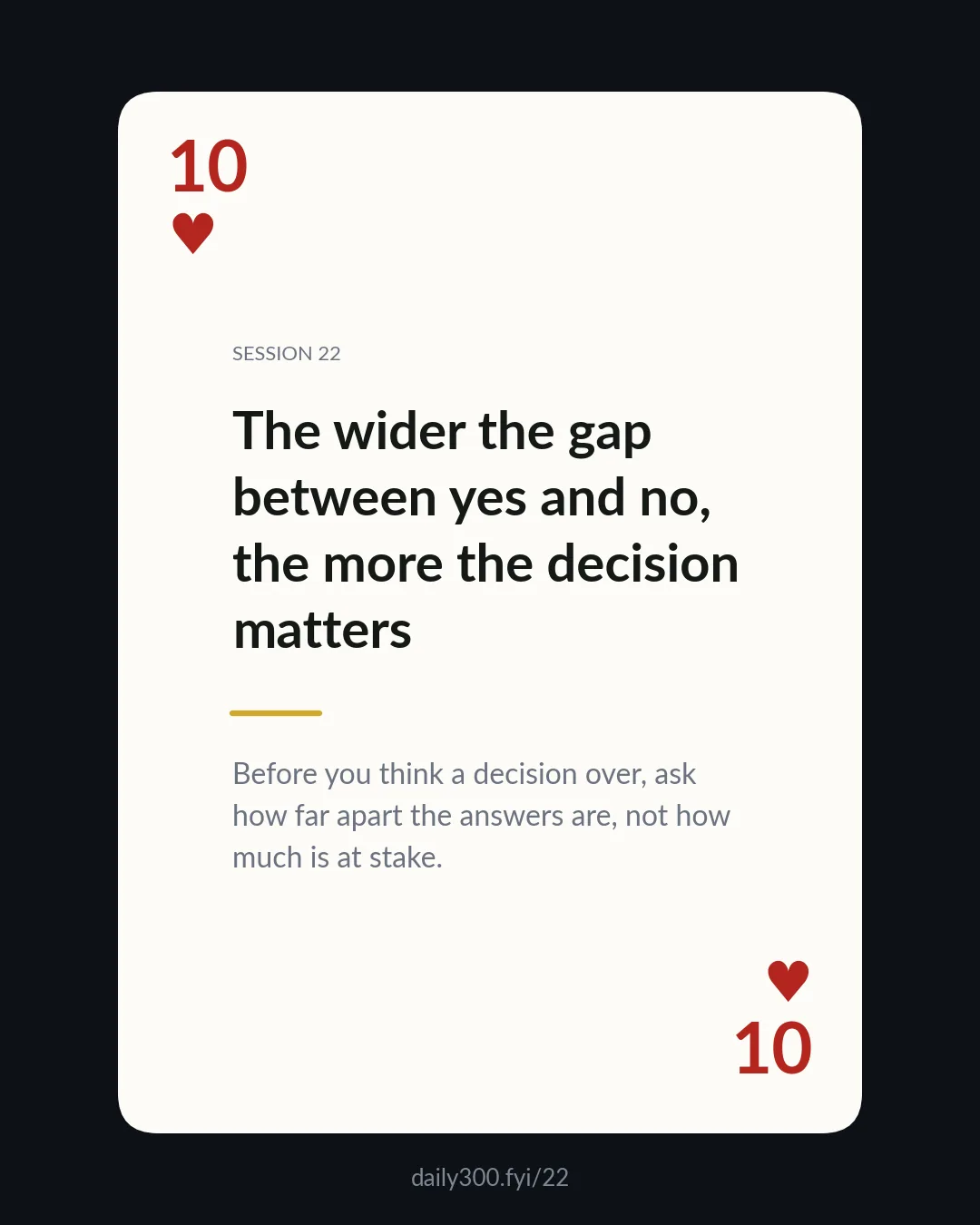
The wider the gap between yes and no, the more the decision matters

Mark Zavadsky. Launched AliExpress in Russia, ran Sberbank's ecosystem, headed the studio behind Smeshariki and Fixiki, now iGaming and investing.
The idea
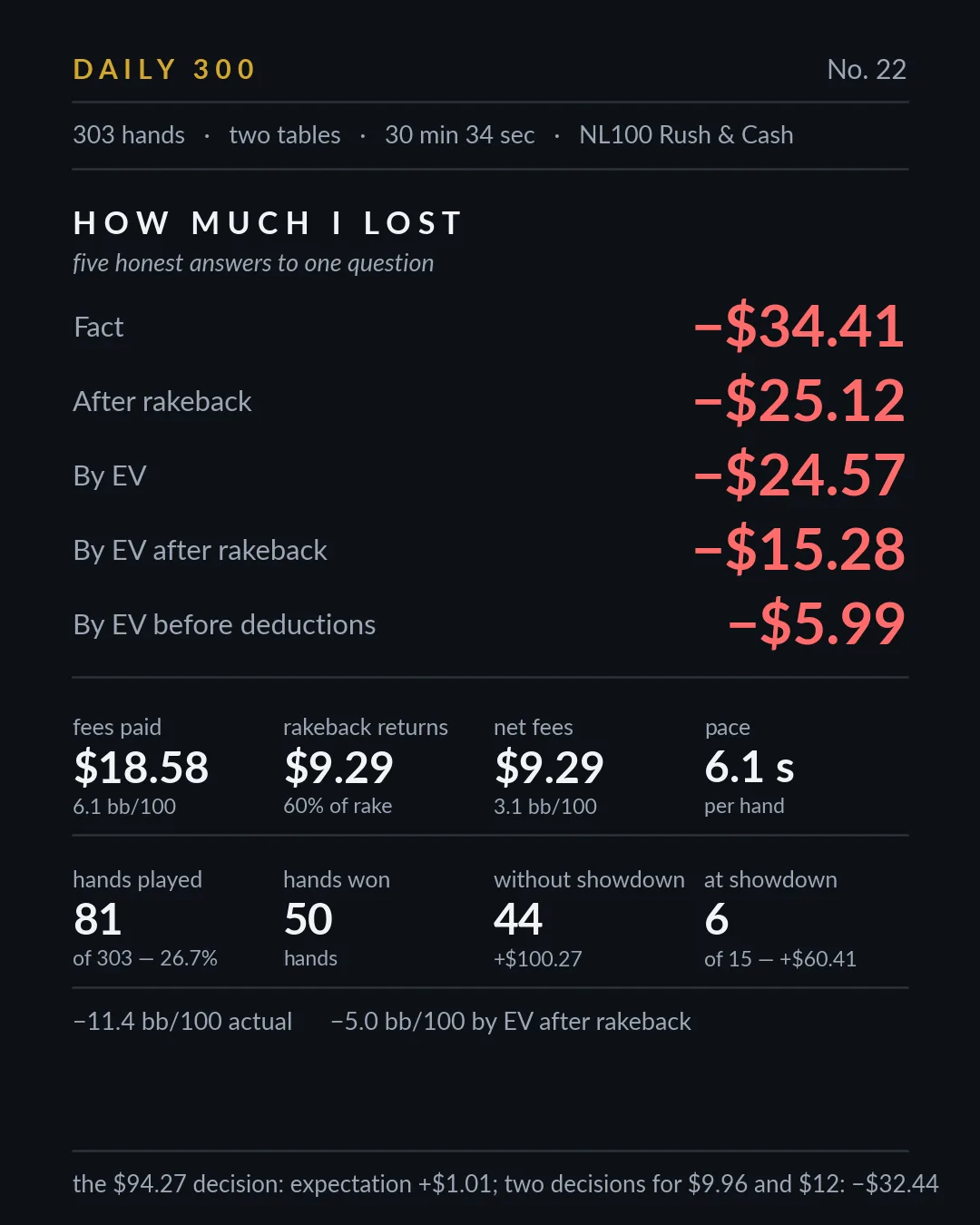
In half an hour, one decision for $94; the rest for $40 or less, and nearly all for $12 or less. In the expensive one both options were, by my estimate, equal: a dollar apart in expectation. I said yes, and almost all the money came back: −$2. In the $10 and $12 decisions, where yes and no were far apart, I lost $32 – nearly the whole loss of the day.
The sum at stake measures the risk, not the decision. A decision matters where yes and no lead to different places. If both give you the same thing, there is nothing to think about: pick either and move on, as after a coin toss. The same goes for business. Directors spend a month on an acquisition where, once the numbers are run, both answers are worth about the same, and sign a bonus plan in passing, though there the gap shows at once, in dollars. Before you think a decision over, ask how far apart the answers are, not how much is at stake. You'll notice the expensive decision anyway; the important one hides among the small.
Below: a case with the same mechanics, and the hands the idea grew out of, with the arithmetic. Poker words are underlined – hover to see what they mean.
The case
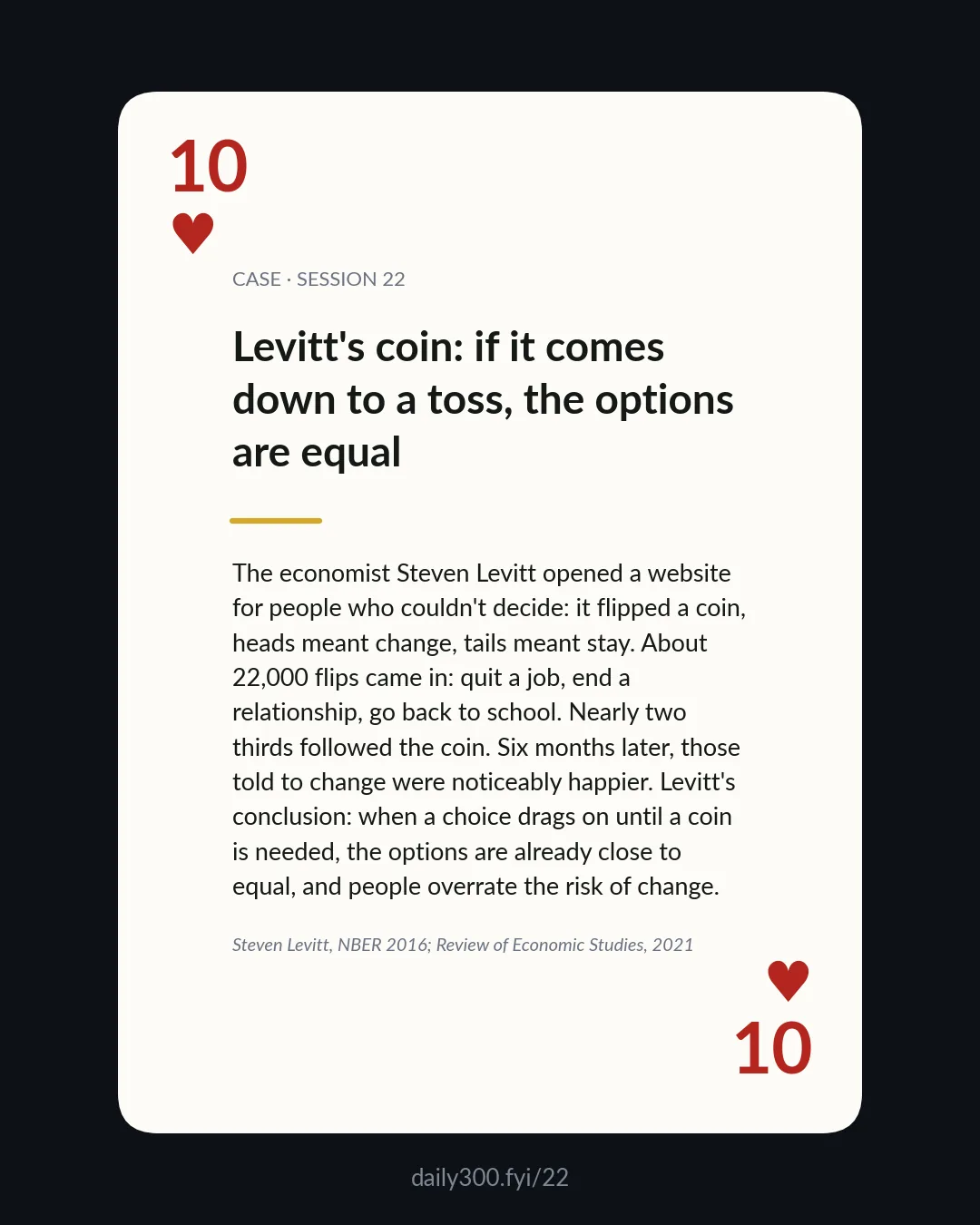
The economist Steven Levitt set up a website for people who couldn't make up their minds: you describe the choice, the site flips a coin, heads means change, tails means leave it as it is. About 22,000 flips came in. The most common questions were whether to quit a job, end a relationship, go back to school, or make a big purchase. Two months and six months later, participants were asked what they had done and how happy they were.
Nearly two-thirds followed the coin. At two months, those who had been told to change were no different from the rest; at six months they were noticeably happier, especially those who had quit a job or ended a relationship. Levitt describes the result as preliminary: people rated their own happiness, and the sample was not random. But his conclusion is one: when a choice drags on until a coin is needed, the options are already close to equal, and people overrate the risk of change.
The analysis
I sorted this session's decisions by price. I put money into 81 hands: in 74 of them no more than $12, in six between $12 and $40, and in one, $121. Eleven times after the flop I folded to a bet heads-up: ten of those folds are right by my model, and the single mistake was a fold to a $1.98 bet. I'll start with the most expensive decision.
Q♦Q♣: calling a 5-bet shove
Preflop
- under the gun fold
- I raise to $2
- cutoff fold
- button fold
- small blind raise to $11 · ×5.5
- big blind fold
- I raise to $27 · ×2.5
- small blind raise to $121.27 · ×4.5
- I call $94.27
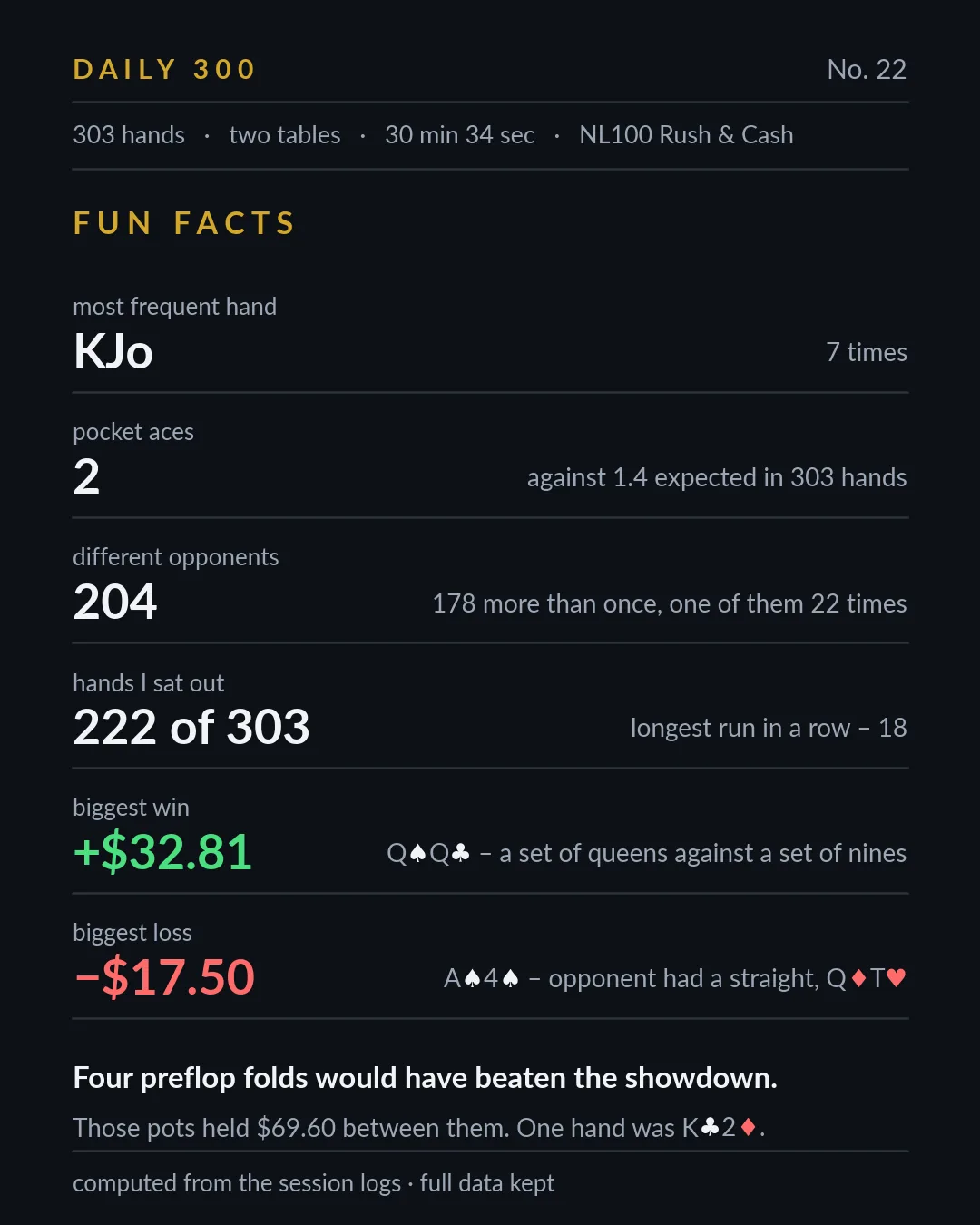
Q♦Q♣ in middle position (MP). I raise to $2, the small blind reraises to $11, I raise again to $27, and he moves all-in for his whole stack: $121.27. I have to put in $94.27 to w, so the call pays if I win at least 39% of the time. A pair of queens is the third-strongest starting hand in the game, and the only question is what he is doing this with. What does a player move all-in with after two raises? My estimate: aces, kings, and ace-king – 28 specific two-card holdings. Against those, queens win 40% of the time, and the call is worth +$1 compared with folding: the same as zero. If he did this only with aces and kings, queens would win 18% of the time and the call would be worth −$51; if ace-queen of one suit is in there too, +$5. The answer depends entirely on what I make of him, and I have nothing to go on: before this hand we had never been in a pot together. The standard range – aces, kings, ace-king – gives exactly a coin flip. I call. He shows A♣K♣. Against that hand queens win 54% of the time: I'm slightly ahead. We run it twice: the board is dealt out two separate times, half the pot on each. The first board, 3♥ A♥ 5♣ 7♦ 3♦, is his: an ace comes. The second, 6♦ 8♥ 4♠ Q♥ T♣, is mine: three queens. The pot is split: −$1.75 in cash, +$8.09 by EV. The biggest decision of the session: $94 at stake, and the right answer differs from the wrong one by a dollar.
A♠4♥: a pot-sized turn bet with nothing
Preflop
- under the gun fold
- middle position fold
- cutoff fold
- button fold
- I raise to $3
- big blind call $2
Now a $10 decision where the answers diverge. A♠4♥ in the small blind. I raise to $3, the big blind calls.
Flop
Pot $6- I bet $1.98 · 33% pot
- big blind call $1.98
I bet $1.98 (33% of the pot), he calls.
Turn
Pot $9.96- I bet $9.96 · 100% pot
- big blind call $9.96
The turn is the 7♦: I bet $9.96 (100% of the pot) with an ace and a four – no pair of my own, no draw – and the bet pays only if he folds at least half the time. By my model of the range he called the flop with, he folds 13% to 31% of the time. By the solver, in two models of his range, a hand like mine checks here 69% and 100% of the time. He calls.
River
Pot $29.88- I check
- big blind check
The river is the T♣: check, check. He shows Q♦8♦: two pair, queens and twos. −$14.94.
A♠4♠: calling a pot-sized river bet
Preflop
- under the gun fold
- middle position fold
- I raise to $2.50
- button fold
- small blind call $2
- big blind fold
And one more, for $12. A♠4♠ in the cutoff (CO). I raise to $2.50, the small blind calls.
Flop
Pot $6- small blind check
- I bet $3 · 50% pot
- small blind call $3
A pair of aces for me. I bet $3 (50% of the pot), he calls.
Turn
Pot $12- small blind check
- I check
The turn is the K♥: check, check.
River
Pot $12- small blind bet $12 · 100% pot
- I call $12
The river is the 6♣: he bets $12 (100% of the pot). A call pays if I win at least 33% of the time. Across the player pool, a pot-sized river bet is made with nothing 20–30% of the time, and everything else that bets this way beats my pair of aces: by my model I win 20% to 30% of the time, below the price. I call, and he shows Q♦T♥ – a straight, made back on the turn. −$17.50.
The day ends at −$34.41 in cash, −$24.57 by EV. The $94 decision was a coin flip and cost $2; two hands, a ten-dollar decision and a twelve-dollar one, where the answers were far apart, cost $32 – nearly the whole loss of the day. The sum at stake tells you what you risk; only the gap between the answers tells you how much the decision matters, and that is what to look at first, before the sum.
Session cards
The best sessions in your inbox, once a week.