Session 21 · 303 hands · 2 tables · 33:14
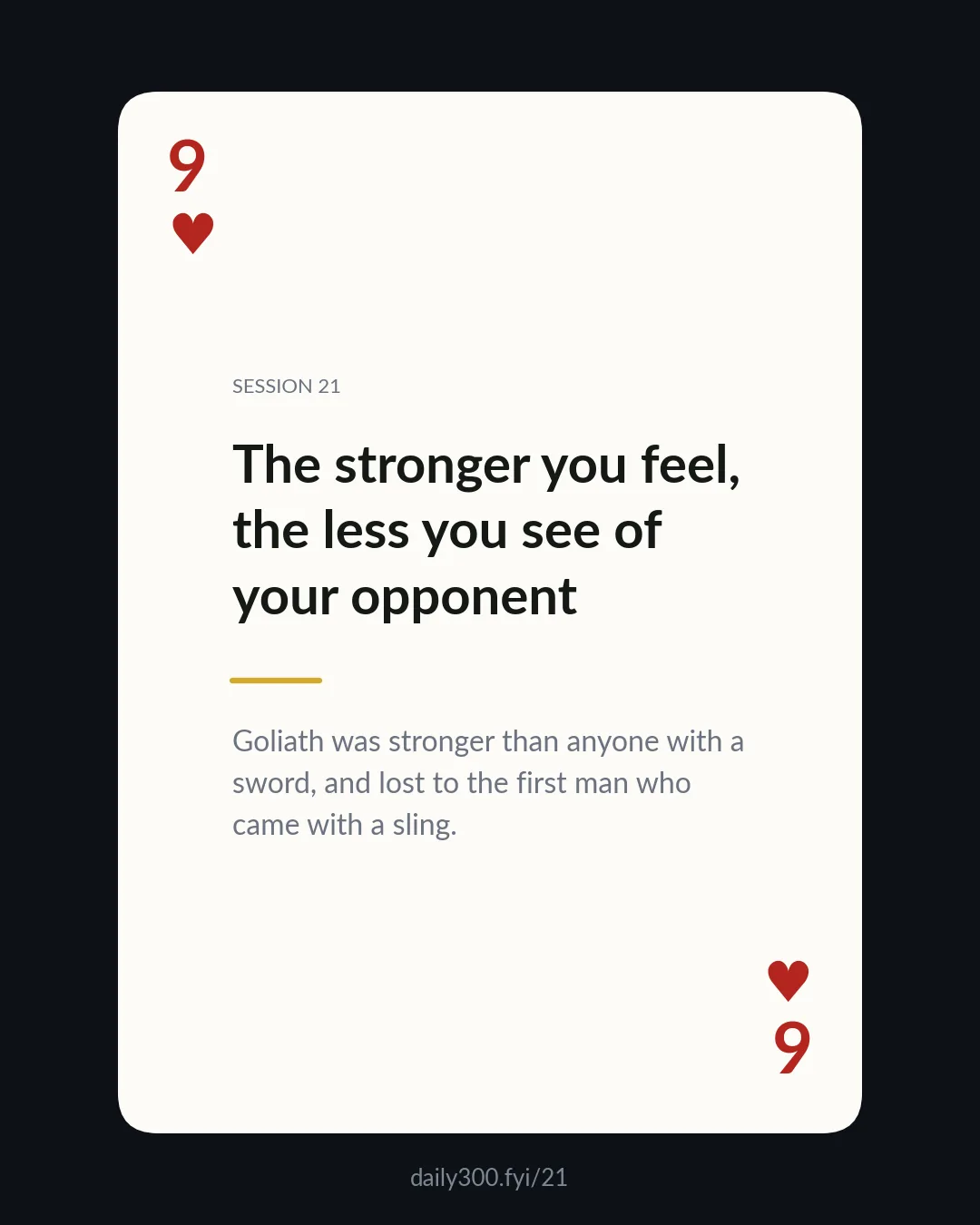
The stronger you feel, the less you see of your opponent

Mark Zavadsky. Launched AliExpress in Russia, ran Sberbank's ecosystem, headed the studio behind Smeshariki and Fixiki, now iGaming and investing.
The idea
In half an hour I was dealt the same strong pair six times: two jacks. Normally it shows up once or twice. Three times I got raised hard with it, and I answered three different ways. Once I put my whole stack in and lost $61 to queens. Another time I made three jacks and folded them. In the third hand I folded on the last card. Both folds, by the numbers, were right. On all the strong pairs of the evening, nines through aces, I lost $91; on everything else I won $86.
The same cards were strong against one opponent and weak against another. Strength is relative: outside a confrontation there is no way to measure it. You feel your own strength all the time; you see your opponent only when the two of you collide. Goliath was stronger than anyone with a sword, and lost to the first man who came with a sling. Before you rely on your strength, look at who's come out to face you. If there is no one to look at, you haven't measured it; you've only felt it.
Below: a case with the same mechanics, and the hands the idea grew out of, with the arithmetic. Poker words are underlined – hover to see what they mean.
The case
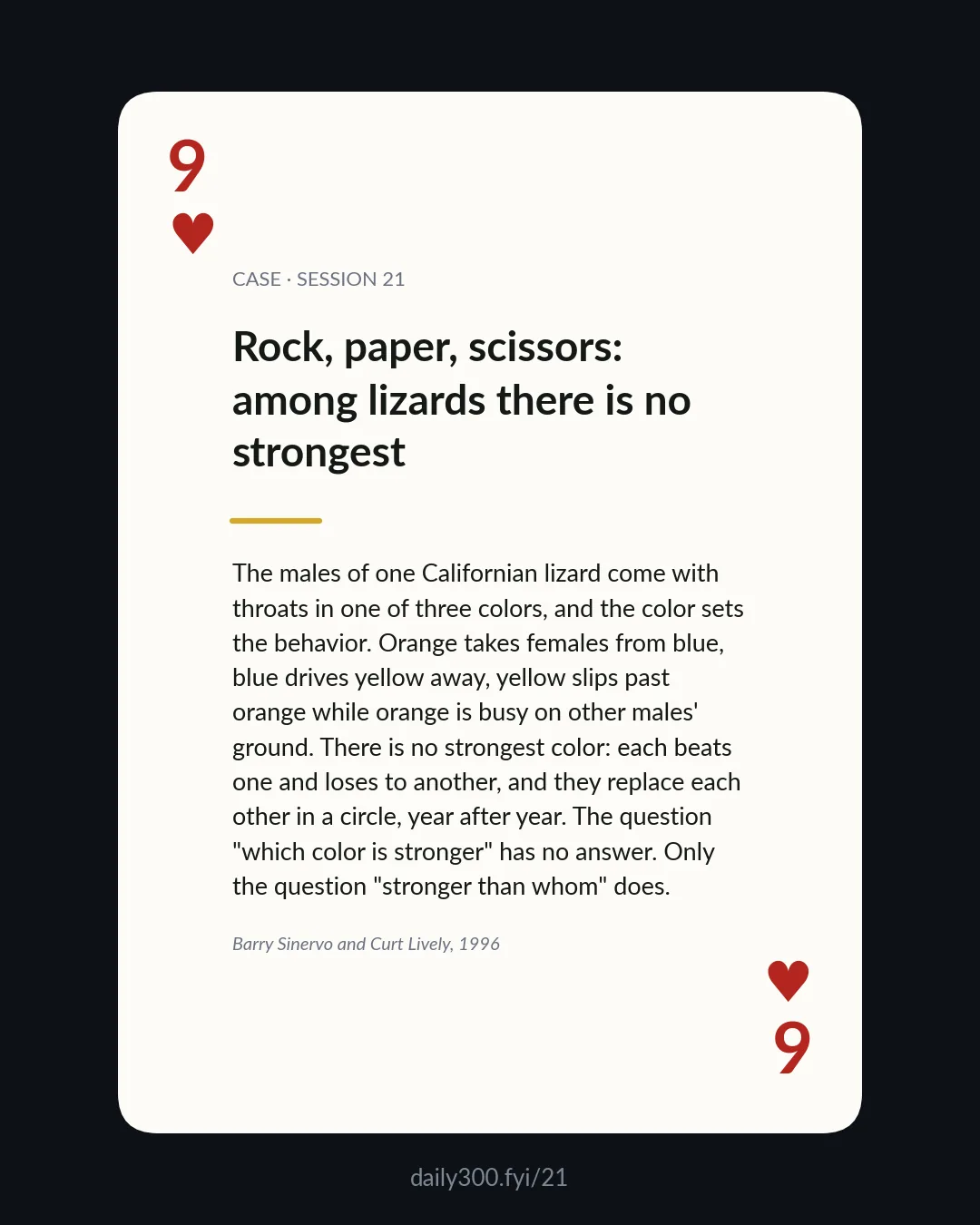
In the dry hills of California lives a lizard whose males come with throats in one of three colors, and the color sets the behavior. Orange males are the most aggressive: they hold a large territory and up to six females. Blue males hold a small patch with one or two females and defend it together with other blues. Yellow males hold no territory at all and sneak in on other males' females. In 1996 the biologists Barry Sinervo and Curt Lively described what comes of this: orange takes females from blue, blue drives yellow away, and yellow slips past orange while orange is busy on other males' ground.
It's rock-paper-scissors: there is no strongest color. Each one beats one and loses to another, so nobody wins for good: orange dominates for a year or two, then yellow pushes it aside, blue pushes yellow, orange pushes blue, and the circle goes on. The question "which color is stronger" has no answer; only the question "stronger than whom" does.
The analysis
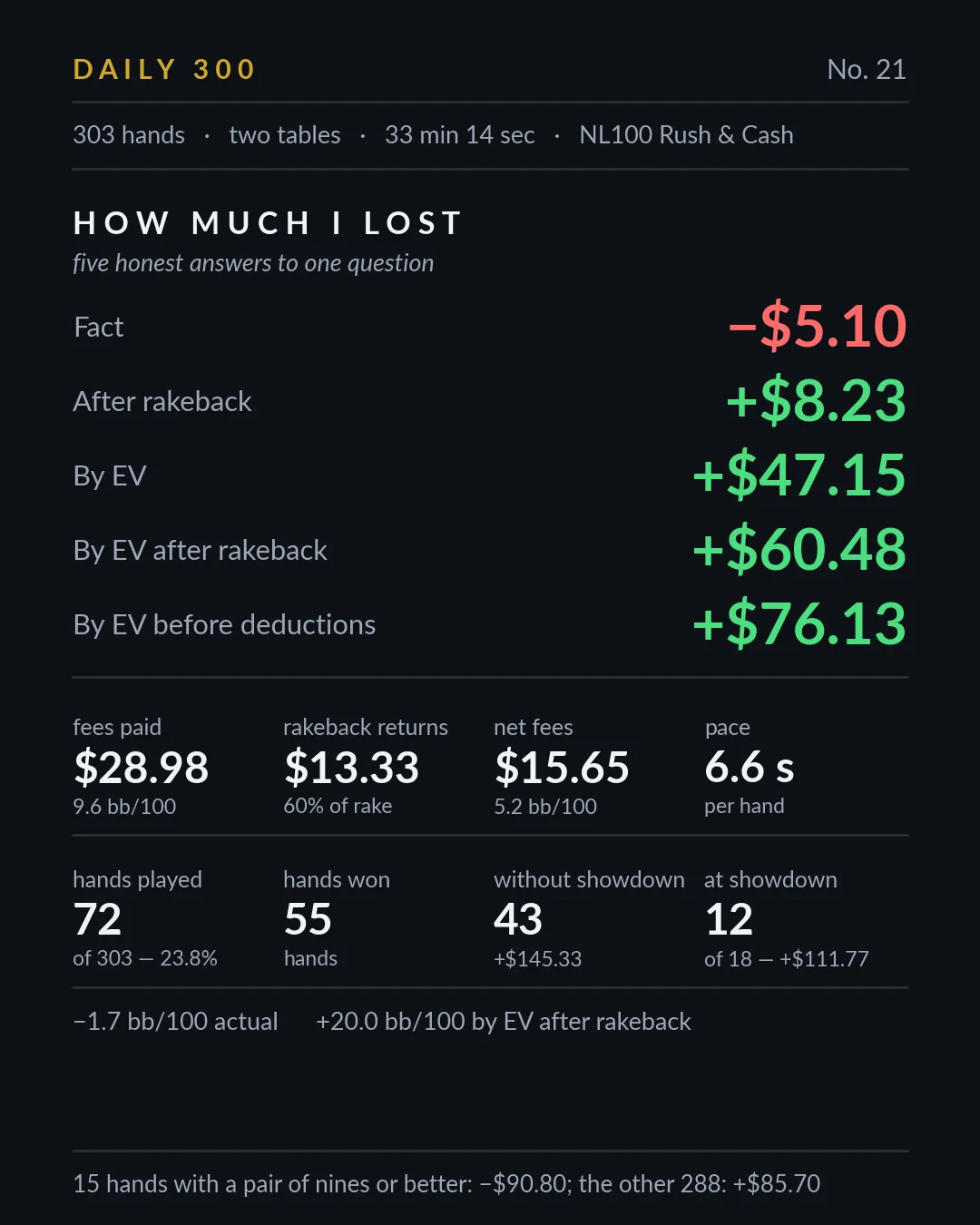
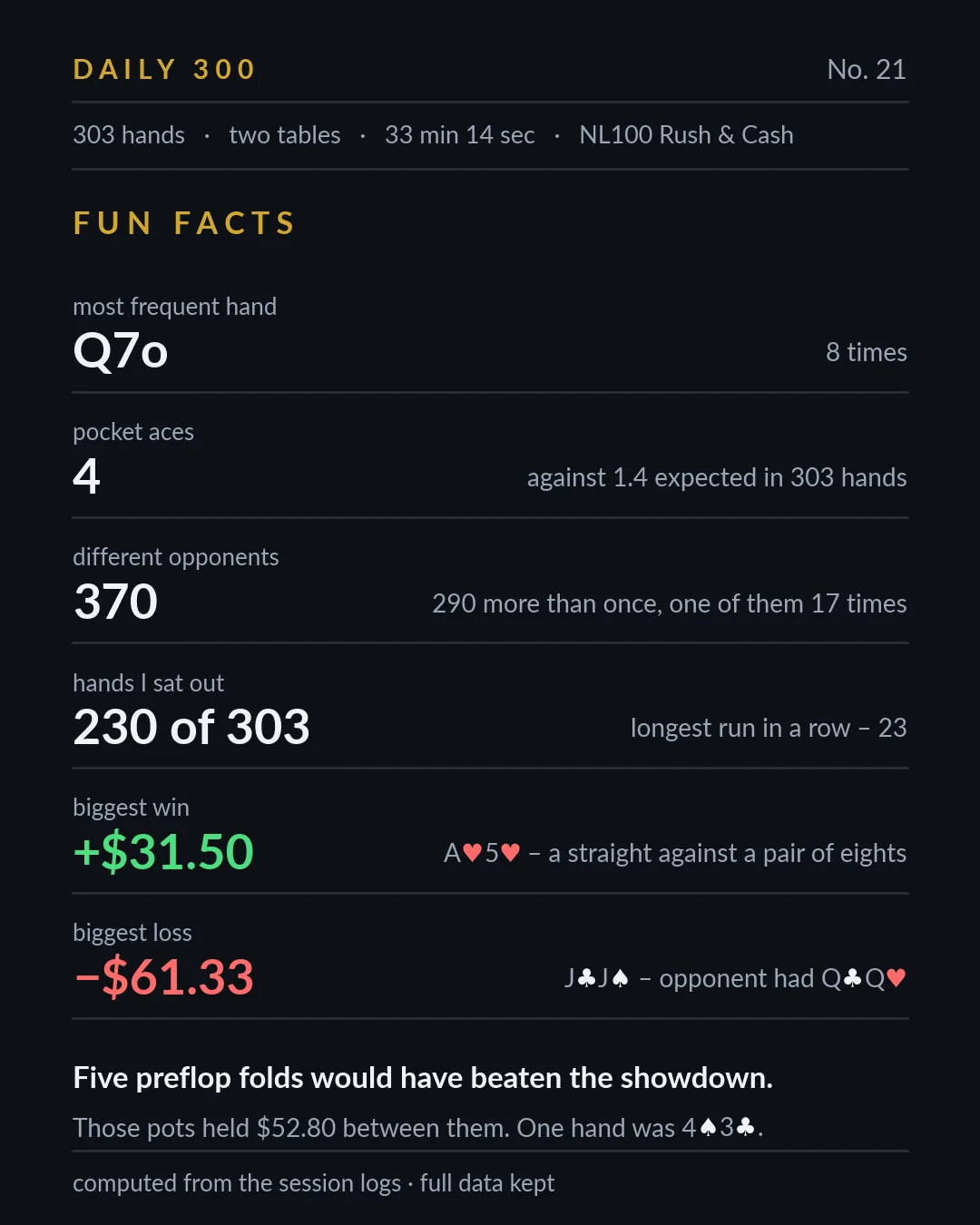
That evening I was dealt aces four times, queens three times, nines twice, and jacks six times: fifteen hands with a pair of nines or better, against an expected eight or so. On those fifteen I lost $90.80; on the other 288 I won $85.70. The jacks cost the most: six hands, −$107.15, and three of them gave three different answers to the same question, what to do with jacks when someone raises you.
J♣J♠: calling an all-in into queens
Preflop
- under the gun raise to $2
- middle position fold
- cutoff call $2
- button call $2
- I raise to $20 · ×10
- big blind fold
- under the gun fold
- cutoff raise to $61.33 · ×3.1
- button fold
- I call $41.33
The hand of the day: jacks against queens, −$61.33. J♣J♠ in the small blind. Under the gun (UTG) raises to $2, the cutoff (CO) and the button call, the pot is $7.50, and I reraise to $20: with three opponents in, I'd rather make jacks expensive now than see a flop with them. The big blind and UTG fold, and the cutoff moves all-in: he has $61.33. I have to put in $41.33 to w, so the call pays if I win at least 32% of the time. What would he do that with? He only called the first raise; it was mine that sent his whole stack in. If he only does this with queens, kings, or aces, I estimate jacks at 18% against that, and the call is worth −$19 compared with folding. If ace-king is in there too, 36% and +$3. The wider his range, the better for jacks: with tens and ace-queen it comes to 47% and +$16. I call. He shows Q♣Q♥: 18%, the worst case. We run it twice: the board is dealt out two separate times, half the pot on each. First board A♣ A♦ 4♥ 6♦ T♣: two pair each, his higher. Second board J♥ 9♣ 3♠ Q♦ 4♦: I have three jacks, he has three queens. Both runs are his. Whether the call was right depends on one thing only: what he moves all-in with, and I don't know it. The 32% price sits between my 18% and 47% estimates, so there is no verdict. My reraise, though, is beyond doubt: by theory, jacks in the small blind against a raise and two callers reraise every time. The jacks were strong right up to the moment he answered with his whole stack, and weak after it, with the same cards in my hand.
J♣J♦: a set of jacks folded on the river
Preflop
- I raise to $2
- middle position fold
- cutoff raise to $7.50 · ×3.8
- button fold
- small blind fold
- big blind fold
- I call $5.50
Another hand with jacks produced the best decision of the day, and it's a fold. J♣J♦ under the gun. I raise to $2, the cutoff reraises to $7.50, everyone else folds, and I call: against one opponent jacks are strong, but raising them again means playing for my whole stack with a hand that queens, kings, and aces all beat.
Flop
Pot $16.50- I check
- cutoff bet $12.38 · 75% pot
- I call $12.38
A king above my jacks. I check, he bets $12.38 (75% of the pot), I call: not everything he reraised with has a king in it.
Turn
Pot $41.26- I check
- cutoff check
The turn is the A♥: a second card above my jacks. Check, check.
River
Pot $41.26- I bet $17.62 · 43% pot
- cutoff raise to $88.29 · ×5
- I fold
The river is the J♥: a third jack, and at the same time the fourth card to a straight: the board now reads T, K, A, J, and any queen in his hand fills the gap. I bet $17.62 (43% of the pot): three jacks are the best hand I've had all evening, and ace-king, two pair, and three tens will all call. He moves all-in for $88.29. I have $65.73 left; to put it in for a $207.96 pot, I need to win 32% of the time. By my model of his range, the hands he'd reraise to $7.50 with and still be here with, that's 84 combinations, specific two-card holdings: three jacks beat 56 and lose to 28, every straight with a queen, three aces, three kings. But does he move all-in with all 84? I ran this river through a solver with his range: in theory, he moves all-in over my bet only with straights, and jacks always fold here. A second model, where he would have bet his strong hands on the turn, gives the same answer. I fold. Minus $37.50 instead of minus $103.23, my whole stack.
J♠J♣: folding to a three-quarter-pot river bet
Preflop
- I raise to $2
- middle position fold
- cutoff fold
- button fold
- small blind raise to $5.75 · ×2.9
- big blind fold
- I call $3.75
One more pair of jacks, J♠J♣, again under the gun and again facing a raise: the small blind reraises to $5.75, I call.
Flop
Pot $12.50- small blind bet $6.25 · 50% pot
- I call $6.25
An ace above my jacks. He bets $6.25 (50% of the pot), I call.
Turn
Pot $25- small blind check
- I check
The turn is the 9♦: check, check.
River
Pot $25- small blind bet $18.75 · 75% pot
- I fold
The river is the 4♦: he bets $18.75 (75% of the pot). A call pays if I win at least 30% of the time. Against my estimate of his range, my chances are 25% to 31%, right around the price. By the solver, in two models of his range, jacks fold here to any bet size. I fold. Minus $12.
9♥9♦: shoving over a squeeze, called by A♦6♦
Preflop
- under the gun raise to $2.20
- I call $2.20
- cutoff call $2.20
- button raise to $15 · ×6.8
- small blind fold
- big blind fold
- under the gun fold
- I raise to $122.30 · ×8.2
- cutoff fold
- button call $68.34
Where does +$47 by EV come from when the result is −$5? From two preflop all-ins. In jacks against queens I lose $39 by EV instead of $61. And the nines: 9♥9♦ in middle position (MP), I call the opening raise, the button reraises to $15, I move all-in over it, and he calls with A♦6♦. Nines win 68% of the time against that hand. We run it twice and take one board each: the pot is split, +$0.70 in cash and +$30.74 by EV. By theory, nines don't go all-in over a reraise like that: if the opponent calls the all-in only with queens or better and ace-king, my expectation when called is −$23, and for the move to pay he has to fold more than half the time. But I read it differently. The button was a player with a short stack, $83, and I read him as an amateur. The archive supports that read: players with less than a full stack call a preflop all-in with a hand weaker than tens or ace-queen 38 times out of 100; players with a full stack, 26. His call with A♦6♦ was exactly one of those. Against a calling range with suited aces, I estimate nines at about 44%, and the move pays if he folds at least a third of the time, and he wasn't reraising only with strong hands. Against the man who was actually sitting there, the all-in was the right decision. Against a player with a full stack and a tight calling range, the same nines are a fold.
The evening ends at −$5.10, +$47.15 by EV. Six pairs of jacks and three big decisions: a call for my whole stack, a fold of three jacks, a fold on the river. None of them could be made by looking only at my own cards. What made them strong or weak was the man sitting across from me and the way he bet. The most expensive of the three was the one where I relied on the jacks: I didn't know then what he moved all-in with, and I still don't. The most dangerous opponent is the one you didn't see while you were busy feeling strong.
Session cards
The best sessions in your inbox, once a week.