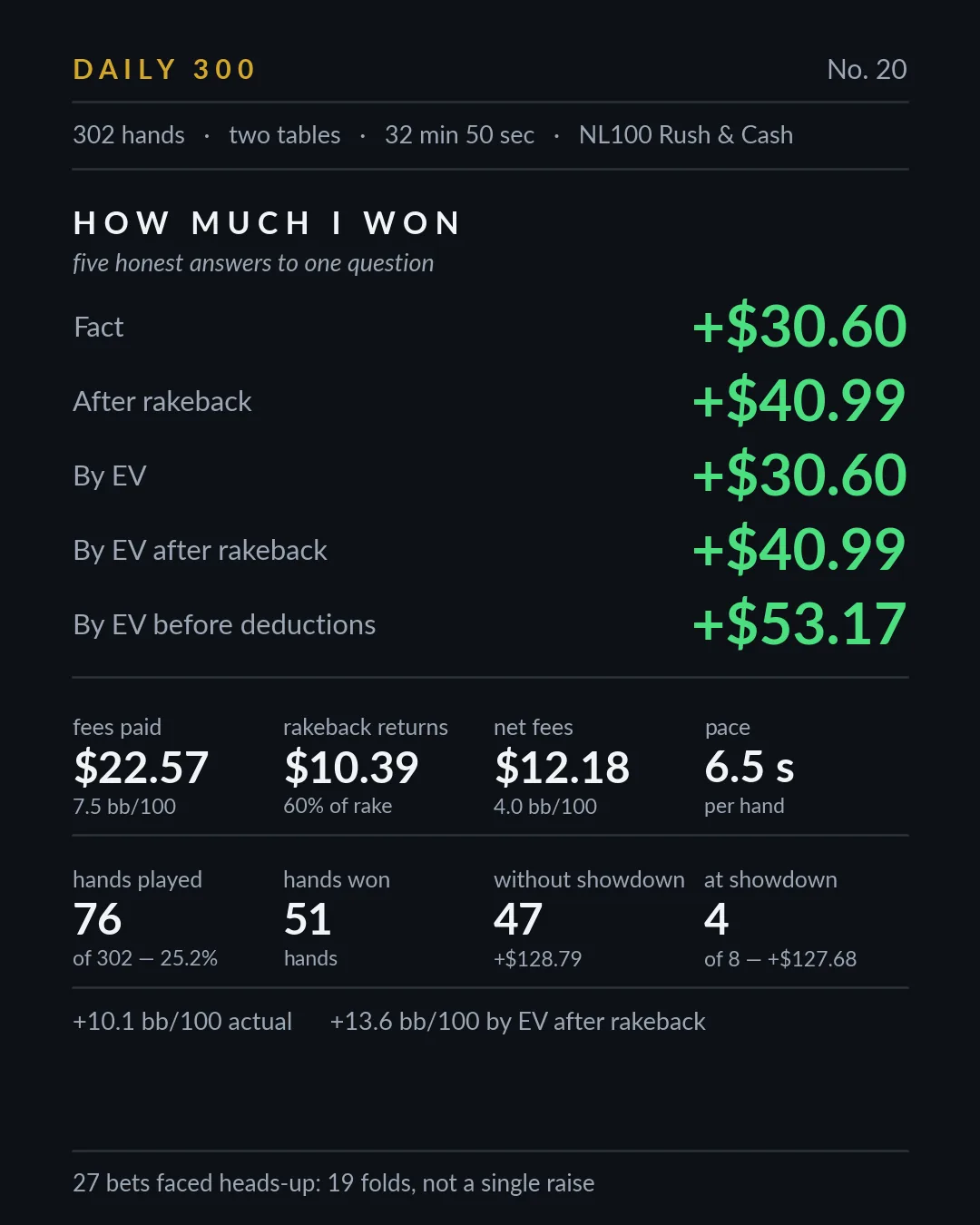
Session 20 · 302 hands · 2 tables · 32:50
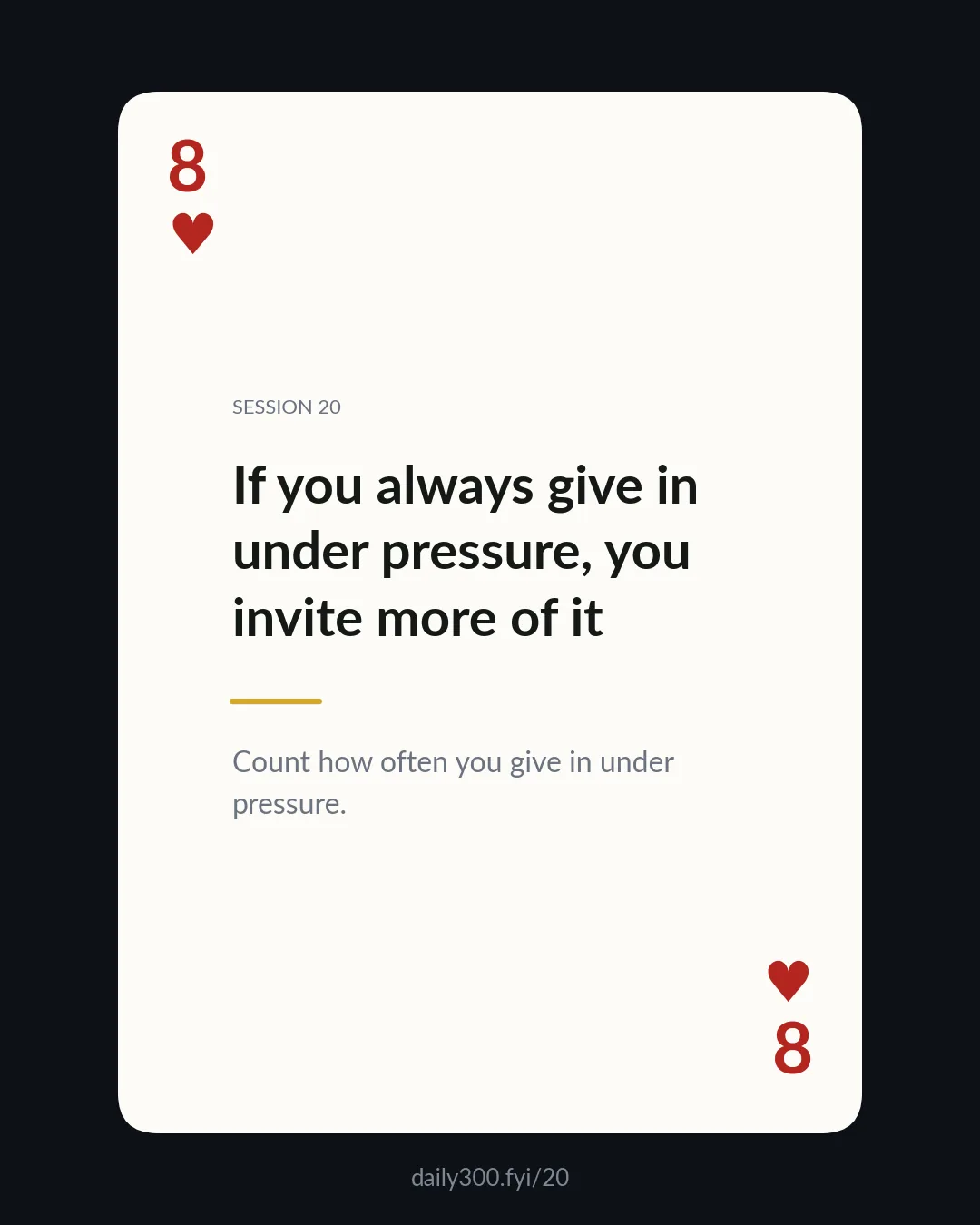
If you always give in under pressure, you invite more of it

Mark Zavadsky. Launched AliExpress in Russia, ran Sberbank's ecosystem, headed the studio behind Smeshariki and Fixiki, now iGaming and investing.
The idea
In half an hour, opponents pushed me 27 times when it was just the two of us; I gave in 19 times and never once pushed back. Five times they demanded more than was already on the table, and all five times I backed off. Imagine every one of those 27 pushes had nothing behind it. When I gave in, he would have taken everything on the table – $226. When I held my ground, he would have lost what he put in – $24. Net for him: +$202. And it isn't just today: over all 20 sessions I've analyzed, when someone pushed me one-on-one, I gave in 54 times out of 100; the other players at the same tables, in the same spot, 46.
Each concession on its own is easy to defend: by giving in, you save money and take no risk. But the person pushing is watching something else: how often you back down. If you give in more often than others do, you're the one it pays to push, and you'll be pushed more. Count how often you give in under pressure. Otherwise the other side will know the number before you do.
Below: a case with the same mechanics, and the hands the idea grew out of, with the arithmetic. Poker words are underlined – hover to see what they mean.
The case
In 2021, Cybereason, a company that sells protection against cyberattacks, commissioned a survey of 1,263 security professionals in seven countries. The subject was ransomware: software that encrypts a company's data and demands money for the key. Every company that paid was solving that week's problem – recovering its data and getting back to work. But 80% of those who paid were hit a second time, and nearly half of them believed it was the same attackers.
A year later, the survey was repeated with 1,456 professionals. Once more, nearly 80% of those who paid were hit again, and in more than two-thirds of the repeat attacks the ransom was higher than the first time. The survey was funded by a security vendor, which is worth keeping in mind. But the mechanism needs no survey: by paying, a company announces that it pays.
The analysis
Today's 27 spots are post-flop moments when only the two of us were left in the hand and he bet first: 19 folds, 8 calls, not a single raise. On the turn and river I folded 9 times out of 10. Five bets were bigger than the pot: on the turn $15 into $10.80, $10.50 into $7.30, and $12.21 into $8.14; on the river $59.52 into $22.50 and $154 into $30.50 – and I folded to all five. Across all 20 sessions I've analyzed, I fold to bets of 125% of the pot or more 86% of the time; the other players at the same tables fold 71% of the time.
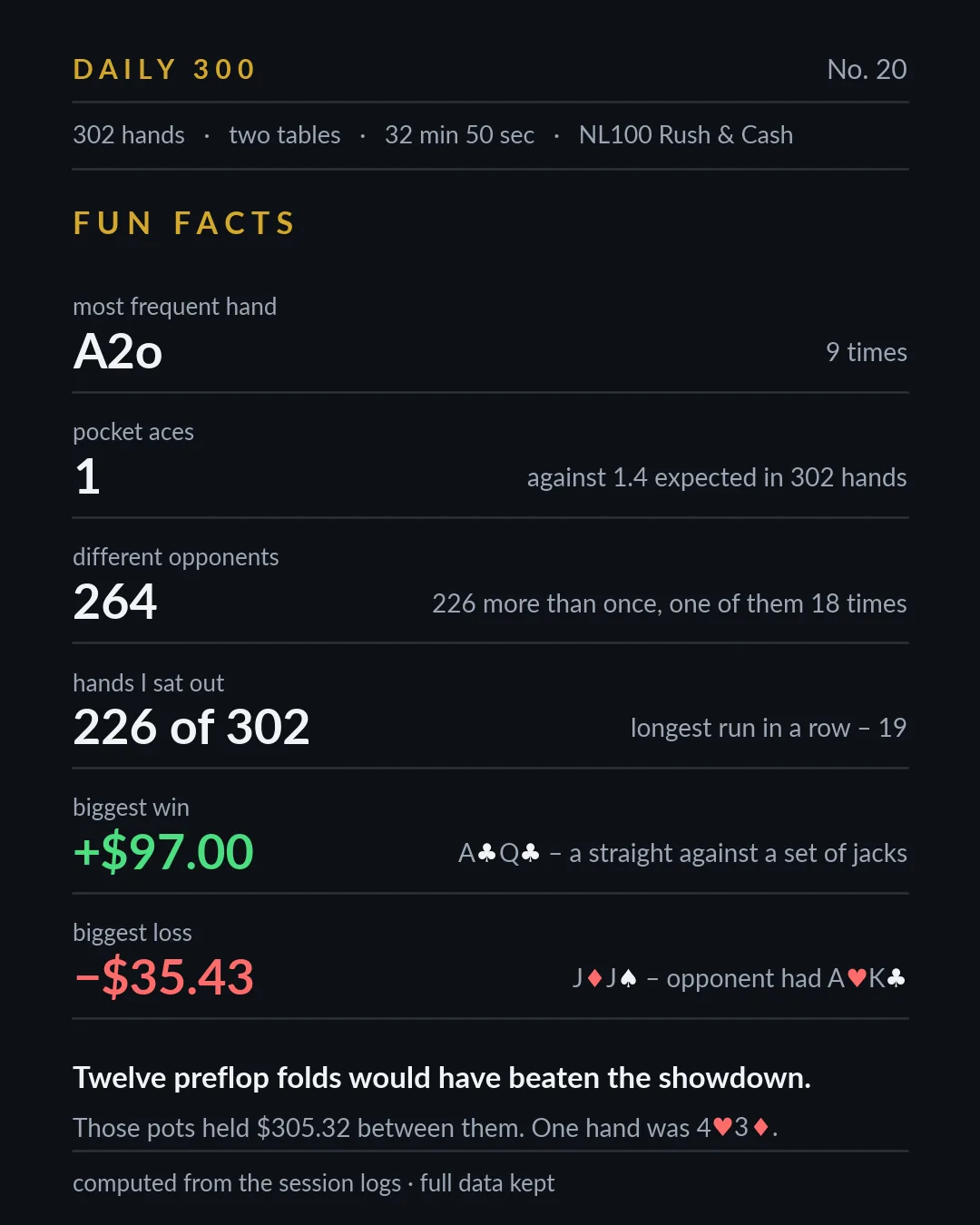
Were those folds mistakes? A call pays if I win more often than the price requires, and how often I win depends on what my opponent bets with. I can't see his cards, but I can see what the rest of the player pool bets with: in an archive of 70,000 hands I measured how often bets on each street, at each size, are made with nothing at all. Using that share, I built his range for every fold in two versions – a moderate one and a tight one in which, apart from those empty-handed bets, he bets only hands that beat me – and compared my chances with the price. Thirteen of the 19 folds were correct, including four of the five against bets bigger than the pot. Three were mistakes, all on the flop and all against bets of a third of the pot or less: with ace-queen, ace-seven, and king-queen, I folded rather than call $1.38 to $5.78 when winning one time in five or six would have been enough. Three have no verdict, and one of them is the hand of the day.
A♠T♣: top pair and a $6.78 fold
Preflop
- under the gun fold
- I raise to $2
- cutoff call $2
- button fold
- small blind fold
- big blind call $1
The hand of the day: I fold a pair of aces to a $6.78 bet. A♠T♣ in middle position (MP). I raise to $2; the cutoff (CO) and the big blind call.
Flop
Pot $6.50- big blind check
- I bet $2.15 · 33% pot
- cutoff fold
- big blind raise to $8.05 · ×3.7
- I call $5.90
The flop comes Q♦ 2♦ A♥: I have a pair of aces, with a ten as my second card (the kicker). The big blind checks, and I bet $2.15 (33% of the pot): I want calls from worse aces and from hands that still need a card. The cutoff folds, the big blind raises to $8.05, and I call.
Turn
Pot $22.60- big blind bet $6.78 · 30% pot
- I fold
The turn is the K♦, a third diamond. If he raised the flop with two diamonds, he now has a flush; with jack-ten, a straight. He bets $6.78 (30% of the pot). A call pays if I win at least 19% of the time: I'd be putting in $6.78 to win $36.16. I fold. Whether that was right depends on one thing: what he raises the flop with. If it's only two pair or better, I estimate my chances at 17% to 21%, right around the price. If his raises include hands that still needed a card on the flop – two diamonds, jack-ten – I estimate about 39%, and folding is wrong. I never saw his cards. His turn bet was smaller than his flop raise – light pressure – and I gave in to it: −$10.05.
The day ends at +$30.60. Of 19 folds, 13 were correct, three were mistakes, and three have no verdict; all three mistakes came against bets of a third of the pot or less. So I gave in not only to heavy pressure but to light pressure too. At the poker table, how often I fold is hard to notice: in Rush & Cash, the table reshuffles after every hand. In a negotiation, everyone sees it, and every concession invites a harder push.
Session cards
The best sessions in your inbox, once a week.