Session 19 · 306 hands · 2 tables · 31:59
The most surprising thing about a result is rarely what caused it

Mark Zavadsky. Launched AliExpress in Russia, ran Sberbank's ecosystem, headed the studio behind Smeshariki and Fixiki, now iGaming and investing.
The idea
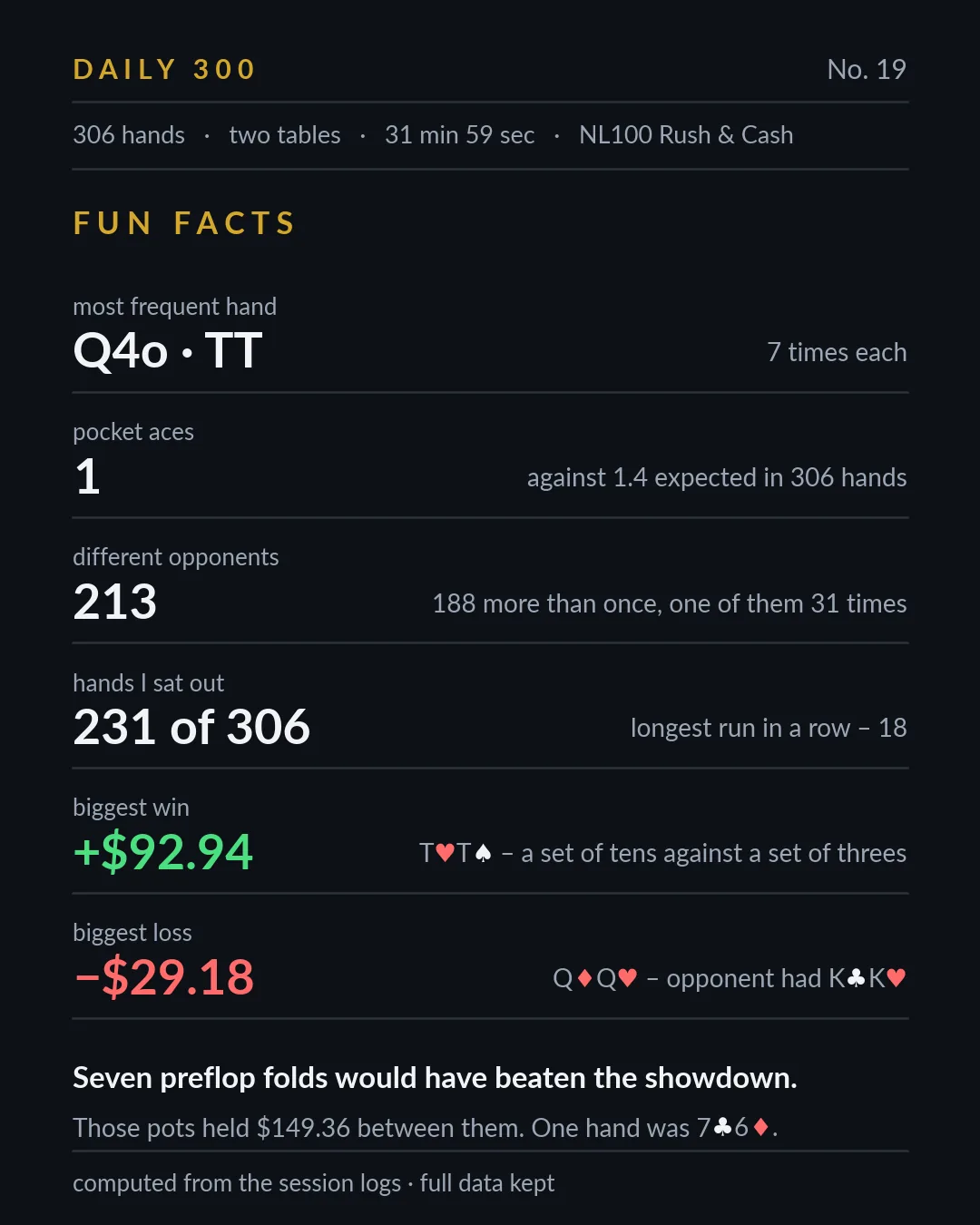
In half an hour of play I was dealt the same strong pair, two tens, seven times. Over that stretch it normally shows up once or twice, and seven or more happens in about one session in 1,800. Those seven hands made me $142 on a day that finished at $83. The easy story is that I got lucky with tens. But at my average for the year, seven pairs of tens are worth about $12. And today all the money they made came from two hands: +$146, with the other five at −$4.
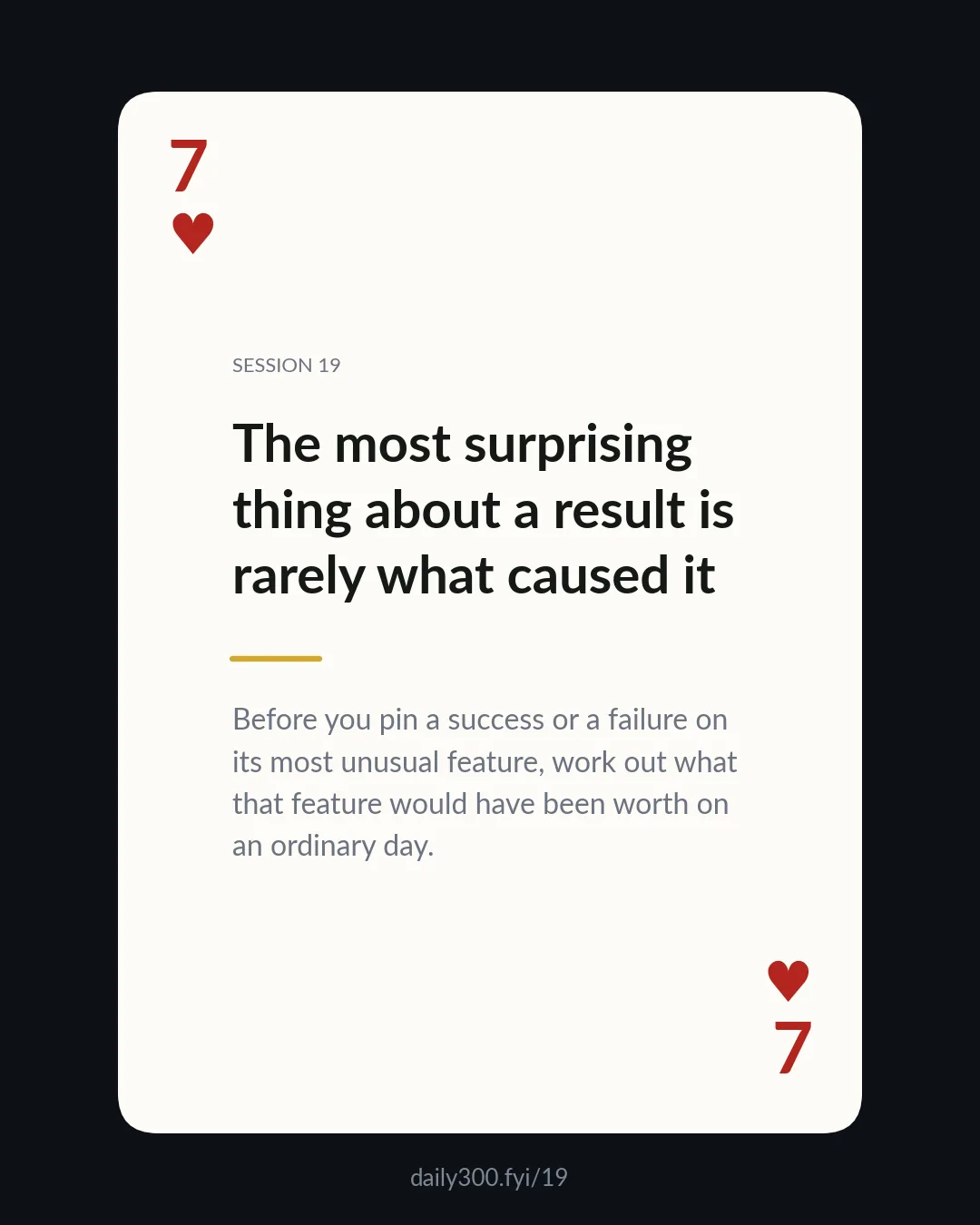
The most surprising fact is always the first thing we reach for as an explanation: it's easy to notice and hard to forget. But an event's rarity tells you how often it happens, and nothing about what it actually means for you. Before you pin a success or a failure on its most unusual feature, work out what that feature would have been worth on an ordinary day. It usually comes to little, and the real cause is duller and sits right next to it.
Below: a case with the same mechanics, and the hands the idea grew out of, with the arithmetic. Poker words are underlined – hover to see what they mean.
The case
Starting in 2000, the Bill & Melinda Gates Foundation, along with other large foundations, put hundreds of millions of dollars into small schools. The argument looked convincing: small schools were overrepresented among the best. Statistician Howard Wainer checked it against fifth-grade reading scores from 1,662 Pennsylvania schools: of the top fifty, six were among the smallest – four times what you'd expect if size made no difference.
But among the fifty worst schools, the smallest were even more common: nine. A small school has few students, so its average moves further in both directions and lands at either extreme more often. Size told you how widely a school's results could vary, but not how good the school was. In his 2009 annual letter, Gates wrote that many of the small schools the foundation had invested in had failed to improve student achievement in any significant way.
The analysis
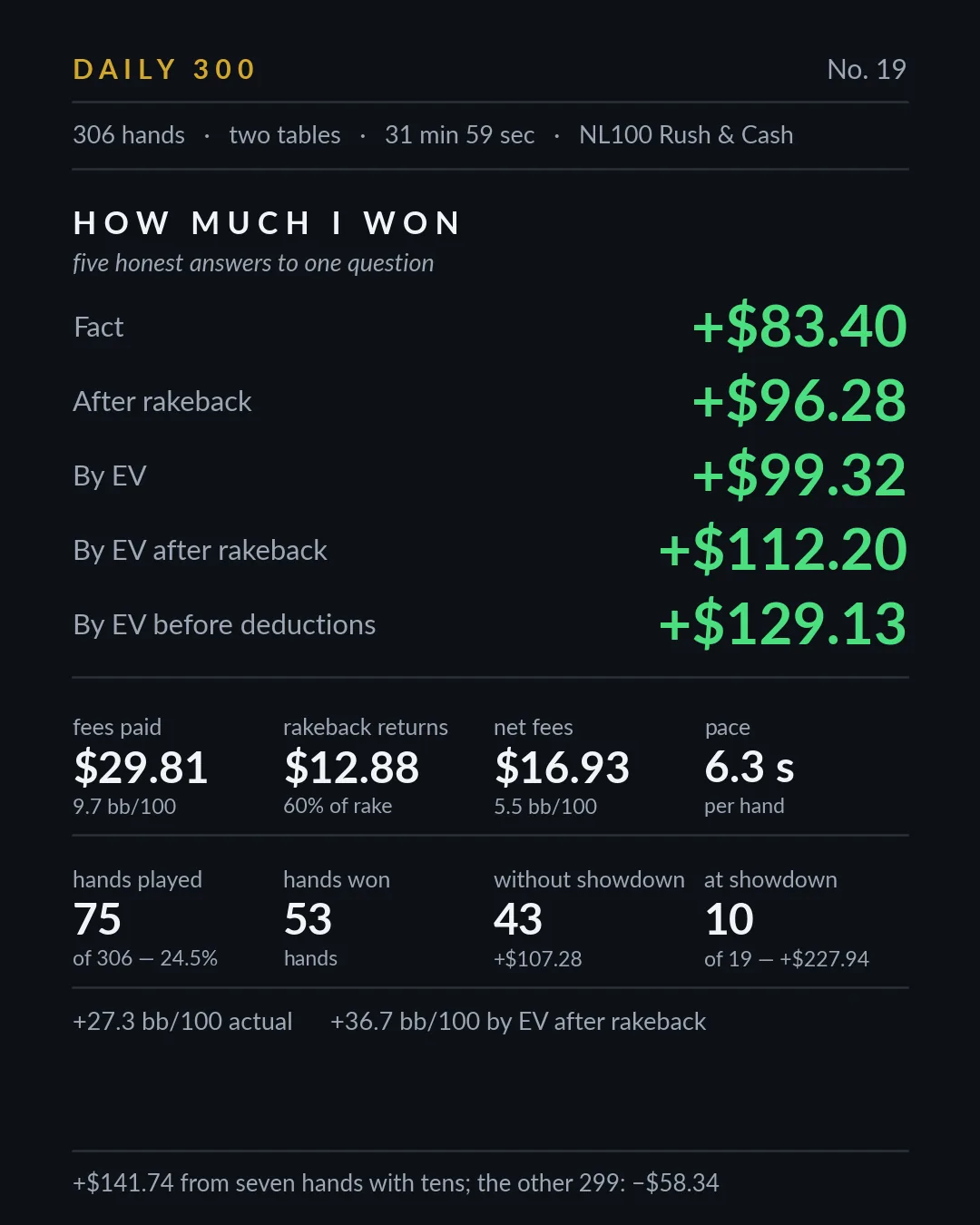
I was dealt tens in seven hands out of 306. Any given pair is dealt once every 221 hands, so the expected count was 1.4, and seven or more in 306 hands happens in about one session in 1,800. At my 2026 average (164 hands with tens, +$1.77 apiece), seven of them are worth about $12. So can they explain the result? I can run the same check on all 306 hands at once: add up what I win on average with each starting hand I was dealt and compare it with what ordinary cards would have been worth. The difference is about $9: the cards ran slightly better than usual today, but that doesn't explain a result of $83. It's only a rough estimate: anywhere from −$8 to +$30. Today the seven hands with tens made +$141.74, and the other 299 came to −$58.34.
All of that $141.74, and then some, came from two hands, the two biggest wins of the day: +$53.27 and +$92.94, $146.21 combined. The other five hands with tens came to −$4.47. One of them was the very first hand of the session: the button raises to $2.90, the small blind, with a short stack, moves all in on top of that, I move all in from the big blind, and the button folds. The small blind has jack-ten suited. I'm a 61.31% favorite – a winner by EV, −$16.65 in reality. That hand and the $92.94 one account for the gap between the actual result and EV: +$20.21 and −$4.29. In every session breakdown, the EV adjustment removes luck only when the money is already in and the cards are face up: I work out who was the favorite and by how much. Luck in the cards I'm dealt is something it can't touch. Today, as shown above, it was small: about $9.
T♠T♥: a turn check and a pot-sized river bet
Preflop
- under the gun raise to $2
- middle position fold
- cutoff fold
- button fold
- I raise to $11 · ×5.5
- big blind fold
- under the gun call $9
The hand of the day. T♠T♥ in the small blind. The player under the gun – first to act before the flop – raises to $2, and everyone folds to me. I reraise to $11: after the flop I'll have to act first, which is a disadvantage, so I want the pot big now and only one opponent in it. The big blind folds, he calls.
Flop
Pot $23- I bet $7.59 · 33% pot
- under the gun call $7.59
The ace is dangerous: he could easily have called my raise with one. I bet $7.59 (33% of the pot), he calls.
Turn
Pot $38.18- I check
- under the gun check
A third spade on the board. All I have is a pair of tens, and any ace in his hand beats me. But I hold the T♠: any of the nine remaining spades gives me a flush – five cards of one suit – and any of the three sevens that aren't spades gives me a straight, six through ten – twelve cards out of forty-six. I raised before the flop and bet the flop, but here I check. In theory, you almost always check tens here: I ran this turn through a solver with two versions of the ranges – two estimates of which hands each of us could hold here. A bet would build the pot precisely when he has an ace and I'm behind. He checks too. He has A♦6♦, two pair, aces and sixes, which beats me. In theory, after my check, he checks this hand back 98.5% of the time: it gives me a free card, but keeps his money out of the pot on a board where I may already have a flush.
River
Pot $38.18- I bet $38.18 · 100% pot
- under the gun call $38.18
I have a straight, six through ten. Only a flush or jack-ten beats it, and by my estimate fewer than two in a hundred of his possible hands are one of those by the river. I bet $38.18, a pot-sized bet. Theory mostly bets a third of the pot here; a pot-sized bet comes up 0 to 16% of the time, depending on the version of the ranges. He calls with two pair. Plus $53.27. There's no way to know what he read into my turn check.
T♥T♠: set over set
Preflop
- under the gun raise to $2
- I raise to $7 · ×3.5
- cutoff fold
- button fold
- small blind fold
- big blind fold
- under the gun call $5
The biggest win of the day. T♥T♠ in middle position. The player under the gun raises to $2, I reraise to $7, he calls.
Flop
Pot $15.50- under the gun check
- I bet $7.75 · 50% pot
- under the gun call $7.75
I have a set – three tens – and nothing on this board beats it. I bet $7.75 (50% of the pot), he calls.
Turn
Pot $31- under the gun check
- I bet $23.25 · 75% pot
- under the gun raise to $81.19 · ×3.5
- I call $57.94
I bet $23.25 (75% of the pot), and he moves all in for $81.19. The call pays off if I win at least 30% of the time; against his set of threes, 3♦3♠, I win 97.73%. I call.
River
Pot $193.38Plus $92.94. There was almost nothing for me to decide in this hand.
The day ends at +$83.40, +$99.32 by EV. The most unusual thing about the session was seven pairs of tens, but at my average they were worth about $12. I won $146.21 in two hands: in one my set of tens ran into a set of threes, in the other I checked the turn and made a straight on the river. Had I put this day down to the tens, I'd have remembered a stroke of luck worth almost nothing and never looked at the only things that were up to me: checking the turn and betting the pot on the river.
Session cards
The best sessions in your inbox, once a week.