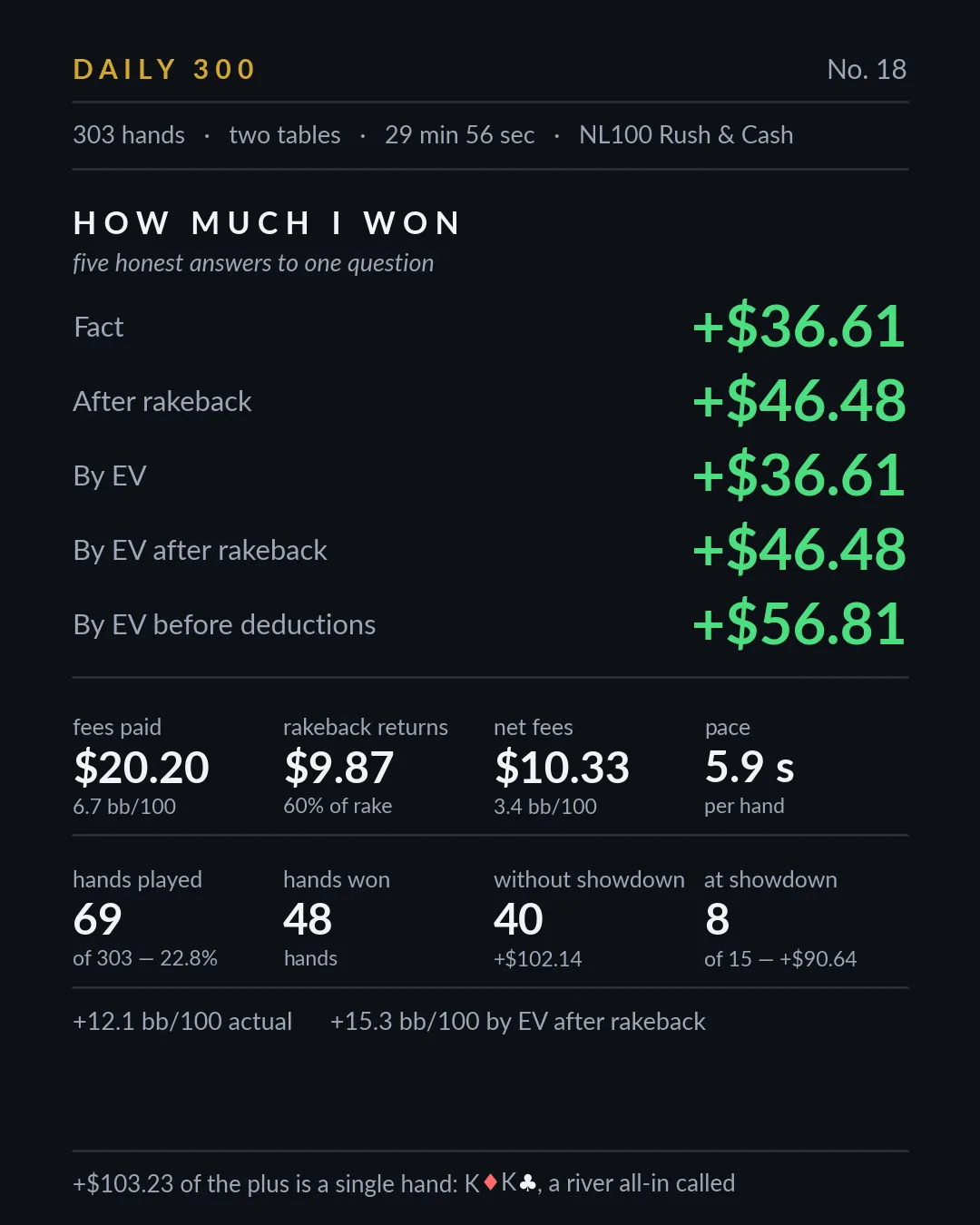
Session 18 · 303 hands · 2 tables · 29:56
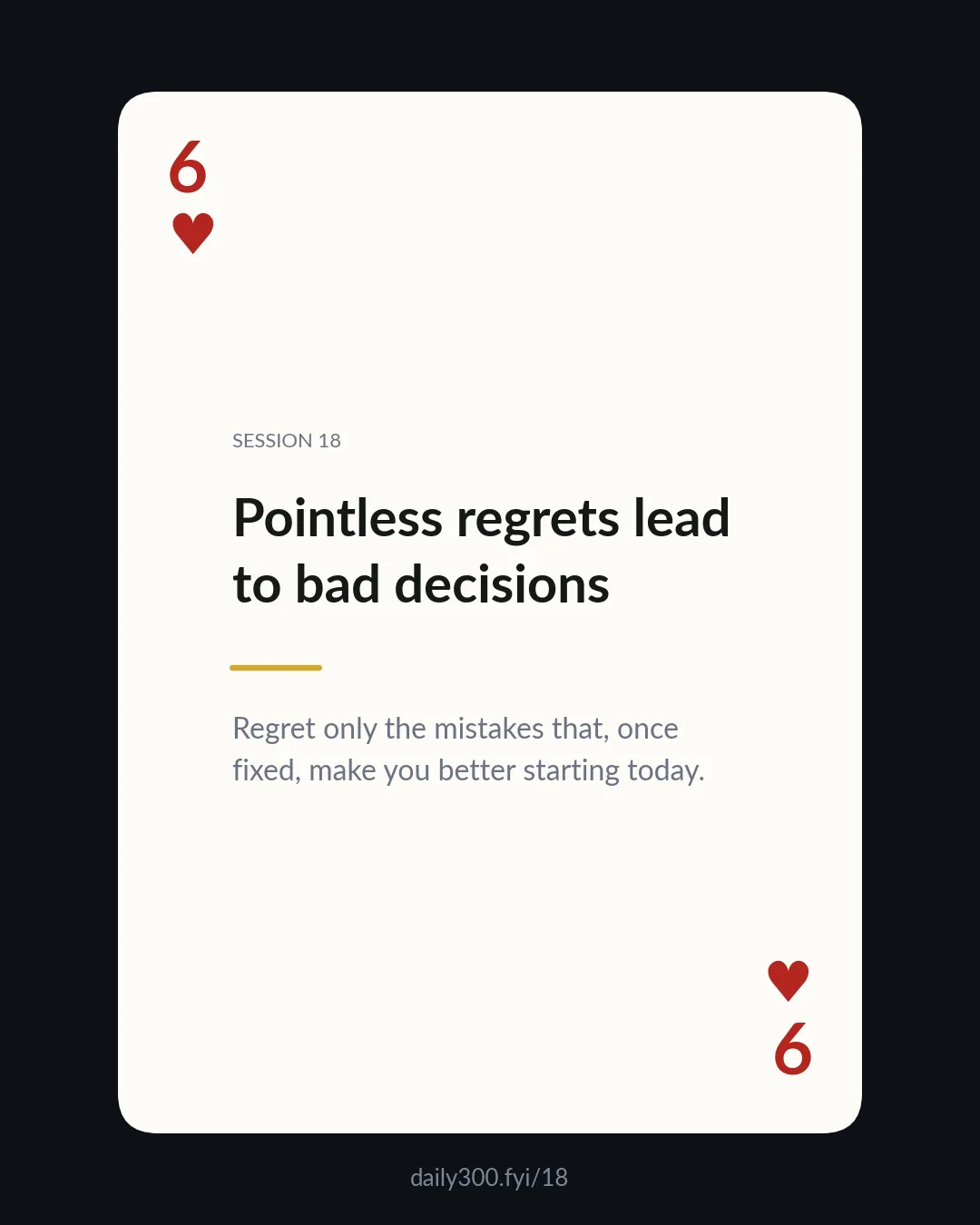
Pointless regrets lead to bad decisions

Mark Zavadsky. Launched AliExpress in Russia, ran Sberbank's ecosystem, headed the studio behind Smeshariki and Fixiki, now iGaming and investing.
The idea
The first reason to be upset: during the session I was up $114 and finished up $37. Across all 18 sessions analyzed so far, the high points add up to $1,336, and I took home one-eleventh of that. The second reason: over the whole series, 88 hands I folded right at the start could, in theory, have won me $2,208.
In hindsight you can always find a path that would have paid more, but that kind of thinking is pointless, counterproductive, and leads to false conclusions. The best moment to stop only becomes visible once it's all over. And out of everything you turned down, what you remember is whatever happened to hit. Jorge Luis Borges wrote a story, "The Garden of Forking Paths," about a novel whose hero, at every fork, takes all the paths at once. In life you walk one path, and you only see the others when you look back. Compare yourself with what you could have chosen then, not with what you can see now. Regret only the mistakes that, once fixed, make you better starting today.
Below: a case with the same mechanics, and the hands the idea grew out of, with the arithmetic. Poker words are underlined – hover to see what they mean.
The case
J.P. Morgan's annual retirement guide includes a simple calculation: what would have happened to $10,000 invested in the 500 largest US companies. Stay invested from the start of 2006 to the end of 2025 and it grows to $80,619 – 11% a year. Miss just the ten best days of those twenty years and you end up with $35,866 – less than half.
Picking those days in advance is close to impossible: six of the ten best days fell within two weeks of one of the ten worst, and five of those six came after one of those worst days. The second-worst day of 2020, March 12, was immediately followed by the second-best. Selling after a crash meant risking the rebound: the best moment to exit only shows up on the finished chart.
The analysis
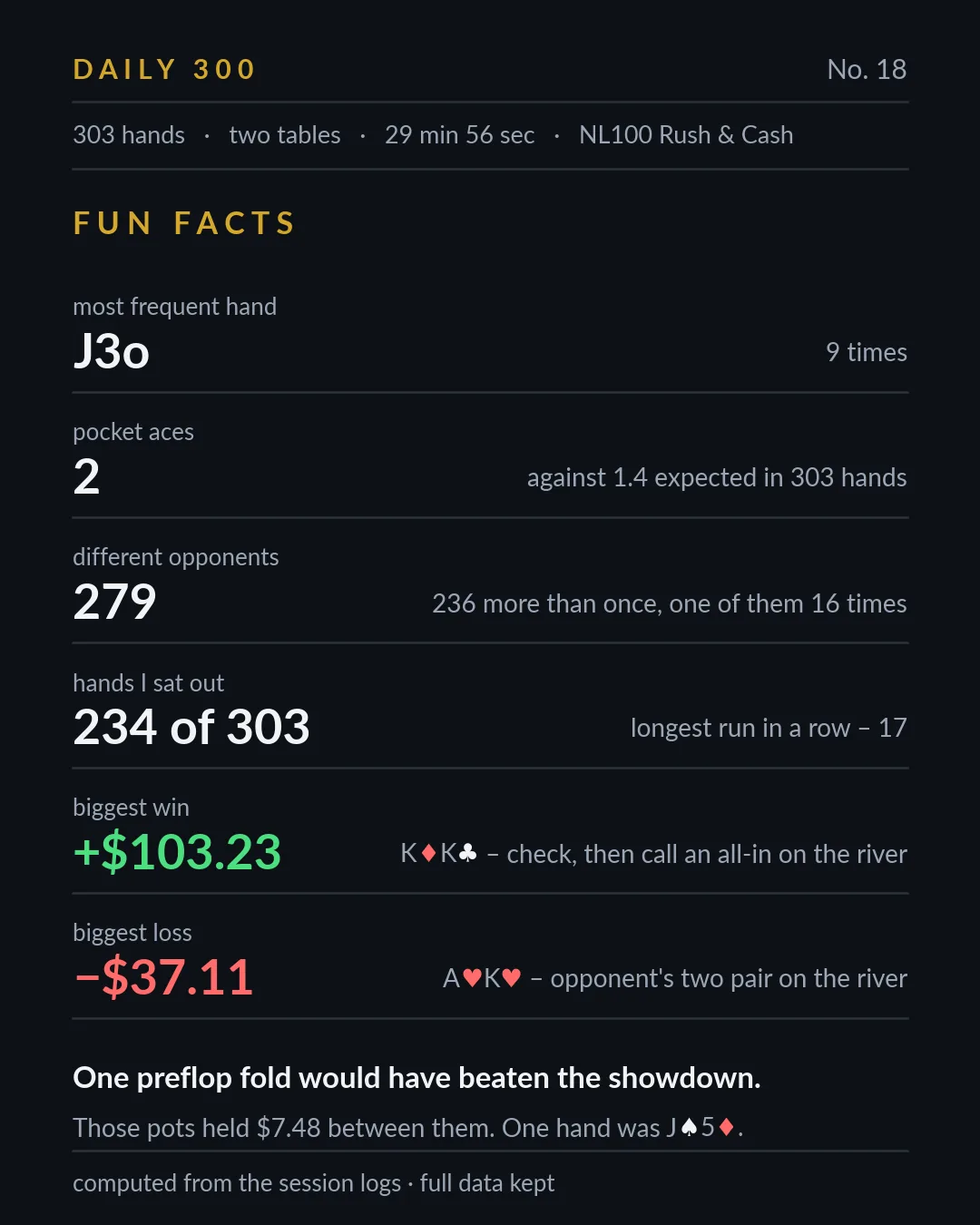
Today the peak came at hand 57: +$114.28. After that it leaked away: the remaining 246 hands came to −$77.67. The damage came from three hands with strong cards: suited ace-king and pocket queens twice, −$37.11, −$32.88, and −$29.06, −$99.05 in all. In two of them I folded to a big bet on the river; in the third we both checked the river, and his two pair beat my ace-king, which had nothing but the pair of queens on the board. The other 243 hands after the peak made +$21.38.
Could I have recognized the peak at the time? I ran the numbers on all my 2026 sessions of 150 hands or more – 91 of them. The peak most often lands at the very start or the very end: in the first tenth of the session 20% of the time, in the last tenth 17%. Shuffle the same hands into random order and you get 26% and 15%: that is simply where the maximum of any random sequence tends to fall. And I don't play worse after the peak, at least not judging by how often I enter pots and raise. When I was $75 or more below my high, I entered 22.8% of pots and raised 15.4%; when I was below it, but by less than $25, 23.4% and 16.7%. In results, I was 14 big blinds per 100 hands worse in those drawdowns, but that's within random variation: at this sample size a difference only starts to mean something at around 22 big blinds.
The second path is the hands I folded. Today there was one such hand: jack-five, folded before the flop, would have won a $7.48 pot at showdown. Across all 18 sessions there are 88 such hands, and that number sits on every fun-facts card. But those are only the winners. There were 416 hands where I folded before the flop without putting in anything beyond a blind, all five board cards were dealt, and someone showed their cards; in 321 of them, 77.2%, my cards would have lost. And those pots were built without me: had I been in the hand, the betting would have gone differently.
K♦K♣: a river check and an all-in call
Preflop
- under the gun call $1
- middle position fold
- cutoff fold
- button call $1
- I raise to $10
- big blind fold
- under the gun fold
- button call $9
The hand of the day. Nearly all of that peak came from a single hand, number 48: K♦K♣ in the small blind. The player under the gun – first to act before the flop – and the button both limp in, just calling the big blind instead of raising. I raise to $10, the button calls, everyone else folds.
Flop
Pot $22- I bet $11 · 50% pot
- button call $11
I have an overpair – kings, higher than any pair this board can make. But the queen and the ten are close in rank, so someone holding, say, jack-nine, king-jack, or nine-eight is one card away from a straight. I bet $11 (50% of the pot), he calls.
Turn
Pot $44- I bet $22 · 50% pot
- button call $22
I bet $22 (50% of the pot), he calls again.
River
Pot $88- I check
- button bet $87.75 · 71% pot
- I call $62.73
And now anyone holding ace-deuce, deuce-six, or six-seven has a straight. The pot is $88 and I have $62.73 left. I check. Theory says bet: I ran this river through a solver with two versions of my range – two estimates of which hands I could have here – and in both, kings always bet, usually all in, and never check. My check is a departure from theory. The button moves all in for $87.75 – more than I have left, so calling costs me my last $62.73. The call pays off if I win at least 30% of the time. What could he have to play the hand this way – limp, call my raise, and call two bets? By my estimate, between 3 and 15 of his possible hands beat me: a set – three of a kind made with a pocket pair – of fives, threes, or fours, and queen-ten for two pair. A straight is all but ruled out: with ace-deuce, deuce-six, or six-seven he had nothing on the flop, and players rarely call my bet there with those. Hands that end the river with no pair at all are more common in his range, 20 to 34 combinations, and my call pays off if he moves all in with at least 6–23% of them. In theory, after checking, you always call here with kings. I call. He has J♣9♣ – one of the straight draws from the flop, and it missed: he doesn't even have a pair. Plus $103.23. Nine hands later I'm up $114.28 – I won't get any higher this session. The peak I'm later tempted to measure from was built on a move theory doesn't make and on an opponent's all-in with no pair. There's no way to know what he read into my check.
The day ends at +$36.61, the same by EV. From the peak I'm down $77.67; from the start I'm up $36.61. I couldn't have quit at hand 57, and I couldn't have picked out only the winners among the hands I folded: the peak shows only once the session is over, and the winners only at showdown. Regret the peak, and I'd chase it for the rest of the session; regret the folds, and I'd start playing those hands. Of the things worth fixing, this session turned up only one: checking the river with kings. In theory it's worth $1 to $1.50 less than a bet on average; this time it made me $63 more. Both river folds with queens were, by my estimate, correct.
Session cards
The best sessions in your inbox, once a week.