Session 17 · 303 hands · 2 tables · 31:25
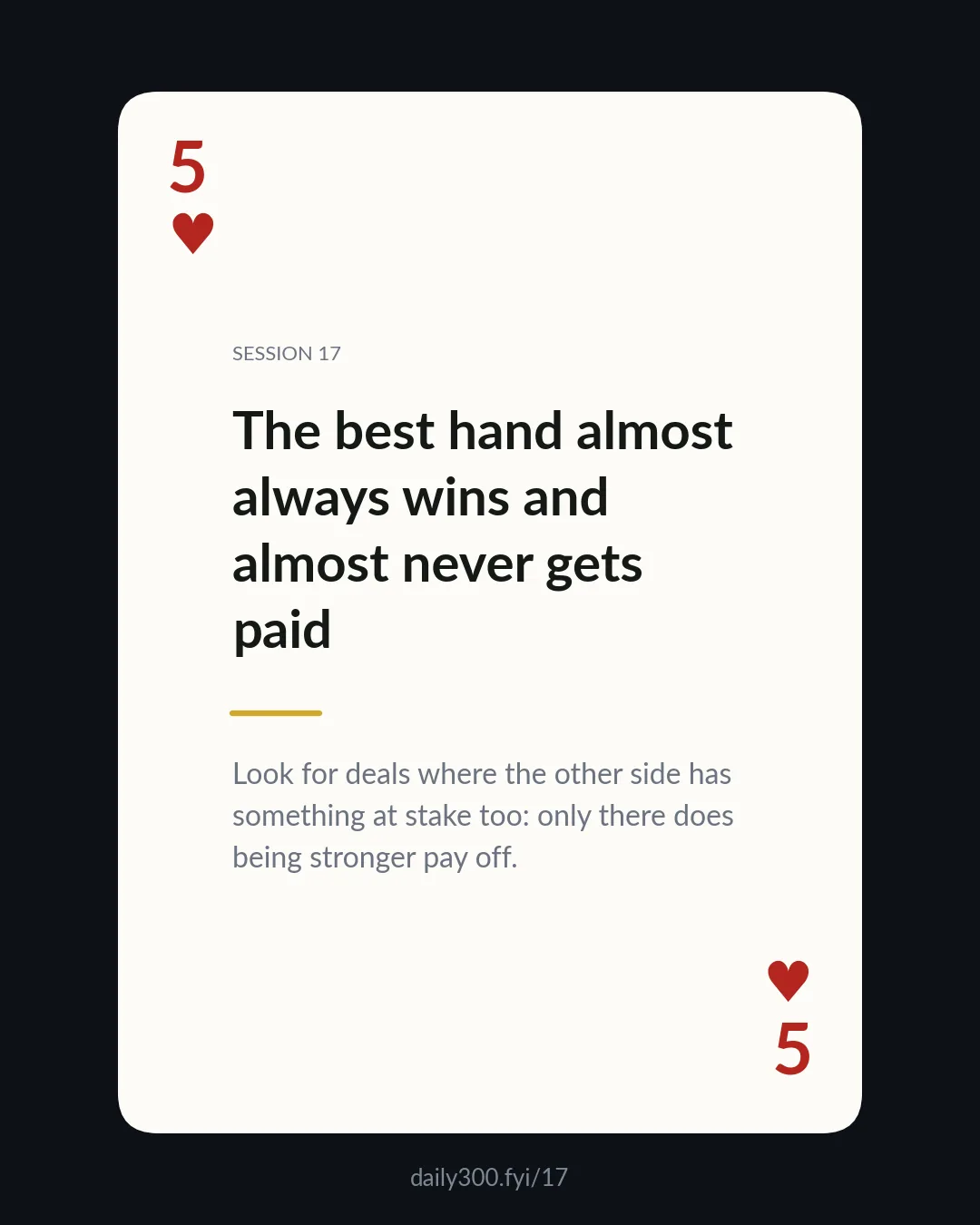
The best hand almost always wins and almost never gets paid

Mark Zavadsky. Launched AliExpress in Russia, ran Sberbank's ecosystem, headed the studio behind Smeshariki and Fixiki, now iGaming and investing.
The idea
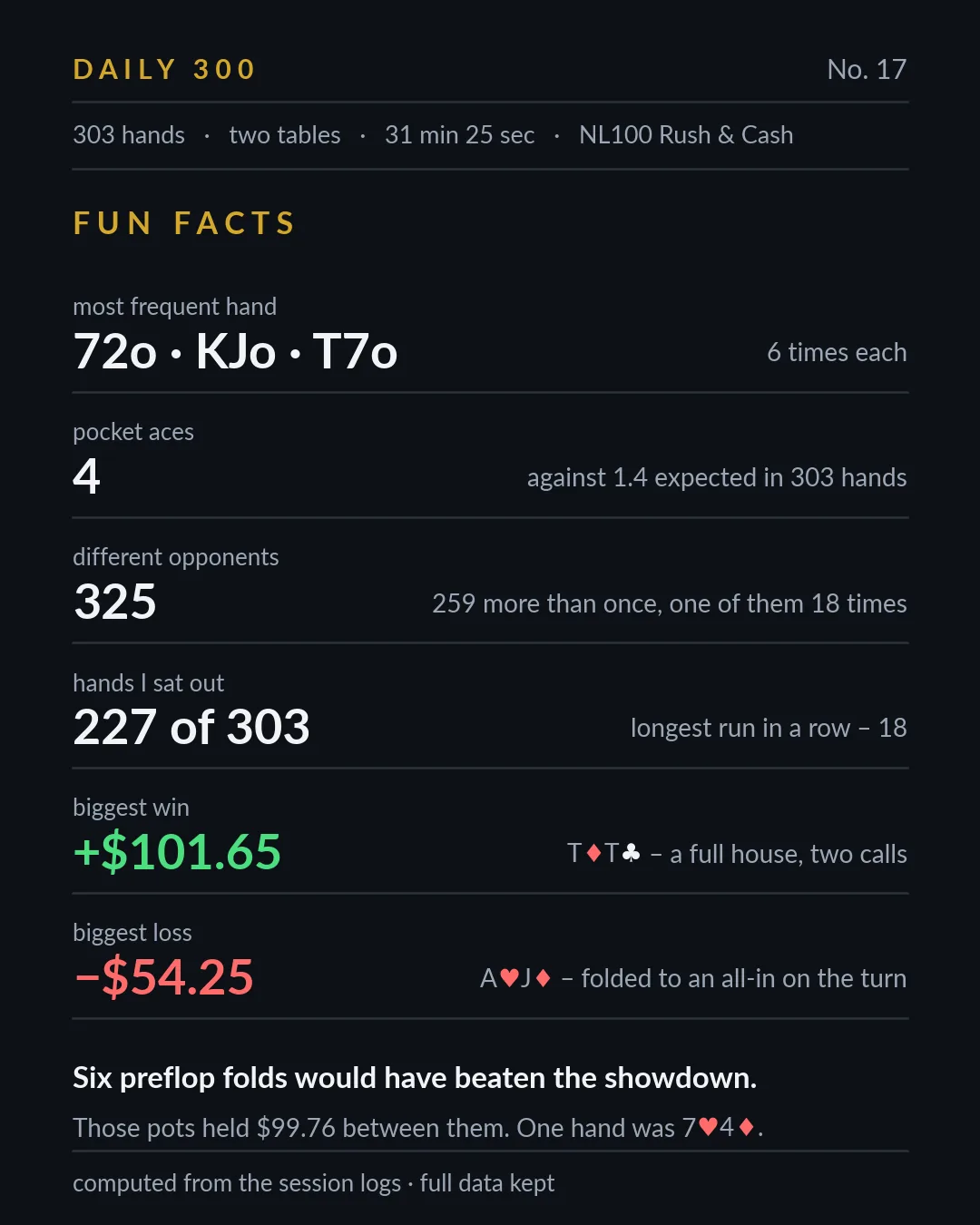
I was dealt pocket aces – the best starting hand in poker – four times in half an hour, nearly three times as often as I should have been. I won all four hands and made $26 on them. I won the biggest pot of the day, +$102, with pocket tens. Since the end of 2023 I have been dealt aces 278 times and won 257 of those hands. But in half of those 278 hands I made less than four dollars. I made four-fifths of my net result with aces in just 25 hands, each worth more than fifty dollars of other players' money.
When you're obviously the stronger party, you almost always win, but precisely because it is obvious, nobody argues with you. And you partly set this up yourself: if the key resource is yours, the other side doesn't have it and has nothing to bargain with. Look for deals where the other side has something at stake too: only there does being stronger pay off.
Below: a case with the same mechanics, and the hands the idea grew out of, with the arithmetic. Poker words are underlined – hover to see what they mean.
The case
In 1984 the economists George Priest and Benjamin Klein published a paper in the Journal of Legal Studies on which disputes go all the way to a verdict. Their finding: when the outcome is clear to both sides, the parties usually settle – there is nothing to fight about. The cases that reach trial are the ones where each side expects to win, and so plaintiffs win at trial roughly half the time, whatever the law says.
Forty years later the Yale Journal on Regulation ran a full-length review of the idea. If you are plainly in the right, the other side settles quickly and cheaply: it has no real case. Courts hand out big awards in cases where both sides have a real argument and both risk losing.
The analysis
T♦T♣: a full house and two calls
Preflop
- I raise to $2
- middle position fold
- cutoff fold
- button fold
- small blind raise to $9 · ×4.5
- big blind fold
- I call $7
The hand of the day. T♦T♣ under the gun (UTG): I'm the first of six players to act, and everyone else decides after seeing what I do. I raise to $2, the small blind re-raises (3-bets) to $9, and I call.
Flop
Pot $19- small blind check
- I bet $9.50 · 50% pot
- small blind call $9.50
I have top set, the strongest three of a kind possible, but the board is dangerous – a straight is already possible, and anyone holding two hearts is one card away from a flush. He checks, I bet $9.50 (50% of the pot), he calls.
Turn
Pot $38- small blind bet $28.50 · 75% pot
- I call $28.50
And I have a full house: tens full of nines. Now he bets: $28.50 (75% of the pot). This is the key decision of the hand – raise or just call. Raising is tempting: my hand is close to the best possible. But raising shows strength, and after a raise the only players who stay in are the ones who beat me or come close. I call. I ran this spot against two versions of his range – two estimates of the hands he could be holding – and in theory, with my hand, the right play here is to call every time and never raise.
River
Pot $95- small blind bet $58.15 · 61% pot
- I call $58.15
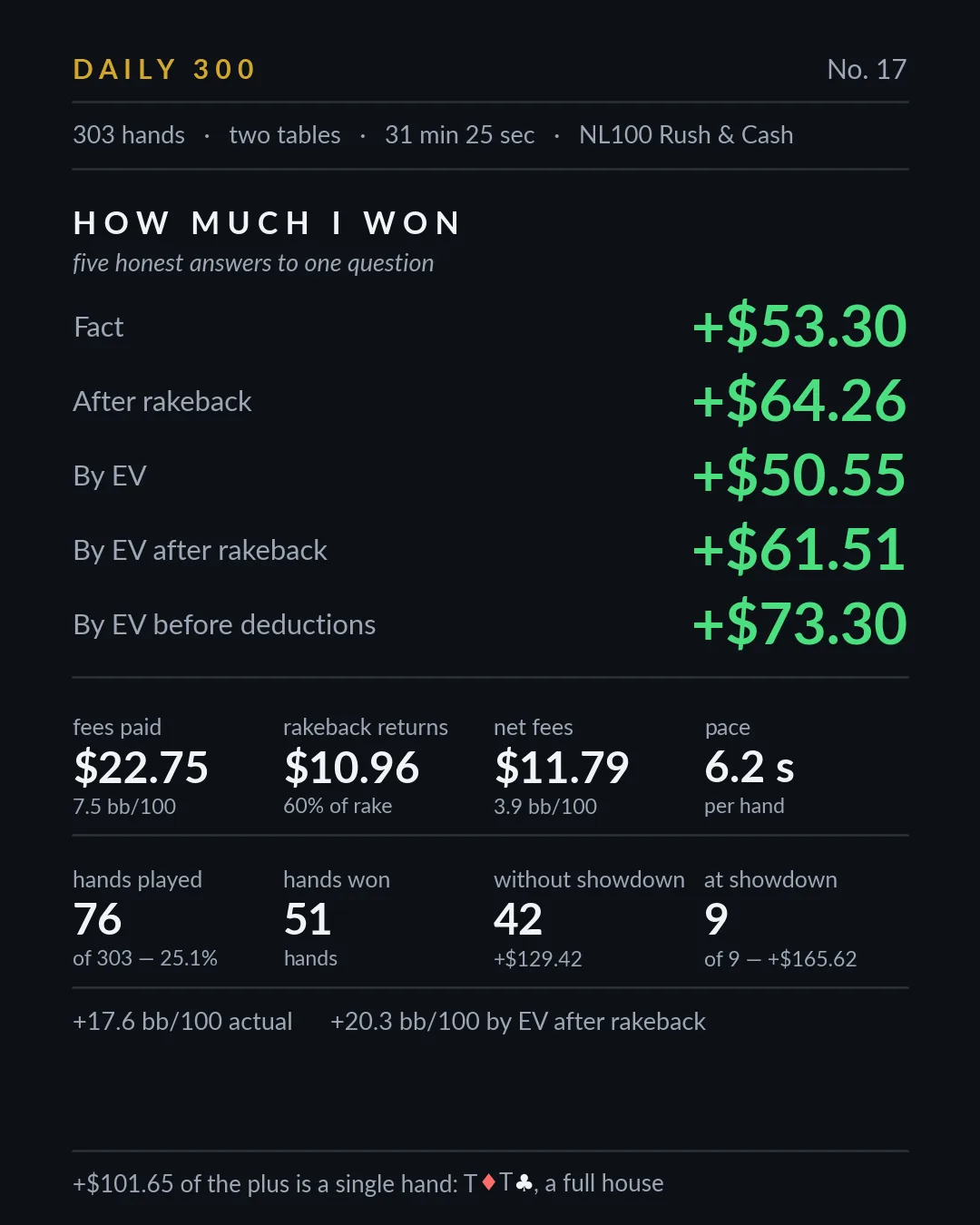
He moves all in for $58.15 (61% of the pot). What could he be holding to play it this way – re-raise preflop, call the flop, bet three-quarters of the pot on the turn? By my estimate, about half the time it is kings or queens, then suited king-queen and king-jack, pocket aces, ace-queen, and ace-jack. Of all of that, only pocket nines beat me – he'd have made four of a kind on the turn – but with four nines, players almost never bet the turn like that: in theory less than once in a thousand. Even if the river had given him a heart flush, he would still have lost to my full house. I call. He shows K♠Q♠: no pair of his own, only the nines on the board. On the flop he would have won 13.7% of the time against my tens; after the turn there was no river card he could win with. Plus $101.65.
This hand is the flip side of the aces story. He never put me on a hand that strong: on the turn and river I only called, and after the turn, already drawing dead – no card could save him – he put in $86.65. What he thought I had cannot be checked; from his bets it looks like he was trying to push me off the pot.
A♦A♠: all-in, he folds
Preflop
- under the gun fold
- middle position fold
- I raise to $2.50
- button fold
- small blind raise to $7 · ×2.8
- big blind fold
- I raise to $227.96 · ×32.6
- small blind fold
With aces, meanwhile, I won $26.18 across four hands. Twice an opponent re-raised me, I raised again, and he folded right away: +$14.13 and +$7.25, the second time after I'd moved all in before the flop. Once everyone folded to my big blind, +$0.50. And once an opponent took two pair, fives and eights, all the way to showdown, and it cost him little: +$4.30.
Part of why I make so little with aces is simple arithmetic. Among the hands opponents have shown down at my tables since the end of 2023 – 15,592 of them – almost a third, 30.9%, contain exactly one ace: ace-king, ace-queen, ace-anything. When I hold two of the four aces, each of those hands is exactly half as likely to be in my opponent's hand. So I cut in half the one-ace hands he most likes to play and keep calling with. By my estimate, the ranges opponents open with or defend the big blind with shrink by 20–27% when I hold aces. When I raised first with aces, everyone else folded right away 47.2% of the time, compared with 42.8% for all my other first raises; the gap could be noise, but it points the same way.
Does the day's result depend on aces? My database has 87 days of 100 hands or more, and the correlation between the number of aces in a day and the day's result is close to zero: 0.11. With aces I win $11.96 a hand on average, and I should get them once every 221 hands – worth about $16 per 300 hands, while my 300-hand results swing with a standard deviation of about $100. Six of the seventeen sessions I have analyzed had no aces at all, and two of those were winning sessions. Three hundred hands without aces is routine: it happens in roughly one session in four.
The day closes at +$53.30; by EV, +$50.55. In four hands with aces I won $26.18, in one with tens $101.65: opponents read the aces as strong and got out of the way; the tens looked more modest, so my opponent kept putting his own money in. The best hand almost always wins, but you only get paid when the other side has something to stake too.
Session cards
The best sessions in your inbox, once a week.