Session 16 · 304 hands · 2 tables · 33:29
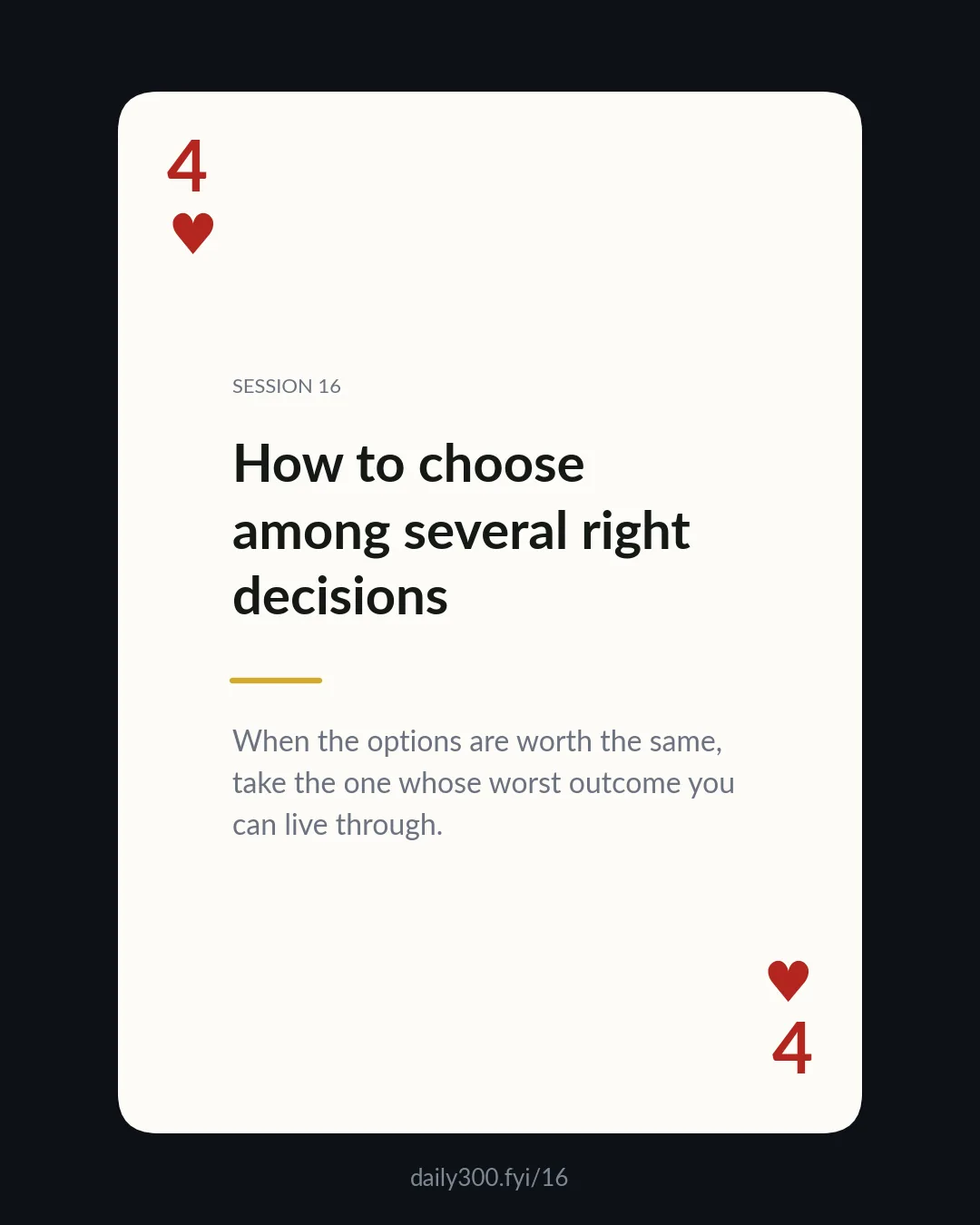
How to choose among several right decisions

Mark Zavadsky. Launched AliExpress in Russia, ran Sberbank's ecosystem, headed the studio behind Smeshariki and Fixiki, now iGaming and investing.
The idea
Twice in that half hour ace-king put me in the same spot, and both times I moved in for everything against a raise. It ended differently: +$13 the first time, −$88 the second. That is not the point. In theory I had three moves with the same positive expectation here – move all in, 4-bet smaller, or simply call. We are used to a decision being either right or wrong. Here three were right, and over three years in my database I have chosen all three.
When two options pay the same, being right stops deciding anything, and the choice is made on what you think about last: how much you can lose before being right starts paying, and who is stronger in the part that begins after your move. When the options are worth the same, take the one whose worst outcome you can live through.
Below: a case with the same mechanics, and the hands the idea grew out of, with the arithmetic. Poker words are underlined – hover to see what they mean.
The case
The economist Ignacio Palacios-Huerta went through more than 1,400 penalty kicks in professional soccer over five seasons, 1995–2000. The kick and the dive happen at the same moment: neither the taker nor the keeper sees what the other has chosen, and there is no second attempt. In a paper for the Review of Economic Studies he showed two things: the taker's scoring rate is statistically the same whichever way he shoots, and the sequence of his choices is indistinguishable from random.
So there is no "right corner." If one corner were better, more kicks would go there, the keeper would adjust, and the edge would be gone. The right thing is to alternate, and the individual kick is chosen on what the scoring table does not show: the stronger foot, the state of the field, and who is in goal. That is how you choose in any business where the options are worth the same: not by which one is right.
The analysis
A♠K♣: all-in, he folds
Preflop
- under the gun fold
- middle position fold
- I raise to $2.50
- button fold
- small blind fold
- big blind raise to $14 · ×5.6
- I raise to $140.78 · ×10.1
- big blind fold
The first time. A♠K♣ in the cutoff – two seats off the button – I raise to $2.50, the big blind makes it $14. I move in for $140.78; he has $100, and that is what is at stake. The point of the move is to take the $17 already in the pot without a showdown: against an all-in over their own 3-bet, the players in my database fold 78% of the time, though the sample is only 64 hands. If he calls, I am a small underdog, a bit over 40% by my estimate: he calls with pocket tens and up, ace-king, and ace-queen. He folds, +$13.08, and that hand leaves me $64.28 up – the peak of the whole half hour.
A♦K♦ against T♣T♠
Preflop
- under the gun fold
- I raise to $2
- cutoff fold
- button fold
- small blind fold
- big blind raise to $8 · ×4
- I raise to $107.39 · ×13.4
- big blind call $79.50
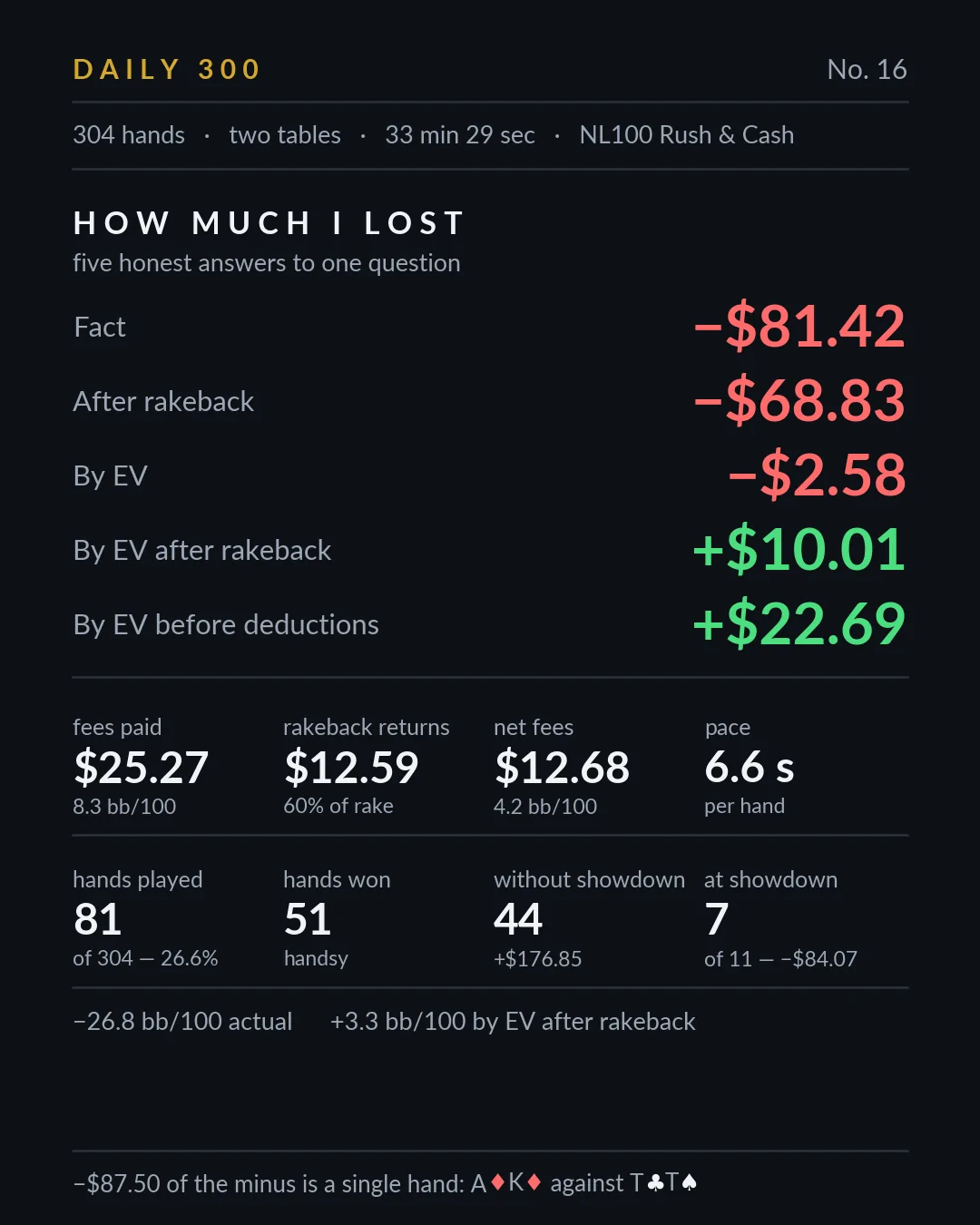
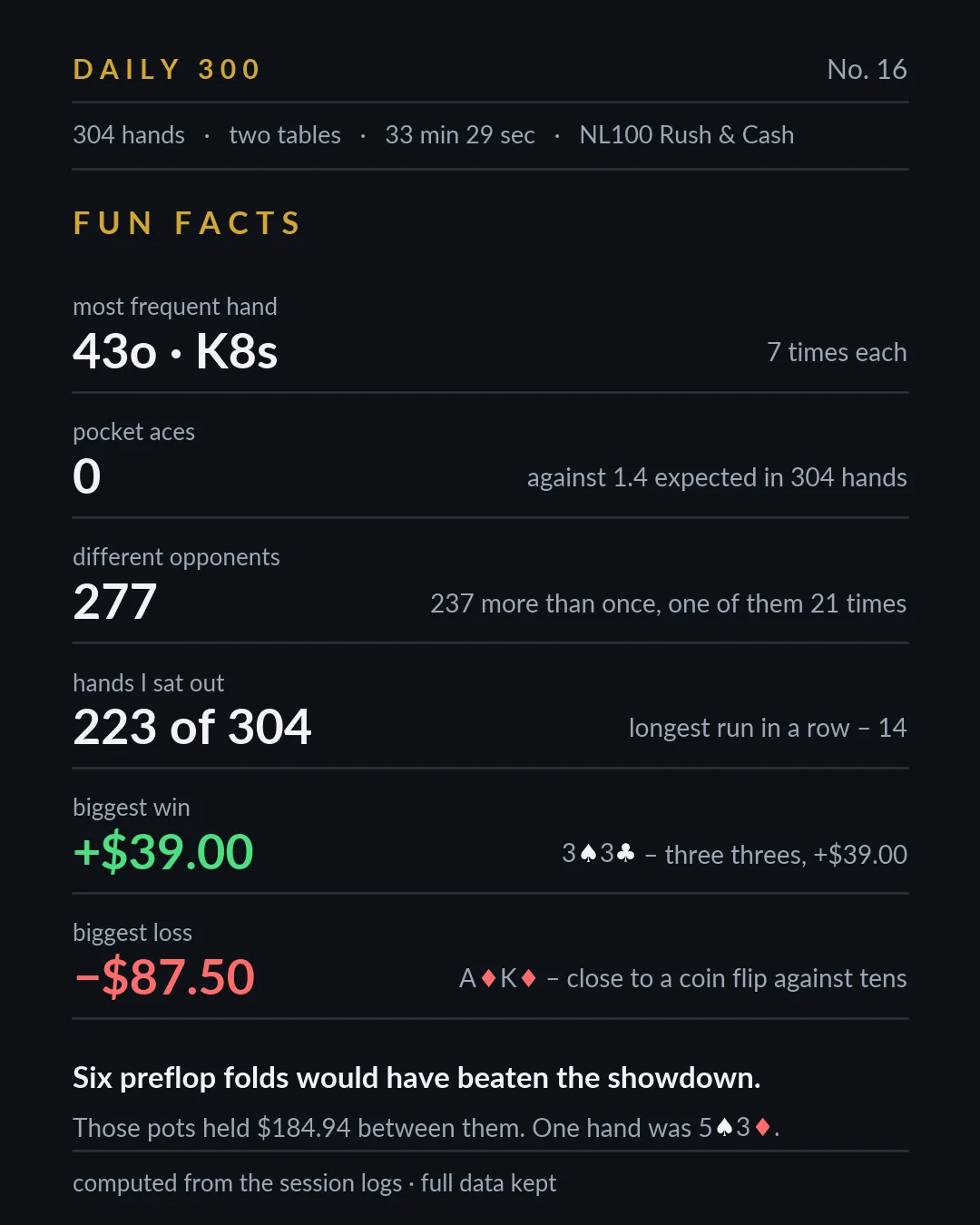
Seven minutes later. A♦K♦ in middle position, I raise to $2, the big blind makes it $8. Same setup, same move: $10.50 in the pot, I move in for $107.39, he has $87.50. This time he calls with T♣T♠. I win 46.1% of the time – close to a coin flip. We run it twice – two separate boards, half the pot riding on each: 4♠ 7♣ 8♦ 5♠ 5♦ and Q♥ 7♠ 9♦ 7♦ 5♥, both boards went his way. Minus $87.50. By EV the hand cost me $8.66: 46.1% of a $171 pot after the rake and the jackpot fee, minus the $87.50 I put in. The other $78.84 I lost to the way the cards fell; without that, the day would have finished near zero. I would make the same move again tomorrow.
Now, the choice. The first thing I go by is how deep my pockets are. Moving in hands the decision to my opponent: three times out of four he folds and I take $13; the fourth time I flip a coin for the whole stack. Calling spreads the same money across three streets: the pot reaches the stack less often, but I face more decisions. The expectation is the same; the size of the holes is not, and I am the one who has to sit in them with my own money.
The second thing is which of us is stronger after the flop. If it is you, calling buys you three streets on which your opponent will make his mistakes where they cost the most. If it is him, moving in takes those three streets away from him, and with them his chance to outplay you. And fast poker has a quirk of its own: there is almost no way to know your opponent. In that half hour 277 different people sat at my tables, five hands each on average, and I saw the cards of exactly eleven of them – that is how many showdowns the half hour held. When you know nothing about the player, the second criterion is silent, and the first one is all you have.
In my database this hand has landed in that spot 75 times since the end of 2023, and I have chosen all three moves: 34 smaller raises, 37 calls, and 4 all-ins. The results are more than $400 apart: +$127, −$284, and −$60. The whole loss on the calls comes from three hands, in two of which a pair on the flop ran into pocket aces and a set of nines. Shuffle the results of those 71 hands at random, and a gap that size between calling and raising comes up 8 times in 100.
The day ends at −$81.42, by EV at −$2.58, and almost all of the difference sits in one hand. Sorting decisions into right and wrong saves effort, but where several of them are right, you end up choosing blind and then justifying the choice by how it turned out. When several decisions are right, you choose on the price of the worst outcome and on who is stronger in the game that starts afterward.
Session cards
The best sessions in your inbox, once a week.