Session 14 · 300 hands · 2 tables · 30:45
How much are you willing to pay to keep being right?

Mark Zavadsky. Launched AliExpress in Russia, ran Sberbank's ecosystem, headed the studio behind Smeshariki and Fixiki, now iGaming and investing.
The idea
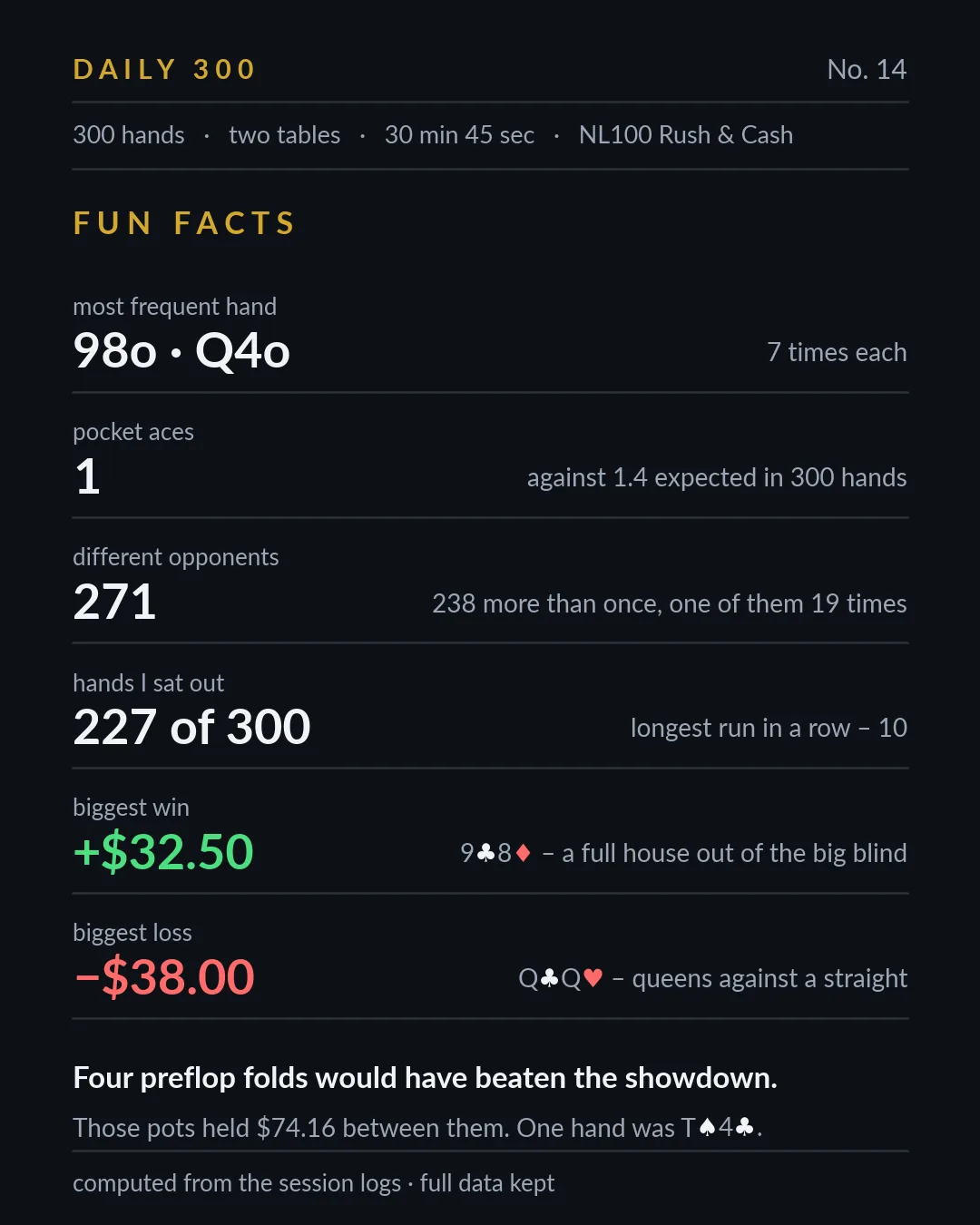
In that half hour I looked at what I was dealt 227 times out of three hundred and got out: net, that cost me $38.00 in blinds. The same $38.00 went in one single spot where getting out was not an option. In all 228 of them I was right.
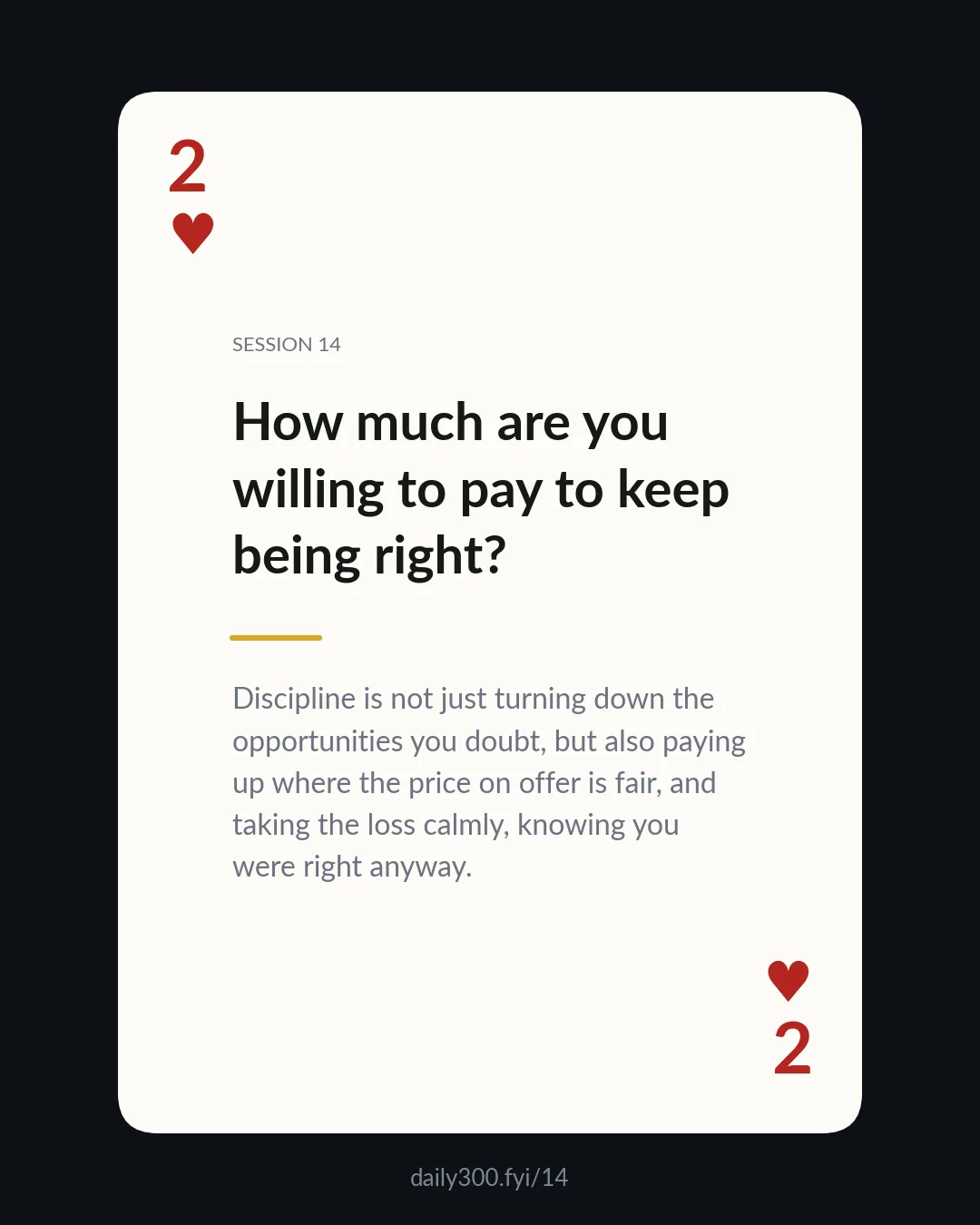
Saying no is the cheapest part of discipline and the most visible one: there is a lot of it, it is almost always right, and on its own it costs nothing. Far more material are the rare cases where saying no is not an option, and there the right decision feels no different from a mistake: you pay and you lose. Discipline is not just turning down the opportunities you doubt, but also paying up where the price on offer is fair, and taking the loss calmly, knowing you were right anyway.
Below: a case with the same mechanics, and the hands the idea grew out of, with the arithmetic. Poker words are underlined – hover to see what they mean.
The case
Mexico's finance ministry buys insurance against a fall in the oil price every year – the right to sell at a price named in advance. It costs about a billion dollars a year, and in sixteen of the twenty years the price did not fall: the premium expired worthless and the budget got nothing back. Not once after such a year was the program wound down or the premium called too expensive.
It paid out four times. In 2009 it returned about five billion dollars, in 2015 a record 6.4 billion, then again in 2016, and in 2020, when demand collapsed, about 2.4 billion. Sixteen years of paying and losing are not sixteen mistakes; they are the price of not having to cut the country's spending in the other four. The program is not run for a profit in any given year: the point is that the budget stops depending on whether anyone guessed the price right.
The analysis
Queens against a made straight
Preflop
- under the gun fold
- middle position raise to $2
- I raise to $7 · ×3.5
- button fold
- small blind fold
- big blind fold
- middle position call $5
The main hand. Middle position (MP) raises to $2, I have Q♣Q♥ in the cutoff (CO), I re-raise to $7, he calls. The pot is $15.50, I have $148 behind and he has more.
Flop
Pot $15.50- middle position check
- I bet $7.75 · 50% pot
- middle position call $7.75
It is an ugly flop: in his range a straight is already there for king-queen and for eight-seven. I built his range by class – the hands he opens from middle position and then calls a re-raise with: 115 combinations, 12 of them already a straight, 9 a set of three cards of the same rank, 5 two pair, and 69 a single pair. Two of the four queens are in my hand, which halves his best holding: he can have king-queen eight ways instead of sixteen. By my estimate I take 71.8% of this pot, against 76.2% before the flop. The next card is the expensive one. He checks, I bet $7.75. The purpose is simple: take money from any pair and from the hands that still need a card for their straight, while they still need it. He calls, which says almost nothing: 109 of those 115 combinations continue at that price.
Turn
Pot $31- middle position check
- I check
The card that completes the straight for the eights that did not have one yet. Now 20 of the remaining 104 combinations hold a straight, one in five of his hands, and my share of the pot drops, by the same estimate, from 71.8% to 64%. That one card cost me more than the whole flop did. I check. The solver bets here three times out of four: the check is not a mistake, but it is the rarer of the two branches, and I took it on exactly the street where his range first became stronger than mine.
River
Pot $31- middle position bet $23.25 · 75% pot
- I call $23.25
My share, by the same estimate, is 60.4%, another three and a half points down. He bets $23.25. Queens beat any one-pair hand and nothing stronger, so there is exactly one question – what he is betting with. The call costs $23.25 and pays for itself if the pot comes to me at least 30% of the time. I work it out from his range – from the hands he could have got here with; every percentage below is my estimate. If he bets only two pair and better, I win none of the time; add the missed draws he bluffs with – 20%; if he also bets top pair for thin value, betting a hand that is only just good enough – 39.4%. The 30% I need sits between the second model and the third: his range alone does not settle it. So I let the solver answer. I ran the spot from the turn with two different versions of his range – a narrow one and a wider one that adds the hands he might not have re-raised with before the flop. The answer is the same both times: the solver calls with queens every time. Against an all-in it would call 55% of the time, but there was no all-in. I call. He has 8♦7♦ – the straight was already there on the flop. −$38.00, the biggest loss of the half hour, more than the session made. There is no mistake on any street: the flop bet is one of two branches, the turn check is the other, and the river call is the only branch there is. The price was right, and it rests on two things at once: his bluffs and the jacks he bets for thin value. Bluffs alone are not enough at that price – with them I have 20% against the 30% I need. This time he had neither.
Ace-king folded on the flop
Preflop
- under the gun raise to $3
- middle position fold
- cutoff fold
- button fold
- I raise to $12 · ×4
- big blind fold
- under the gun call $9
The same job from the other side of the table – and there I said no. A♣K♣ in the small blind: under the gun (UTG) raises to $3, I re-raise to $12, he calls.
Flop
Pot $25- I check
- under the gun bet $14.50 · 58% pot
- I fold
I check. I was the one who raised before the flop, so the check is worth a word of its own: by the solver this hand checks here 42% of the time and bets the rest in two sizes, so the check is one of three ordinary branches. He bets $14.50. The call needs 26.9%, and against the range that opens under the gun and then pays a re-raise I have an estimated 22.2% – an exact count, running every possible runout against each of those 78 combinations. Almost five points short – and that is before counting the two streets where I have to act first. The solver folds this hand to that bet 63% of the time. I fold and give up $12.00 – a fold far more obvious than the call with queens, and three times cheaper: $12.00 against $38.00.
I also checked the thing everyone who folds a lot worries about: whether a long run of folds makes you want to play. The longest run of that half hour is 10 hands in a row, 13 if you count one table on its own; there were eight runs of eight or more. The average amount I put into the first hand I played after such a run is $3.90 against $7.72 for the session. There is no blow-up in those numbers. Eight cases are still only eight cases, though, and all they show is that after a long run of folds I played more carefully than usual. The same question from the other side – what I did after the expensive losses. There were four of them, $9 and up, and the average put into a played hand in the window after each is $7.74, $6.92, $4.85, and $2.50 against $7.72 for the session. The window is ten hands, and after the most expensive one, with the queens, only eight were left in the session: I played one, opened from the cutoff and folded to a re-raise, giving up $2.50. There is no chasing in those numbers, but there is almost nothing to measure either.
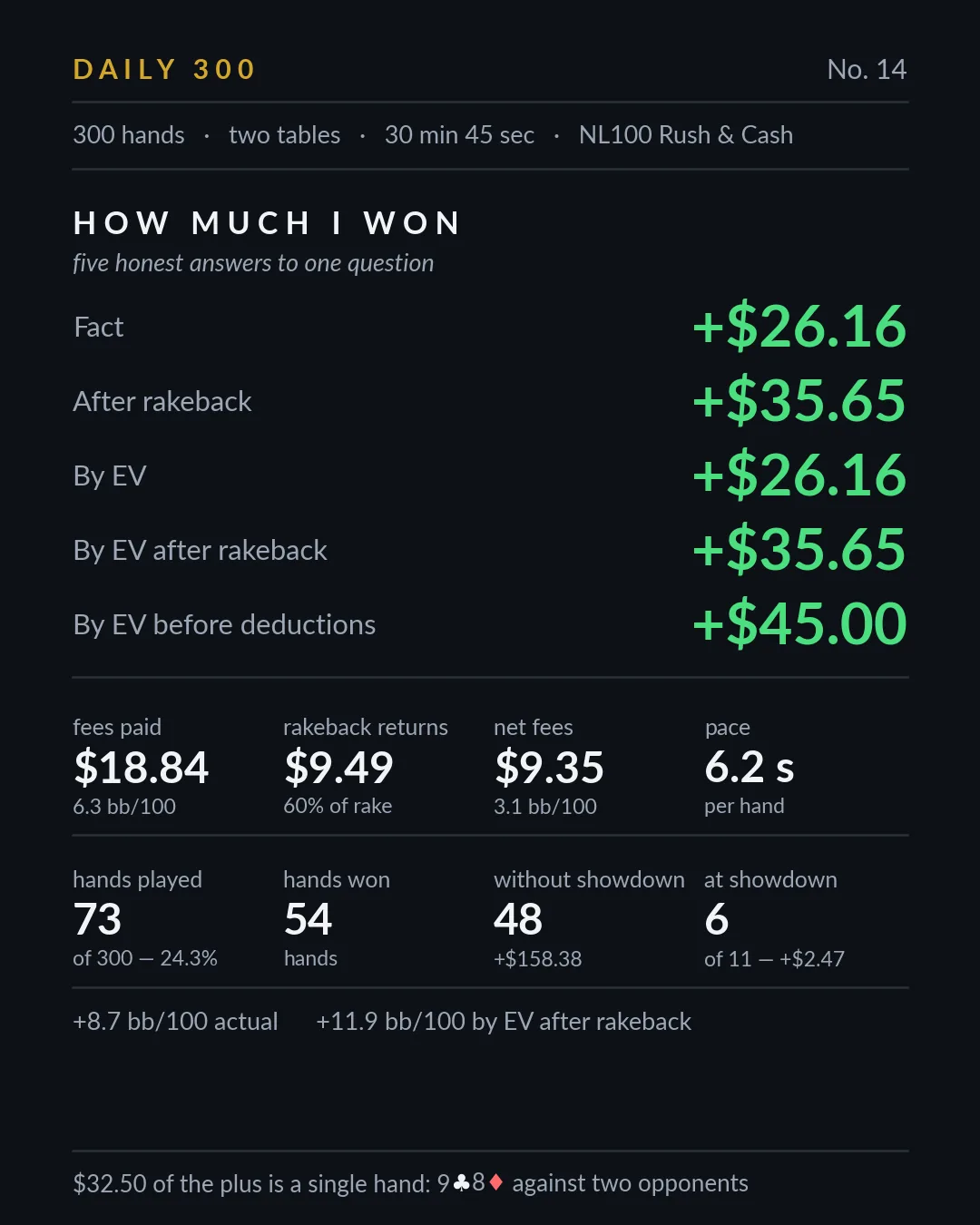
The half hour breaks into three parts that do not overlap: 227 hands I did not play cost $38.00 net, 23 folds after the money was already in cost $93.69, and 50 hands played to the end brought in $157.85. The most expensive hand took $38.00 – exactly as much as all 227 free exits together. Staying right today cost me $23.25 – the price of the river call. Without that call the session would have made $49.41 instead of $26.16, almost twice as much. Being willing to pay it is an important part of the discipline that wins you the small pots and the big ones.
Session cards
The best sessions in your inbox, once a week.