Session 15 · 306 hands · 2 tables · 27:42
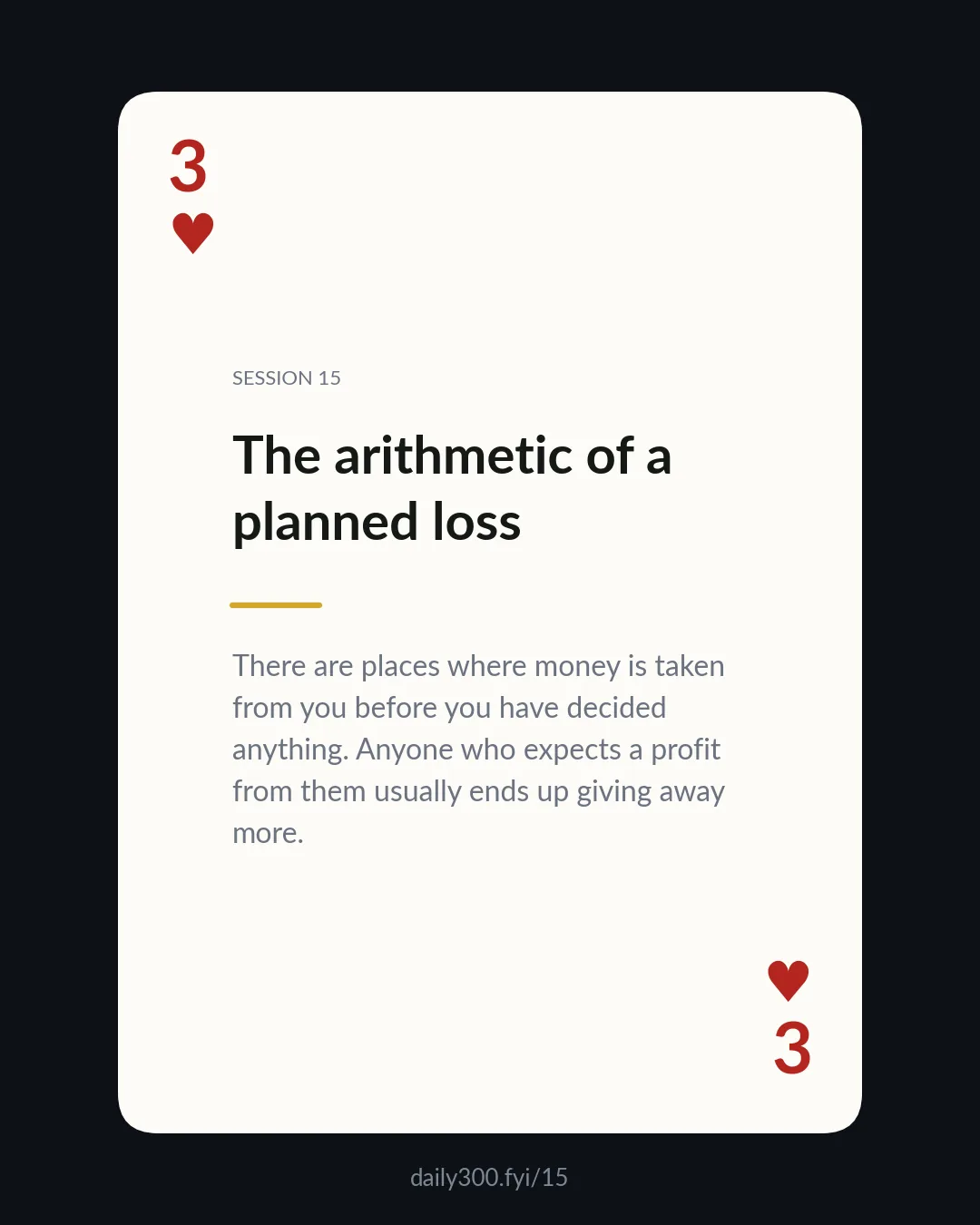
The arithmetic of a planned loss

Mark Zavadsky. Launched AliExpress in Russia, ran Sberbank's ecosystem, headed the studio behind Smeshariki and Fixiki, now iGaming and investing.
The idea
This is not about the half hour's result – that, I planned to win. But at every table there is a seat where winning is impossible. In poker, two players in every hand have to put money in before they see their cards; at my stakes the big blind is a dollar, and it is taken whether you want to play or not. In that half hour, by actually playing from that seat, I lost $10.05 less than if I had simply folded everything. In twenty-two hands I called someone's raise and lost sixteen of them – and it still came out cheaper. Over almost three years in that seat I have given up $5,688 across 8,727 hands, 65 cents instead of a dollar; nobody ever turns a profit there.
There are places where money is taken from you before you have decided anything. Anyone who expects a profit from them usually ends up giving away more.
Below: a case with the same mechanics, and the hands the idea grew out of, with the arithmetic. Poker words are underlined – hover to see what they mean.
The case
In the winter of 2021–22, Lufthansa operated about 18,000 flights that it itself called unnecessary: the planes flew nearly empty. The reason was the slot rule: the right to take off and land at a given time stays with an airline only if the airline uses it. In a normal year the threshold is 80% of the flights; for that winter the European Commission lowered it to half, but not to zero. Brussels Airlines operated another 3,000 or so flights for the same reason.
Every such flight is a loss: fuel, crew, airport fees, and an empty cabin. But without the flights the slot is lost, and with it the place in the schedule for the seasons to come. The airlines were choosing between two losses and took the smaller one. On the winter's books those flights look like a bad result; measured by what they preserved, they were the only right decision.
The analysis
The seat that matters. The big blind is a dollar taken from you before the cards are dealt, every sixth hand. In that half hour it happened 51 times. Seven times everyone folded before me and the dollar came back with fifty cents on top; another twenty-two times I gave it up without putting in another cent. That leaves twenty-two hands where I called someone's raise – put in more money to stay in – and saw a flop. Sixteen of them I lost, $38.65 in total, almost all of them for two or three dollars: called, missed the flop, folded. Six I won, $26.70. Net across those twenty-two: −$11.95. Had I never called, it would have been exactly −$22.00. A run of sixteen losses in twenty-two hands came out ten dollars cheaper than not playing at all.
A full house in the big blind
Preflop
- under the gun raise to $2
- middle position fold
- cutoff fold
- button fold
- small blind fold
- I call $1
The biggest of the six wins. K♦Q♥ in the big blind, the first player to act (under the gun, UTG) raises to $2, I call for a dollar.
Flop
Pot $4.50- I check
- under the gun bet $1.35 · 30% pot
- I call $1.35
Gives me a full house, kings full of queens; on this board nothing beats my hand, and only another king-queen can tie. I check, he bets $1.35 (30% of the pot), I call.
Turn
Pot $7.20- I check
- under the gun bet $5.40 · 75% pot
- I raise to $23.40 · ×4.3
- under the gun fold
I check, he bets $5.40 (75% of the pot), I raise to $23.40, he folds. In theory – by the computed optimal strategy – a hand like this calls and waits for the next street nine times out of ten and raises the tenth: I took the rare line, and he was gone. I collected $17.10, +$8.35 net: the biggest win from that seat in the half hour.
The most expensive blind defense
Preflop
- under the gun fold
- middle position raise to $2
- cutoff call $2
- button fold
- small blind fold
- I call $1
The most expensive of the sixteen losses: A♠J♦. A player in middle position (MP) raises to $2, the next one, on the cutoff (CO), calls, I put in the extra dollar.
Flop
Pot $6.50- I check
- middle position check
- cutoff check
Everyone checks.
Turn
Pot $6.50- I check
- middle position check
- cutoff bet $3.15 · 48% pot
- I call $3.15
- middle position fold
I check, the cutoff bets $3.15 (48% of the pot), I call: a ten gives me a straight, an ace gives me two pair, and the call already pays for itself if I win a quarter of the time.
River
Pot $12.80- I check
- cutoff bet $7.23 · 56% pot
- I fold
I check, he bets $7.23 (56% of the pot), I have nothing but the pair of kings on the board, I fold. −$5.15: that is what the most expensive defense of that seat cost in the half hour. The other fifteen cost two or three dollars each.
Three tens against a straight
Preflop
- under the gun fold
- I raise to $2
- cutoff fold
- button fold
- small blind fold
- big blind call $1
The most expensive hand of the day did not come from the blind. T♣T♦ in middle position (MP), I raise to $2, the big blind calls.
Flop
Pot $4.50- big blind check
- I bet $1.49 · 33% pot
- big blind call $1.49
He checks, I bet $1.49 (33% of the pot), he calls.
Turn
Pot $7.48- big blind check
- I bet $12 · 160% pot
- big blind raise to $36.61 · ×3.1
- I call $24.61
The card that gives me three tens and at the same time completes a straight for anyone holding ace-queen or queen-nine. He checks, I bet $12 (160% of the pot); in theory that bet is one of three standard lines here. He raises to $36.61. This is the moment where the hand has already told me everything: in theory, of a hundred hands he reaches the turn with, no more than six raise a bet like this, and between half and two-thirds of those six are straights, the rest bluffs with no pair. Folding three tens for $24.61 is still out of the question, of course: the call pays for itself at 30%, and beyond the chance that he is bluffing, ten of the forty-six unseen cards give me a full house.
River
Pot $80.70- big blind bet $40 · 50% pot
- I call $40
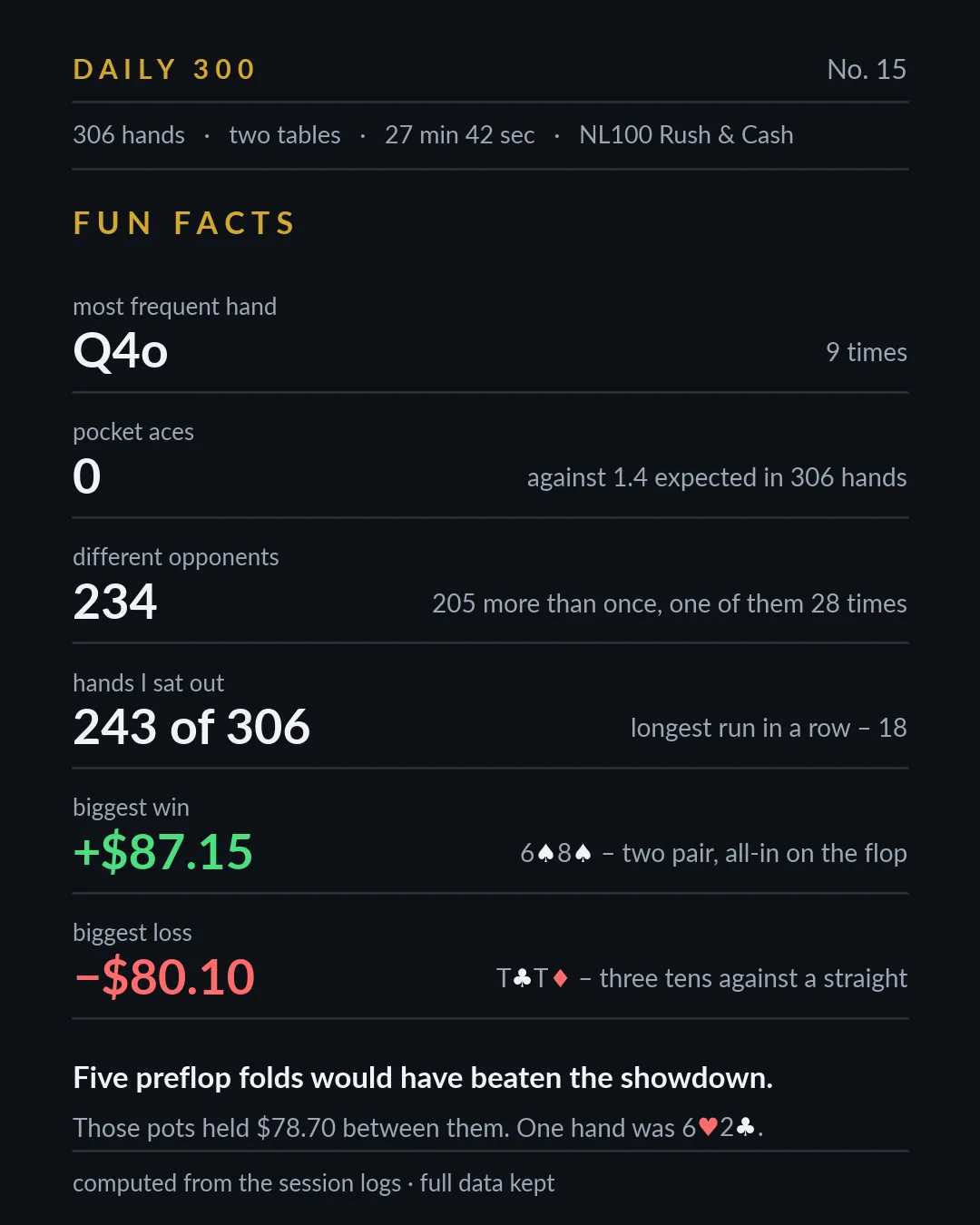
Changes nothing. He bets $40 (50% of the pot), and the call pays for itself at 33%. By my estimate straights make up between half and three-quarters of his bets here, which means the pot is mine 27–47% of the time: the price falls inside that range, and in theory a hand like this rarely calls here – but it does call. I call. He has A♦Q♣, a ten-to-ace straight. −$80.10, two and a half times the day's result. There is no mistake on any street; there is only the price of finding out what he had after his raise: $64.61, four-fifths of all the money in the hand.
Two pair and a flop all-in
Preflop
- under the gun fold
- I raise to $2
- cutoff fold
- button call $2
- small blind call $1.50
- big blind call $1
And the day's entire upside came from a single hand. 6♠8♠ in middle position, I raise to $2 (in theory you don't open this hand from here; I open it about half the time) and get three callers.
Flop
Pot $8- small blind check
- big blind check
- I bet $4 · 50% pot
- button call $4
- small blind fold
- big blind raise to $24 · ×6
- I raise to $98 · ×4.1
- button fold
- big blind call $57.65
Gives me two pair, eights and sixes. I bet $4 (50% of the pot), the button calls, the big blind raises to $24, I move all-in for $98, he calls off his last $57.65 with 7♦6♥, a lower two pair. Run twice, both run-outs mine, 84.8% against his hand, +$87.15. Against everything that raises on a board like this, my hand wins about half the time by my estimate, so the credit for this one is his: he paid $57.65 with fifteen chances in a hundred. Before that hand I was down $114.56.
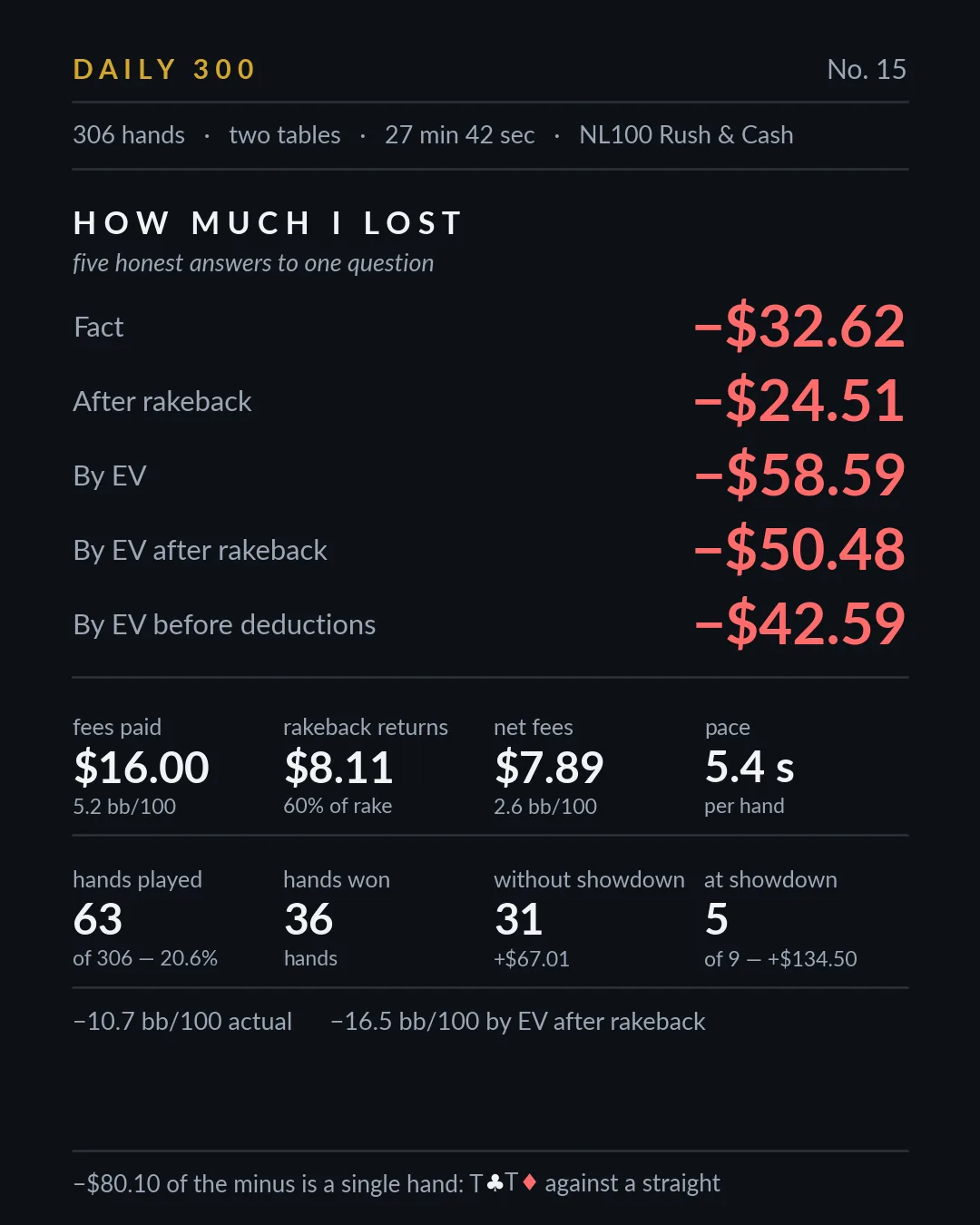
The half hour's total: −$32.62, and −$58.59 by EV. In the only hand where my money went to showdown, I was owed $61.18 and received $87.15 – the $25.97 difference is luck, not anything I did. The big blind gave up $30.45, versus the $40.50 taken from someone who never plays a hand: sixteen losses out of twenty-two, and still cheaper. There is no way to profit from that seat, not for me and not for anyone at these tables, and anyone who looks for one gives away more. A planned loss is measured against the plan, not against zero. If a seat is obliged to give money away, there is only one question to ask of it: how much less did it give than it had to? Anyone who understands that difference knows their business better than those who expect a profit from everything.
Session cards
The best sessions in your inbox, once a week.