Session 13 · 300 hands · 2 tables · 52:02
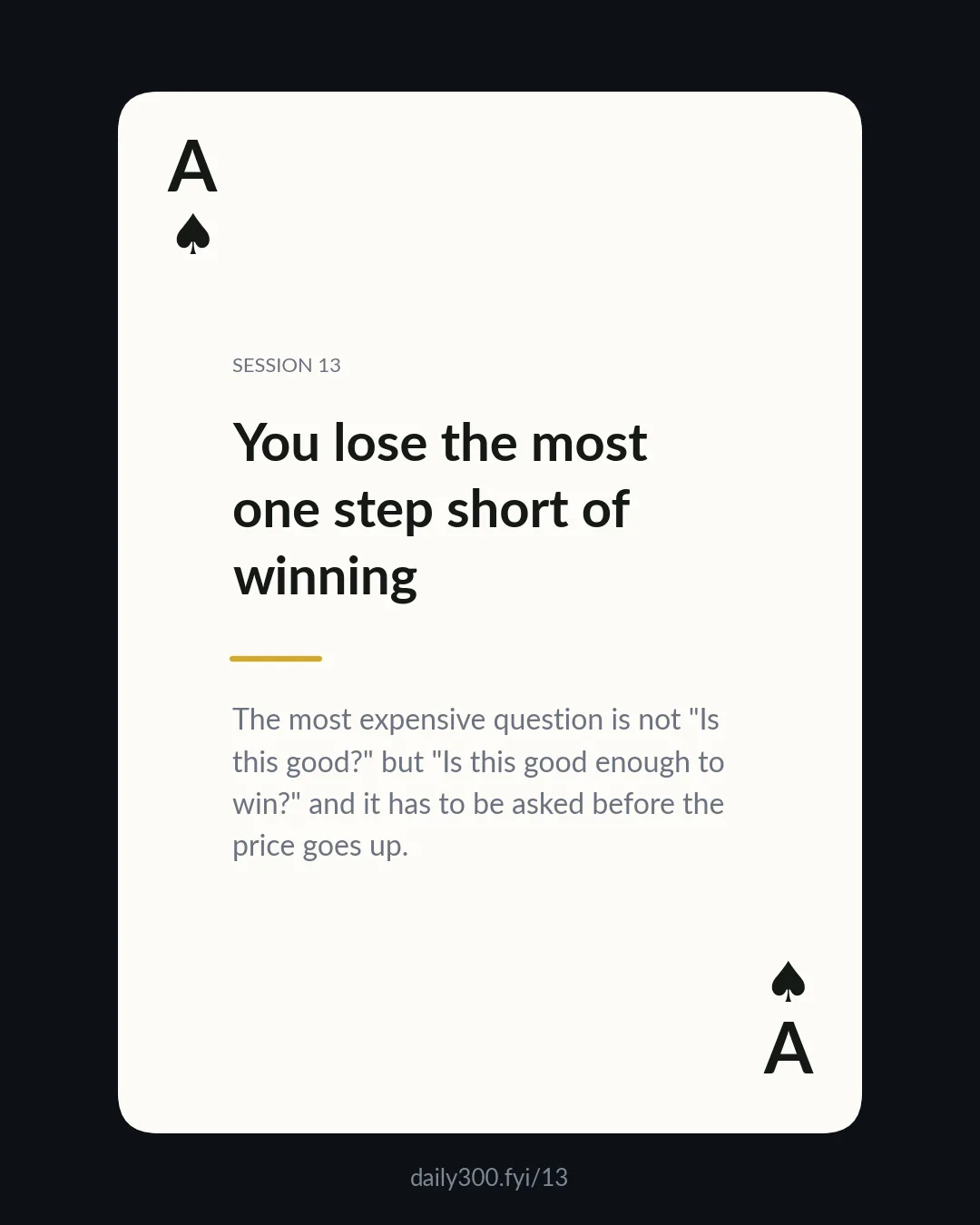
You lose the most one step short of winning

Mark Zavadsky. Launched Alibaba in Russia, ran Sberbank's ecosystem, headed the studio behind Smeshariki and Fixiki, now iGaming and investing.
The idea
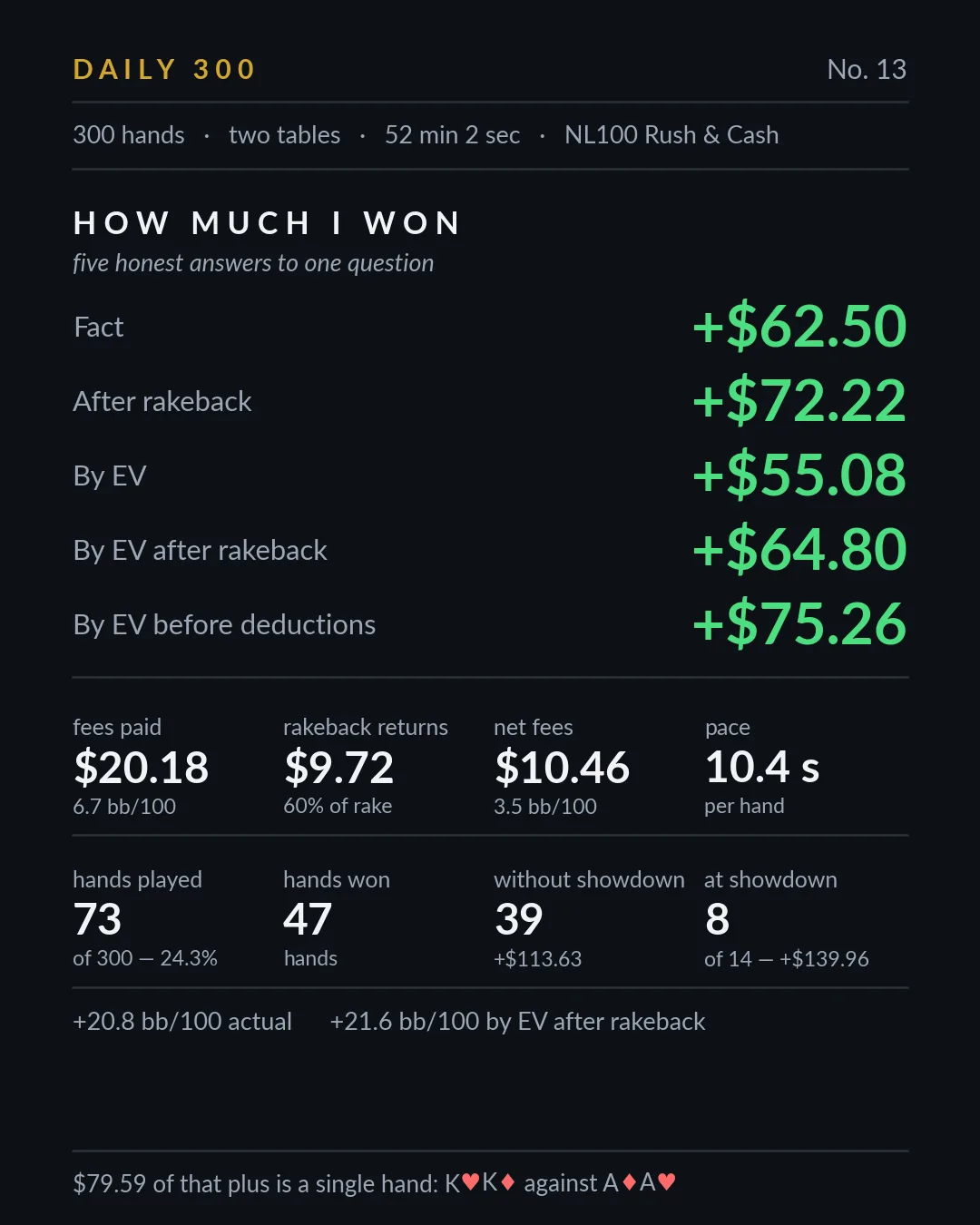
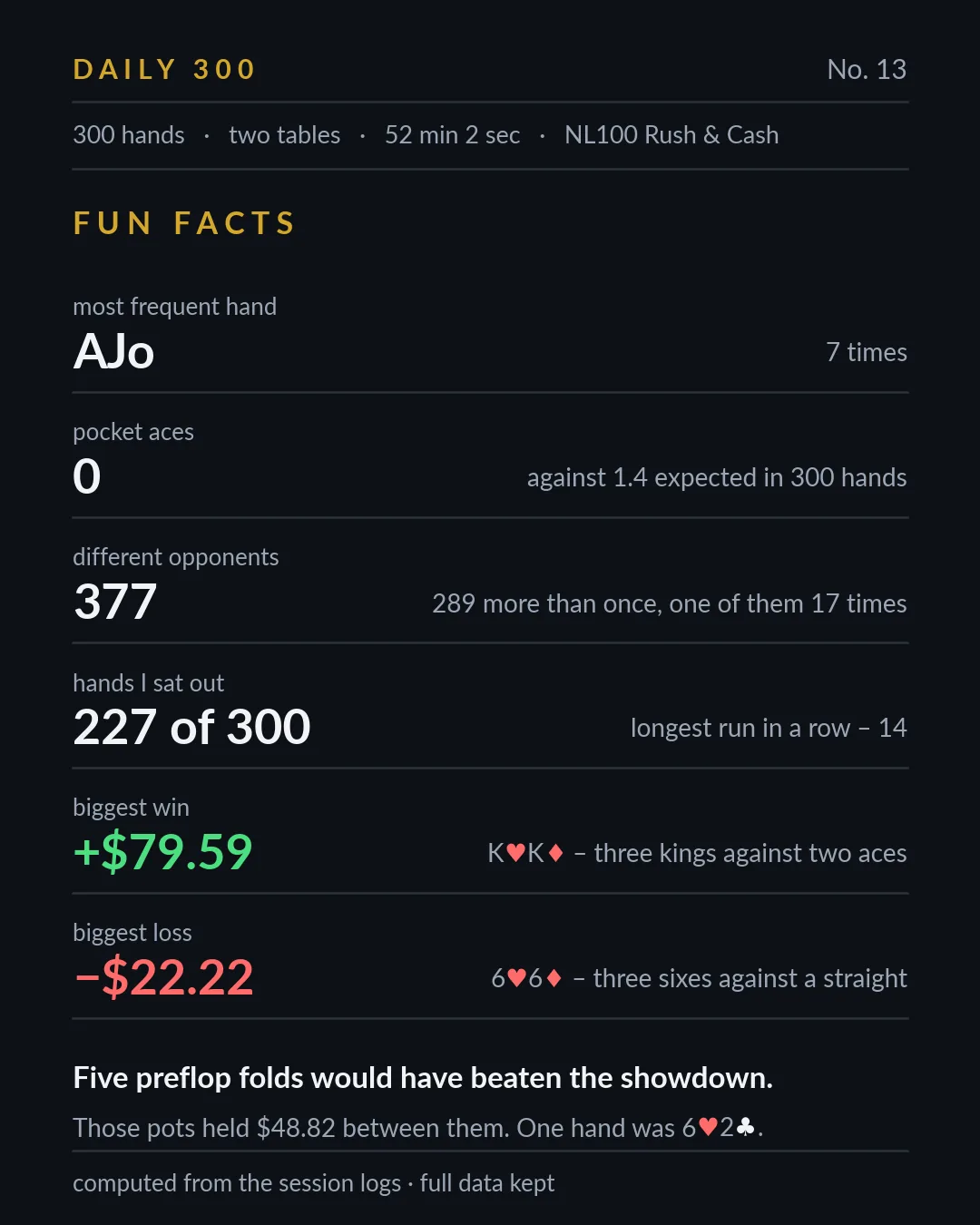
In 52 minutes I lost 95 hands and won 47, and still finished up. The three most expensive losses all came from the spots where I had almost everything and my opponent had slightly more. Where I had nothing, I lost a dollar or two. The biggest win of the hour, though, was handed to me by a man who also came up just short.
Business works the same way. An idea that does not work is cheap: it is shut down in its second month, and the whole loss is those two months. The expensive one is the other – the one that works but does not win: it clears the approval, the pilot, and the budget, and then stumbles at the last step, with more people and more money added at every step along the way. The most expensive question is not "Is this good?" but "Is this good enough to win?" and it has to be asked before the price goes up.
Below: a case with the same mechanics, and the hands the idea grew out of, with the arithmetic. Poker words are underlined – hover to see what they mean.
The case
In 2006 Pfizer stopped the trials of torcetrapib, a drug meant to be sold alongside its main product, Lipitor. The molecule did exactly what it had been designed to do: patients' "good" cholesterol rose by 72 percent, and their "bad" cholesterol fell by almost a quarter. $800 million had gone into development, the final trial was running in fifteen thousand people, and in the spring of 2007 the company was preparing to file for approval.
It was that final trial that showed people taking the drug died half again as often as those who were not. Nothing reaches a trial in fifteen thousand people unless it has cleared every earlier one: a molecule that does not work is stopped sooner and cheaper. Eight hundred million was the price of a molecule that was good at everything except the last step.
The analysis
Three sixes against a straight
Preflop
- under the gun fold
- middle position fold
- cutoff fold
- I raise to $2.50
- small blind call $2
- big blind fold
Here is the hand. I have 6♥6♦ on the button – I act last on every street, the best seat at the table. I raise to $2.50 and the small blind calls; he has $22.22, a shade over a ninth of my stack, and after the call he has $19.72 left – that is the money I am playing for, and three streets put all of it in the pot.
Flop
Pot $6- small blind check
- I bet $1.98 · 33% pot
- small blind call $1.98
I have a set of sixes, and the board is unpaired and rainbow – no two cards of the same suit. It is a high board, and it connects better with his range than with mine: top pair or better is there, by my estimate, in 27% of the hands he arrives with and in 21% of the hands I open on the button. That is what I want – it means he has something to call my bets with. By my estimate, my share of this pot is 88%. He checks, I bet $1.98, a price any pair calls: the first bet should be the cheapest. He calls.
Turn
Pot $9.96- small blind check
- I bet $7.47 · 75% pot
- small blind call $7.47
A card that improves almost nothing: a five is in only four combinations of his range, and my share of the pot rises, on the same estimate, from 88% to 93%. He checks again, I bet $7.47, and after that bet he has $10.27 left: whatever comes on the river, the rest of his stack is going in. He calls. I work out the river plan right there, before the card: of the 46 cards I cannot see, eight are dangerous – four kings and four eights. After those, by my estimate, 15–17% of his hands beat me; after any other card, 8% or less, and on the other thirty-eight cards I call whatever he bets.
River
Pot $24.90- small blind bet $10.27 · 41% pot
- I call $10.27
That eight. My share falls, on the same estimate, from 93% to 85%, and he moves all-in: $10.27. The arithmetic: for the call to pay, the pot has to come to me at least 22.6% of the time – $10.27 against the $24.90 already in it and his $10.27. I built his range by class – the hands that call a button open and then answer two bets: a pair made with one of his hole cards, a pocket pair, or a straight draw. 147 combinations reach the river, and 22 of them beat my set: the straight, eight through queen, plus pocket eights and pocket jacks. The other 125 are worse. For the call to be a mistake he has to put his last money in with those twenty-two only; if he goes all-in with two pair as well, the call is, by my estimate, profitable. I call. He has T♣9♣, a straight. −$22.22, the biggest loss of the hour. On the flop he did not even have a pair – just four cards to a straight, and only a king or an eight completes it. The eight came. I did not pay for the hand being bad: a set beats everything that reached the river in his range except those twenty-two combinations. I paid for it being good – with nothing at all there would have been nothing to bet on the turn, and I would never have reached the river.
Three kings against two aces
Preflop
- under the gun fold
- middle position fold
- cutoff raise to $3
- button fold
- small blind fold
- I raise to $7.88 · ×2.6
- cutoff raise to $16.01 · ×2
- I call $8.13
The same mechanism from the other side of the table, and it is the biggest pot I played this hour. I am in the big blind with K♥K♦. The cutoff (CO) raises to $3, I re-raise to $7.88, he makes it $16.01, I call.
Flop
Pot $32.52- I check
- cutoff bet $16.26 · 50% pot
- I call $16.26
A set of kings. I check, he bets $16.26, I call.
Turn
Pot $65.04- I check
- cutoff bet $51.32 · 79% pot
- I call $51.32
I check, he moves all-in for $51.32, I call. He has A♦A♥. Of the 44 possible rivers, two save him – the other two aces; the other 42 are mine.
River
Pot $167.68And the $167.68 pot is mine – $163.18 after the rake and the jackpot drop. By EV the hand was worth +$72.17 against +$79.59 actual: the difference is the price of those two cards. He lost $83.59, his whole stack, with the best starting hand in the game, and $67.58 of it went in after the flop, when my set of kings was already there.
Ace-queen against a whole stack
Preflop
- I raise to $2
- middle position raise to $6.50 · ×3.2
- cutoff fold
- button fold
- small blind fold
- big blind fold
- I raise to $18 · ×2.8
- middle position raise to $255.32 · ×14.2
- I fold
The second-biggest loss of the hour is $18 with A♥Q♦, and it is about the same thing. Under the gun (UTG): I raise to $2, a player in middle position (MP) re-raises to $6.50, I make it $18, and he moves all-in for his whole stack, $255.32. The call would cost me the rest of mine, $82.76, and would need 41.4% equity. Against aces, kings, queens, and ace-king my hand wins, by my estimate, about 24% of the time; even adding jacks, tens, and ace-queen itself to his range, about 34%. I fold. Ace-queen was strong enough to re-raise and not strong enough to call the shove, so folding it cost $18 instead of $2.
A full house against quads
Preflop
- I raise to $2
- middle position fold
- cutoff fold
- button fold
- small blind fold
- big blind call $1
The small losses at showdown work the same way. A♠J♥ on the button: a jack on the river gave me top pair, my opponent had 9♠7♠ and a straight, −$8. 8♥7♥ against the big blind on a board of A♣ 8♠ J♣ J♦ J♠: I had a full house, he had Q♠J♥ and quad jacks; −$4.25, because after the second jack I never bet again. The three showdowns where I had nothing cost $7.80 between them.
The hour in totals: 47 hands won brought in $253.59, 95 hands lost cost $191.09, and of that $191, three hands where I held the second-best hand and one with ace-queen took $52.47. The hands with nothing in them cost $7.80 at showdown over the same hour and brought in $24.94 in bets. That is no reason to be afraid of good hands: without them there would be no $253 either. You only find out what being one step short costs in the final test – which is why you have to work that price out before the first one.
Session cards
The best sessions in your inbox, once a week.