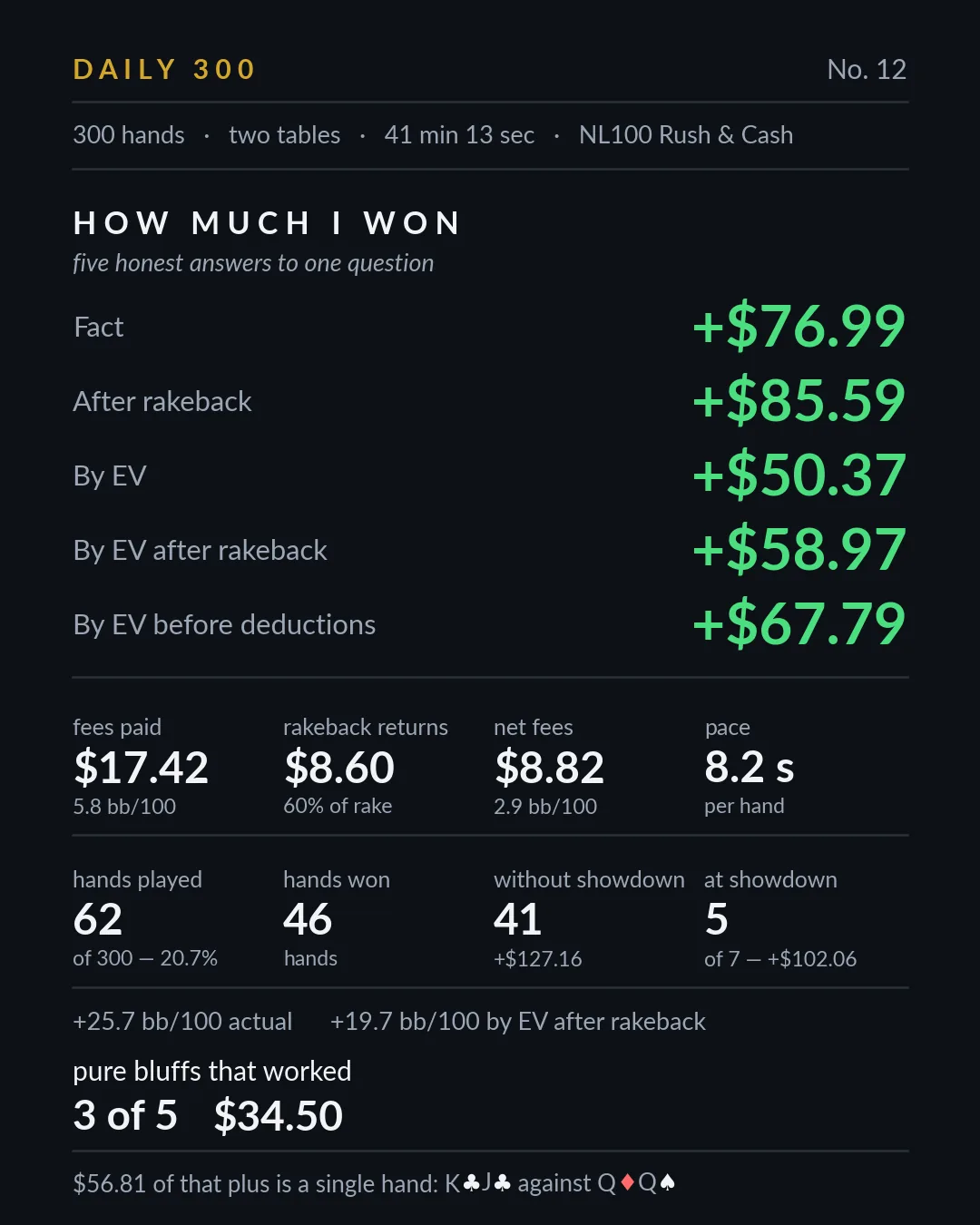
Session 12 · 300 hands · 2 tables · 41:13
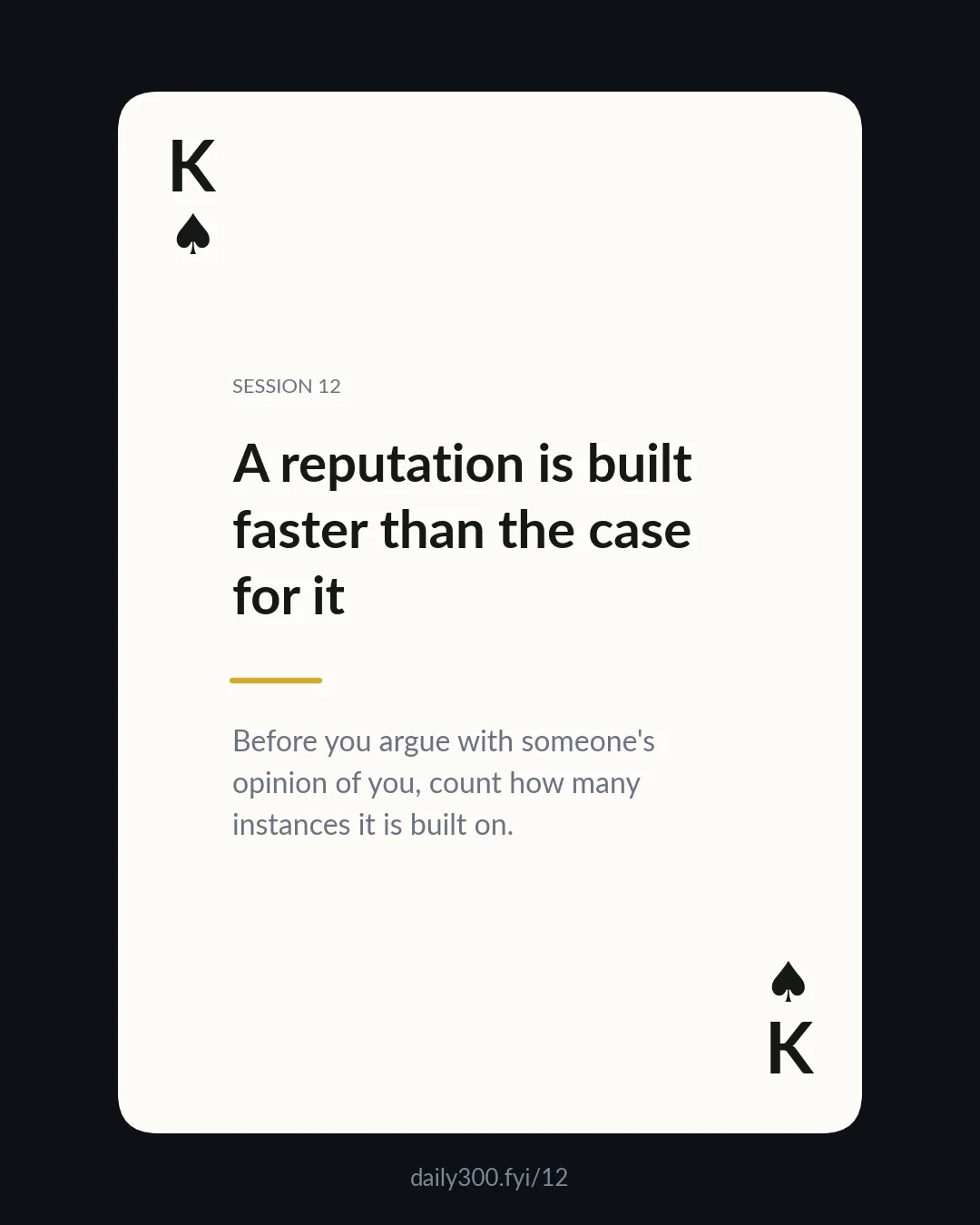
A reputation is built faster than the case for it

Mark Zavadsky. Launched Alibaba in Russia, ran Sberbank's ecosystem, headed the studio behind Smeshariki and Fixiki, now iGaming and investing.
The idea
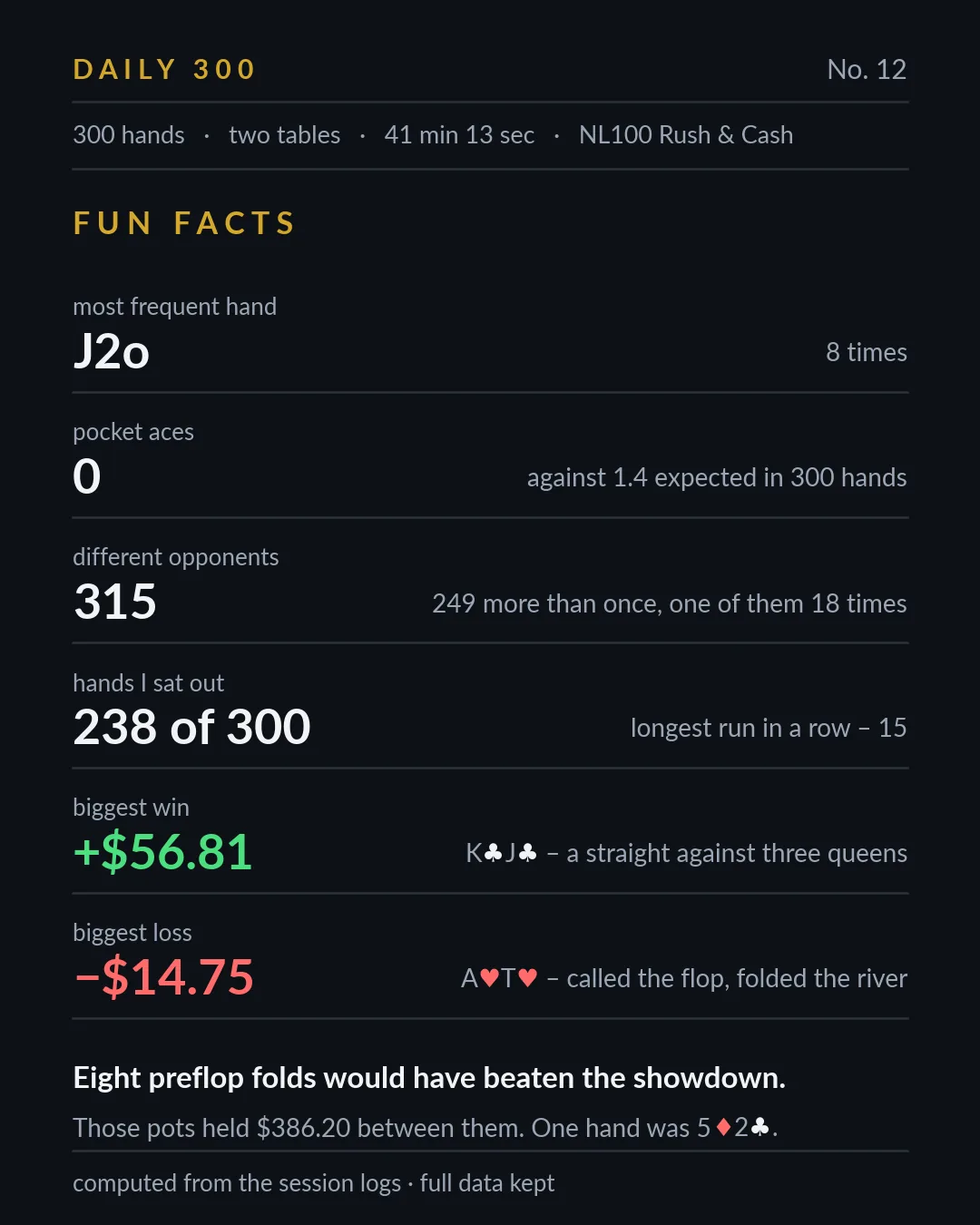
In those forty minutes 315 different people sat across from me, and more than half of them saw me for four hands or fewer. Every one of them had to decide at some point what kind of player I was. The man who pushed everything he had at me that day had sat with me for three hands and had not seen me put in a dollar in any of them.
An opinion of you closes before the material for it has piled up, and is not revisited: the picture already feels complete. That is how people decide whether to hire someone after two conversations, and hand over money after one meeting. It is not, in fact, stupidity: there are situations where you cannot wait and have to decide today. Before you argue with someone's opinion of you, count how many instances it is built on. You are doing well if you can count them on one hand. Bad news if you were counting on fairness, good news if you remember this: where there is almost no evidence, your next right move can decide a great deal.
Below: a case with the same mechanics, and the hands the idea grew out of, with the arithmetic. Poker words are underlined – hover to see what they mean.
The case
In an experiment, students were asked to predict what grade another student would finish the term with. Some were given the student’s past grades; others got the past grades plus a twenty-minute interview. The interview made the predictions worse: the correlation with the real result fell from 0.61 to 0.31.
Some of the people being interviewed answered at random – yes or no by a rule agreed in advance. The interviewers did not notice, and more than half the participants afterwards said that even that interview was better than none. An impression forms out of anything, and it forms once.
The analysis
A straight against three queens
Preflop
The first: K♣J♣ under the gun (UTG), first to act before the flop, and I raise to $2. The small blind re-raises to $7 and I call.
Flop
Pot $15Flop T♠ 9♦ 5♥ – no pair, an inside straight draw: a queen gives me nine through king. And the king and the jack are live: if either one lands on the board, I have top pair. He bets $11.25 into $15 and I call. The price of that call asks me to be right exactly thirty percent of the time: to break even on the spot, I need the pot to come to me nearly one time in three. The small blind re-raises rarely – under eight percent of hands across the field – and against that range, by my estimate, my equity comes out just short of thirty, which is to say right about at the price. The immediate price is not what settles the call anyway: it counts the hand as though it ended right there, and a draw that gets there still gets paid on the later streets. Against what he actually held – two queens – it was twenty percent – but I could not know that, and hindsight is not an argument. The argument is this: of the queens that complete my straight, two were left in the deck rather than four. He was holding the other two.
Turn
Pot $37.50Turn Q♣ – the card I had been asking for, and the only one in the deck that helps him more than it helps me. I make a straight, nine through king; he makes three queens. He bets $42.06, his whole stack, and I call. There is nothing left to work out: enumerating the forty-four remaining cards gives me 77.3% – ten cards beat me, the ones that pair the board and give him a full house. The hand was run twice – two separate rivers, half the pot riding on each – and both came blank, so both halves came to me: +$56.81. By EV the hand was worth +$30.19, and the whole gap between those two numbers is about how the last two cards fell, not about how I played it. By that point he had sat with me for three hands and had not seen a single one where I put in so much as a dollar. He was moving all-in against a blank line. To him I was neither careful nor reckless – I was nobody, and he filled that in for himself.
A bet bigger than the pot, read off one hand
Preflop
The second big pot works the same way from the other side. Under the gun again, I hold A♠K♦. I raise to $2, a player in middle position (MP) re-raises to $6, the big blind calls, and I raise again to $28. MP folds, the big blind calls, and $62.50 is in the pot.
Flop
Pot $62.50Flop 7♣ 4♥ 6♥ – a miss, and we both check.
Turn
Pot $62.50Turn K♥: top pair, top kicker, and a third heart on the board. I bet $75.70 into $62.50 – more than the pot, my whole stack. He folds and I take $58.00. The bet is arguable: almost the only hands that can call it are hands that beat me. But in the seven hands we had spent at a table together, this opponent had seen exactly one where I played. He read that bet off a single hand.
Across those forty minutes, 188 of the 315 saw at least one hand I actually played. Of those, 112 saw exactly one. That is the whole sample anyone had to form an opinion of me from that day.
In forty minutes I played against 315 people, and every one of them saw exactly as much of me as I saw of them: the same handful of hands, the same blank line. Was it fair to be read off three hands? That is not the question. The question is how many people I read exactly that way that same day and filed that conclusion away as experience.
Session cards
The best sessions in your inbox, once a week.