Session 11 · 303 hands · 2 tables · 30:32
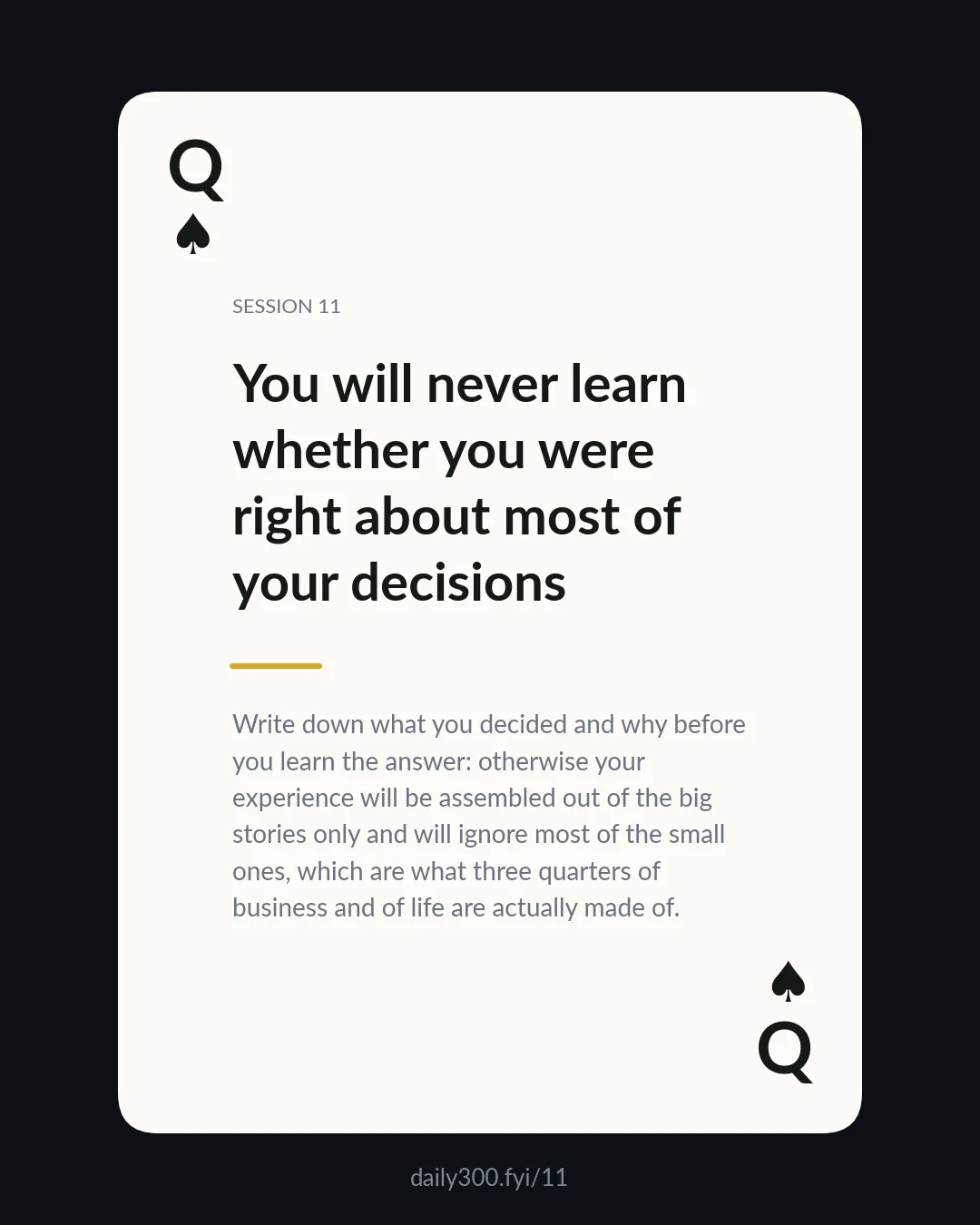
You will never learn whether you were right about most of your decisions

Mark Zavadsky. Launched Alibaba in Russia, ran Sberbank's ecosystem, headed the studio behind Smeshariki and Fixiki, now iGaming and investing.
The idea
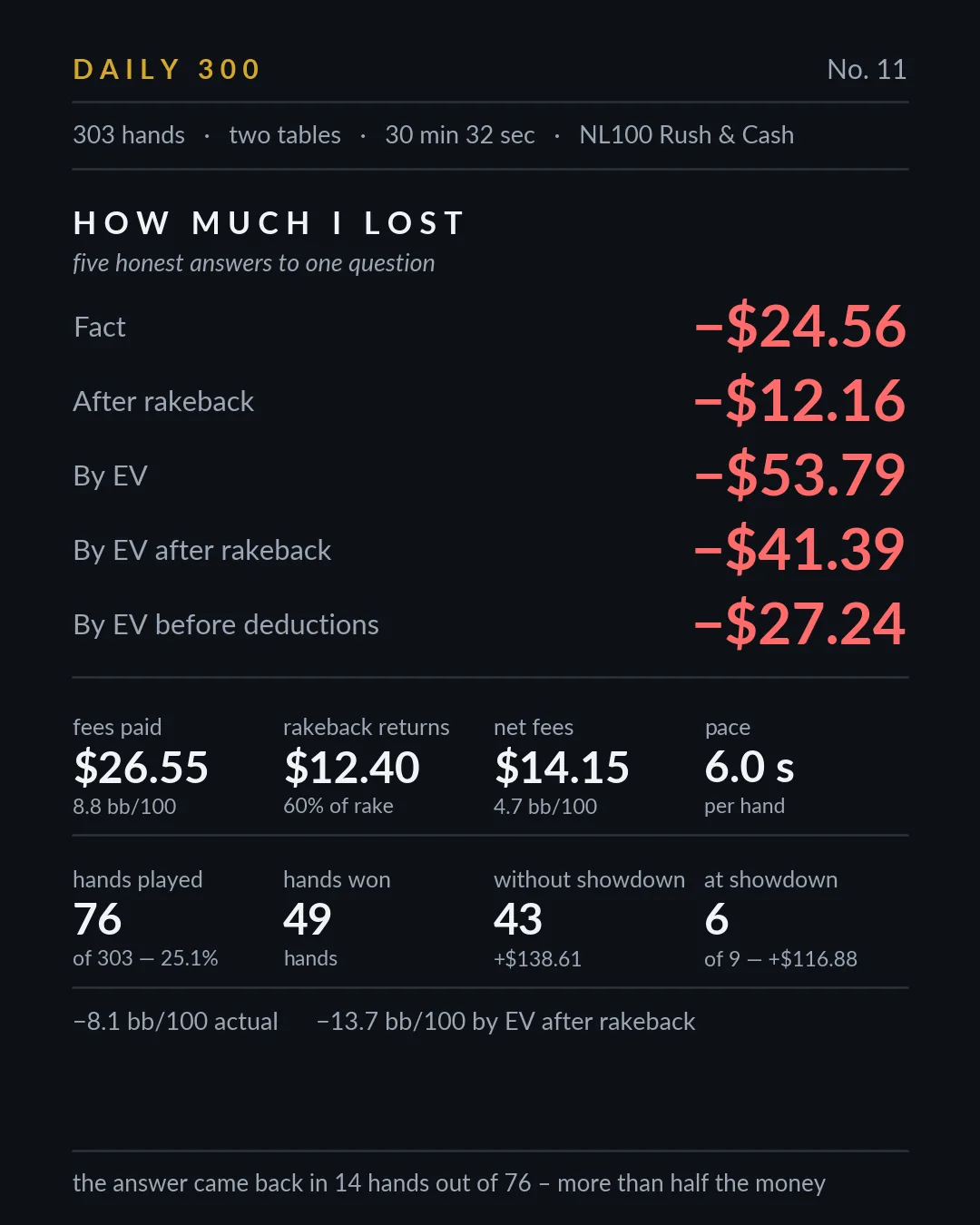
In half an hour I paid money for seventy-six decisions – and learned how fourteen of them ended. In the rest he folded or took the pot without showing, and nobody will ever tell me whether I was right. Those fourteen are roughly every fifth decision of the day, but more than half of all the money I put in: a hand that came back with an answer cost me close to six times what an ordinary one did.
That is how almost all feedback works: rarely, and on the most expensive episodes. The candidate who never got the offer, the client who never wrote back, the deal you walked away from – all leave in silence, and none will be in your experience. What stays is a handful of big stories that ran to the end, and you will judge yourself by those. Write down what you decided and why before you learn the answer: otherwise your experience will be assembled out of the big stories only and will ignore most of the small ones, which are what three quarters of business and of life are actually made of.
Below: a case with the same mechanics, and the hands the idea grew out of, with the arithmetic. Poker words are underlined – hover to see what they mean.
The case
Since 2000, the large trials funded by America’s national heart institute have had to declare in advance exactly what they are measuring. Before that rule a trial could measure a dozen outcomes and declare the one that worked the primary one: seventeen trials out of thirty reported a significant benefit on it. After it, two out of twenty-five.
The authors themselves warn that this does not prove cause: the number of trials is small, and much else changed around the year 2000. But it looks exactly like the difference between a conclusion written down before the answer and a conclusion found afterwards.
The analysis
Out of three hundred and three hands I voluntarily put money in on seventy-six of them, and those are all of my decisions for the half hour. My opponent's cards came face up in fourteen of them, and in one more he showed exactly half – one card out of two. The other sixty-one decisions stayed unanswered, and in thirty-two of those I even took the pot without seeing what it had cost.
Do those fourteen resemble the other sixty-one? Barely: they are roughly every fifth decision by count, but more than half of all the money I put in that day, and a hand that came back with an answer cost me close to six times what an unanswered one did. Cards go face up where the hand ran to the end, and the ones that run to the end are the expensive ones. So my feedback is not merely rare, it is also selected on "where I bet the most," and it looks nothing like the rest of my decisions.
The biggest bet of the day, and no answer to it
Preflop
The biggest bet of the day sits squarely in the half with no answer. Under the gun, I hold K♦K♠ and raise to $2, and the big blind calls.
Turn
Pot $7.48Turn 7♥, I bet $3.74, he calls again. The pot is $14.96.
River
Pot $14.96River 7♣, and I bet $132.56 – my whole stack, close to nine times the pot. He folds and I collect $14.22. And that decision, the largest one by money in the entire half hour, cannot be verified against anything: I do not know whether he had a queen, a seven, or nothing at all, and I do not know whether he would have called ten dollars if I had asked for ten. I can build a model, but the fact will never exist – he folded, moved to another table, and the two of us are unlikely to be dealt in together again.
Half an answer for $47.74
Preflop
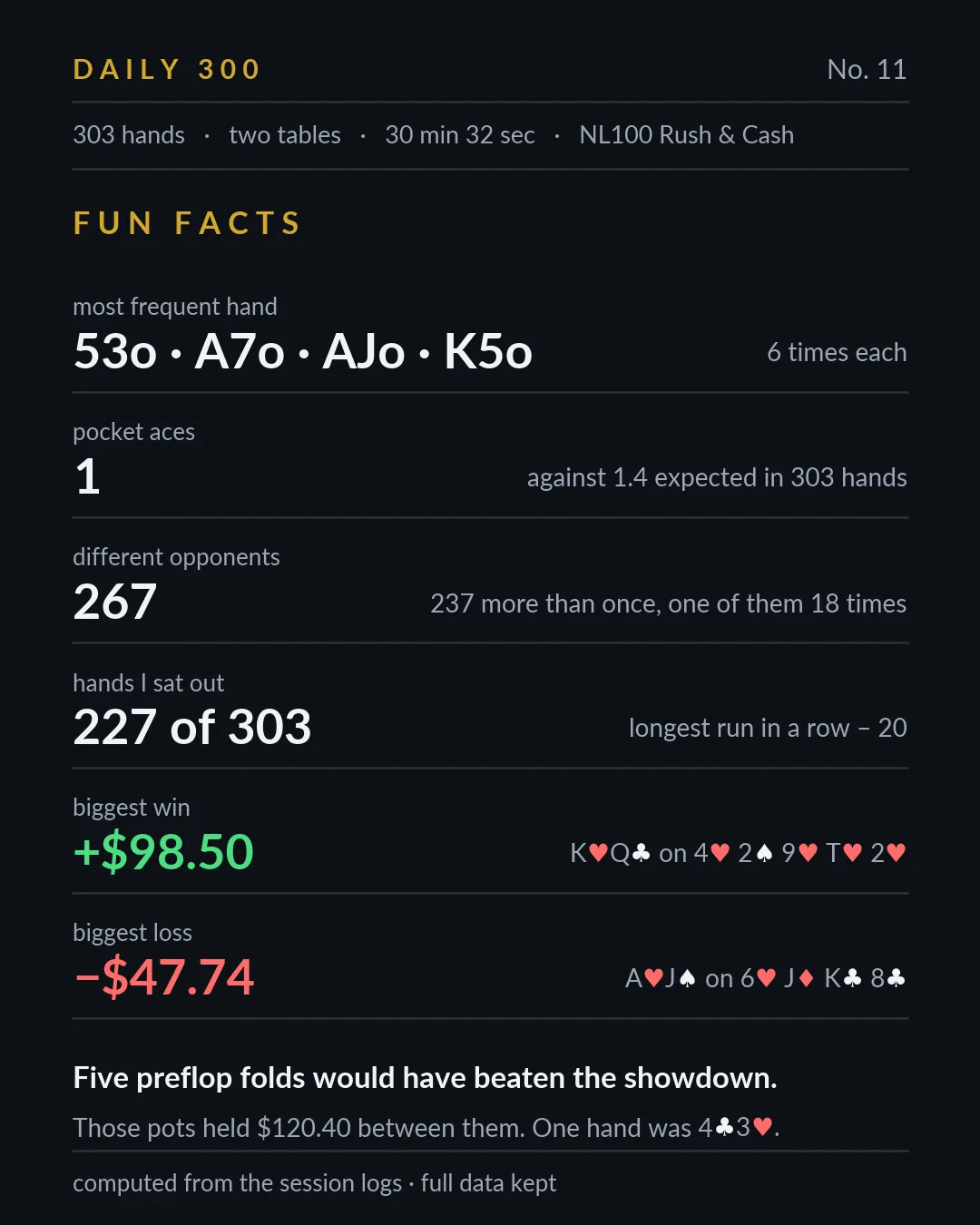
In the most expensive loss of the day the answer arrived half-finished. Big blind, I hold A♥J♠, an opponent raises, I raise again to $15, he calls.
Flop
Pot $33.50Flop 6♥ J♦ K♣ – middle pair of jacks with an ace kicker. I bet $13.06, he raises to $32.74, I call.
Turn
Pot $98.98Turn 8♣, I check, he moves all-in for $55.44, and I fold. Minus $47.74, the worst hand of the day. And then he shows one card – J♥. So he had a jack, same as me, and that is half an answer: a jack on that board can be king-jack, which beats me, or jack-nine, which does not, or a third jack. Enumerate every combination containing that card and ten of them beat my hand, thirty-two are behind it, three are exactly level – but that is a count against the deck rather than against the hands he could actually have arrived with, and it settles nothing. I paid $47.74 and got one card back.
The fourteen hands where the answer did come in full were, though, generous that day. In one I held aces against jacks and was right nine times out of ten; in another, king-queen with no pair against a pair of nines, and I was wrong three times out of four. The first one returned −$1.50 and the second +$98.50. So even where there is an answer, it is about how the cards fell rather than about how I thought.
I only have half an answer for what to do with this. Inside the game the fix is dull: the decision and its reasoning get written down before the cards are turned over, and then the fourteen answers test a list made in advance instead of whatever stuck in memory. Almost nobody does that at work, because work has no showdown – no second in which it suddenly becomes clear that it is time to check yourself.
In half an hour I learned the answer to every fifth decision I made, and those were precisely the decisions that cost the most. The other sixty-one left in silence, and they will not be in my experience unless I write them down myself, before the answer. A judgment assembled from three big stories that ran to the end will be wrong precisely because they did not run to the end by chance.
Session cards
The best sessions in your inbox, once a week.