Session 7 · 302 hands · 2 tables · 31:05
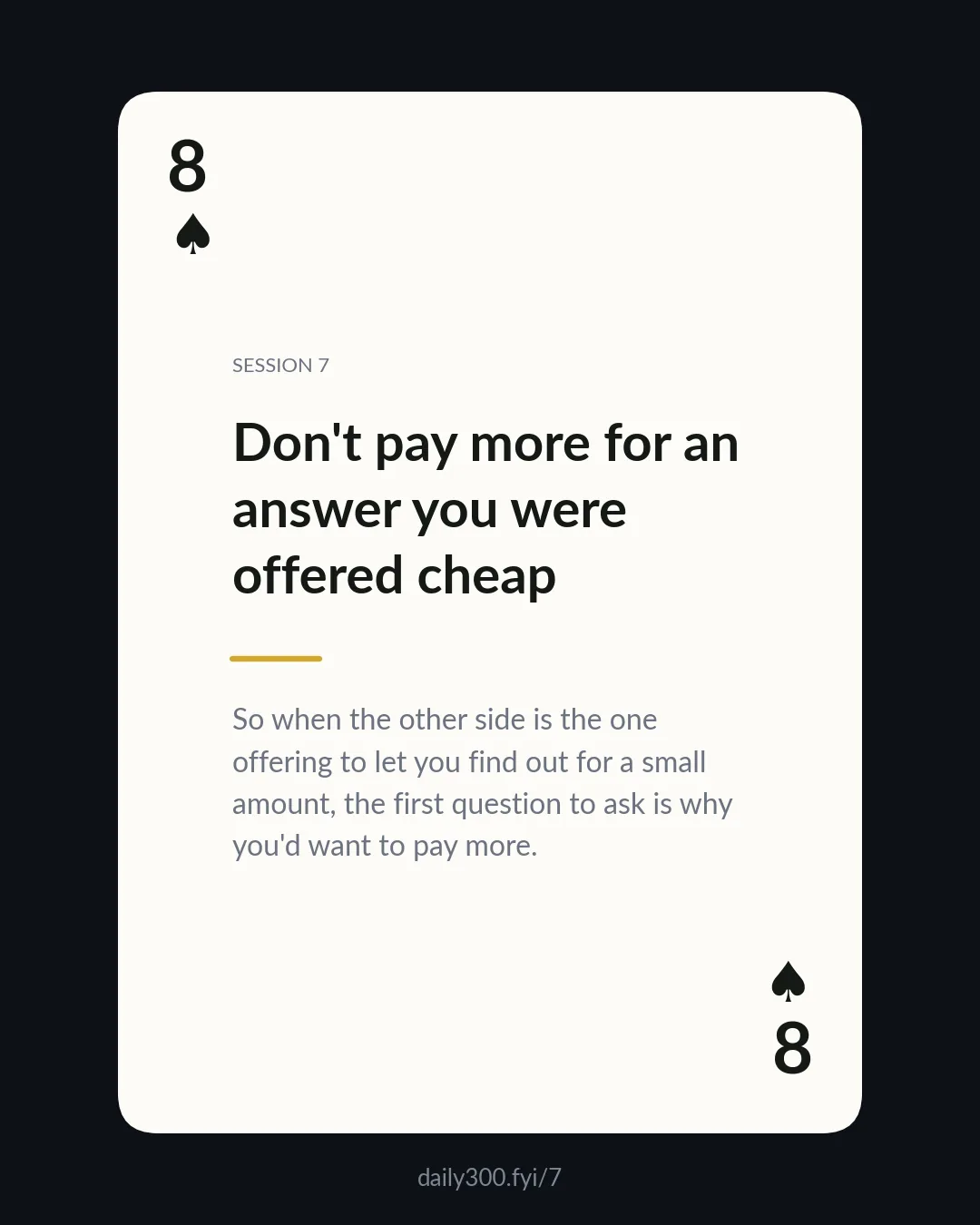
Don't pay more for an answer you were offered cheap

Mark Zavadsky. Launched Alibaba in Russia, ran Sberbank's ecosystem, headed the studio behind Smeshariki and Fixiki, now iGaming and investing.
The idea
I was offered the answer for six dollars. I replied that the answer would cost twenty-eight, and got a counter-price: all the money I had on the table. By the math, the gap between the two options was twelve to fifteen dollars – that is what the idea of the day cost.
Business works the same way. You're offered a settlement and go to court, to get the same answer two years later. You're offered a short pilot and insist on the full contract, to find out nobody wants the product once it is built. Someone asks you a question and you answer with a statement, and now the argument is about the statement. The cheap decision, admittedly, is not always the right one, but it is always cheap, and that is the whole point of it. So when the other side is the one offering to let you find out for a small amount, the first question to ask is why you'd want to pay more.
Below: a case with the same mechanics, and the hands the idea grew out of, with the arithmetic. Poker words are underlined – hover to see what they mean.
The case
Denver was building an airport and ordered an automated baggage system for the whole airport at once, a $193 million contract. The ordinary conveyor system that ended up carrying the bags was costed at $51 million, and was only agreed to after test runs had bags falling out of the carts.
The airport opened sixteen months late. The delay cost the city and the airlines around $360 million, at eighteen to nineteen million a month. The cheap answer had been on the table from the start, and it was also the only one that worked.
The analysis
The price of a cheap answer
Preflop
Here is the hand. I am in the big blind with 9♠3♠; everyone else has folded, the small blind, with five hundred and change behind, raises to $3, and I put in two more dollars to call. By the theory, this hand folds to a small-blind raise every time, so the call was already a mistake, if a cheap one.
Flop
Pot $6Flop 9♦ T♥ T♠, $6 in the pot. I have two pair – the tens on the board and my nines. He bets $1.50, I raise to $6, he calls.
Turn
Pot $18Turn K♥, $18 in the pot, we both check.
River
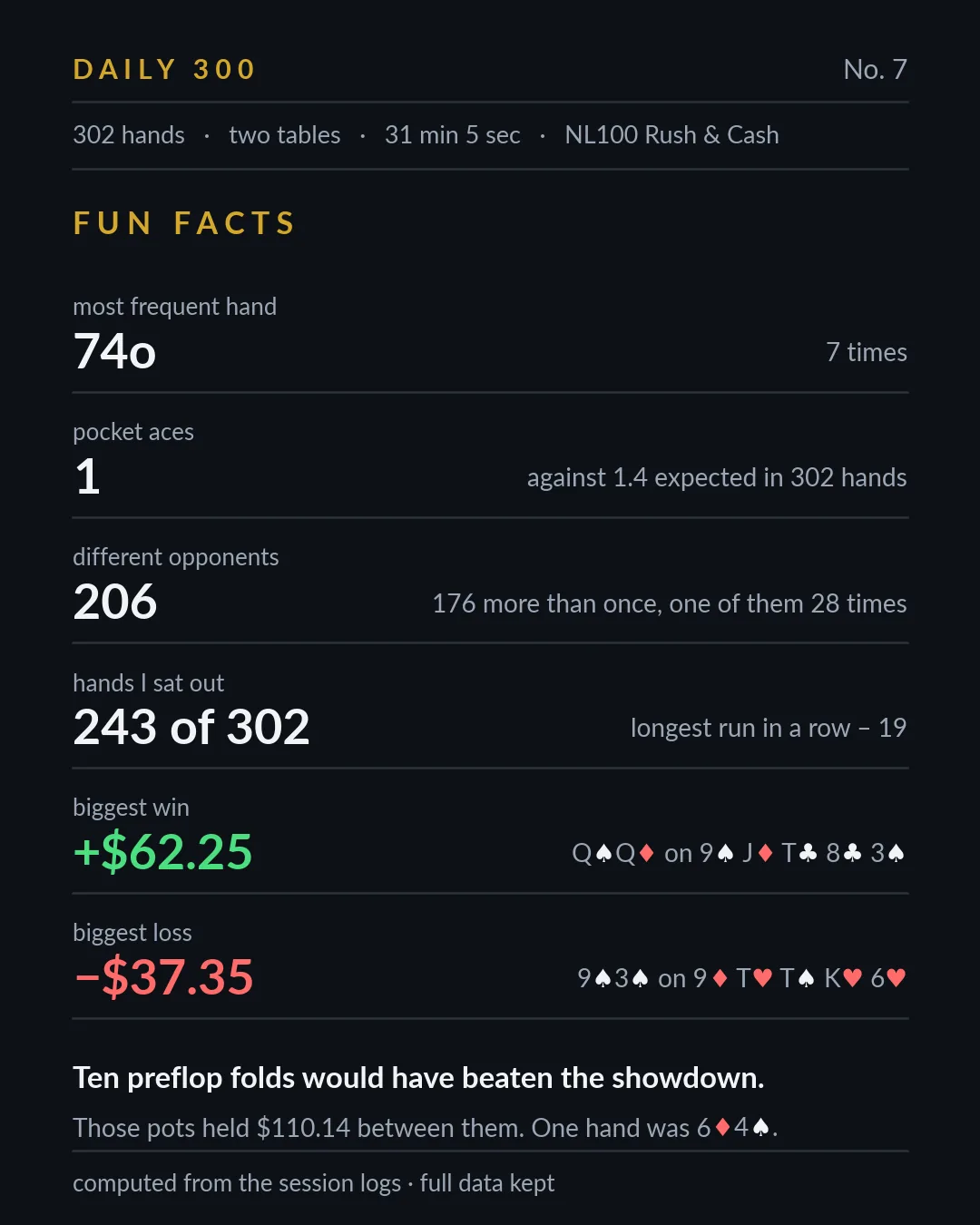
Pot $18River 6♥ – the third heart on the board: T♥ K♥ 6♥. He bets $5.94, a third of the pot. Now, an honest look at my hand. The three does nothing; my hand is the two tens and two nines, with the king on the board as my fifth card. Any king beats me, any ten, pocket nines or pocket sixes, any pocket pair above tens, any flush, and two straights – QJ and 87. A nine with a small card in his hand is a split pot – a chop. It is a weak hand, but it has one thing going for it: for $5.94 it gets to see the answer. A $5.94 call into a $23.94 pot needs to be right one time in five, and with a chop against those nines and a win against every hand that missed, that is enough: by the model the call is worth plus three to five dollars. I raised to $28.35. That is no longer a question but a statement: "I have a flush or a ten." For the raise to pay, he has to fold 54% of the time. The range of hands he could have gotten here with (open from the small blind, bet and call my raise on the flop, check the turn) I put at 183 combinations. Two-thirds of them beat me, eight percent chop, a quarter lose to me. On two models of who calls, he folds somewhere between a tenth of the time and just under half. The raise is worth minus seven to minus twelve dollars. By the theory, this hand calls here 72% of the time, folds 24%, and raises 5%. What did I buy for that $28.35? The call would have given me the same answer – a showdown – for $5.94, and two times out of three the answer would have been bad, but it would have cost six dollars. The raise bought the same answer at a higher price and added one more: how much he was willing to put in to find out whether I had what I claimed. He answered by moving all in. The log says $530.62, but we play for my stack: what was on the line was my remaining $62.65. I folded, and that is correct: against the range that shoves like this, tens and nines are not ahead often enough – the price needs a third, and they do not get there. The hand cost $37.35, and by the calculation twelve to fifteen of that was avoidable. I never found out what he had, and that too is part of the price: for $5.94 I would have.
The same question at a different size
Preflop
The second hand is the same sizing mistake from the other side. Q♦6♦ in the big blind against a raise to $4 from middle position (MP); by the theory this is a fold too, and I called.
Flop
Pot $8.50Flop 8♦ 4♠ 7♥: I check, he bets $6.38, I call with an inside straight draw – four cards to a straight, missing the five.
Turn
Pot $21.26Turn 7♣ – we both check.
River
Pot $21.26River J♥, $21.26 in the pot, and I bet exactly the pot. He calls and shows A♥A♠. The aces had checked the turn, and I read the silence as weakness. By the model the bet pays: between half and seven-tenths of his opening range folds, and half is what the bet needs. By the theory this hand bets on this river every time – but for half the pot, never the full pot. An eleven-dollar question, and I asked it for twenty-one. Minus $31.64.
When the price is justified
Preflop
The third is my only all-in of the day and the best decision of the day. Q♠Q♦ on the button, middle position opens to $2, I raise to $7, he calls.
Flop
Pot $15.50Flop 9♠ J♦ T♣: he checks, I bet half the pot, $7.75, he raises to $23.25, I call – my queens are higher than anything on the board, and a king or an eight makes a straight.
Turn
Pot $62The turn 8♣ completes it: I now have a straight, eight through queen. He bets $15.50, I raise to $35, he calls.
River
Pot $132River 3♠, $132 in the pot, he checks, I bet the rest – $76.71 – and he folds. The only straight above mine is KQ, and here the expensive statement was justified: the best hand was behind it. Plus $62.25.
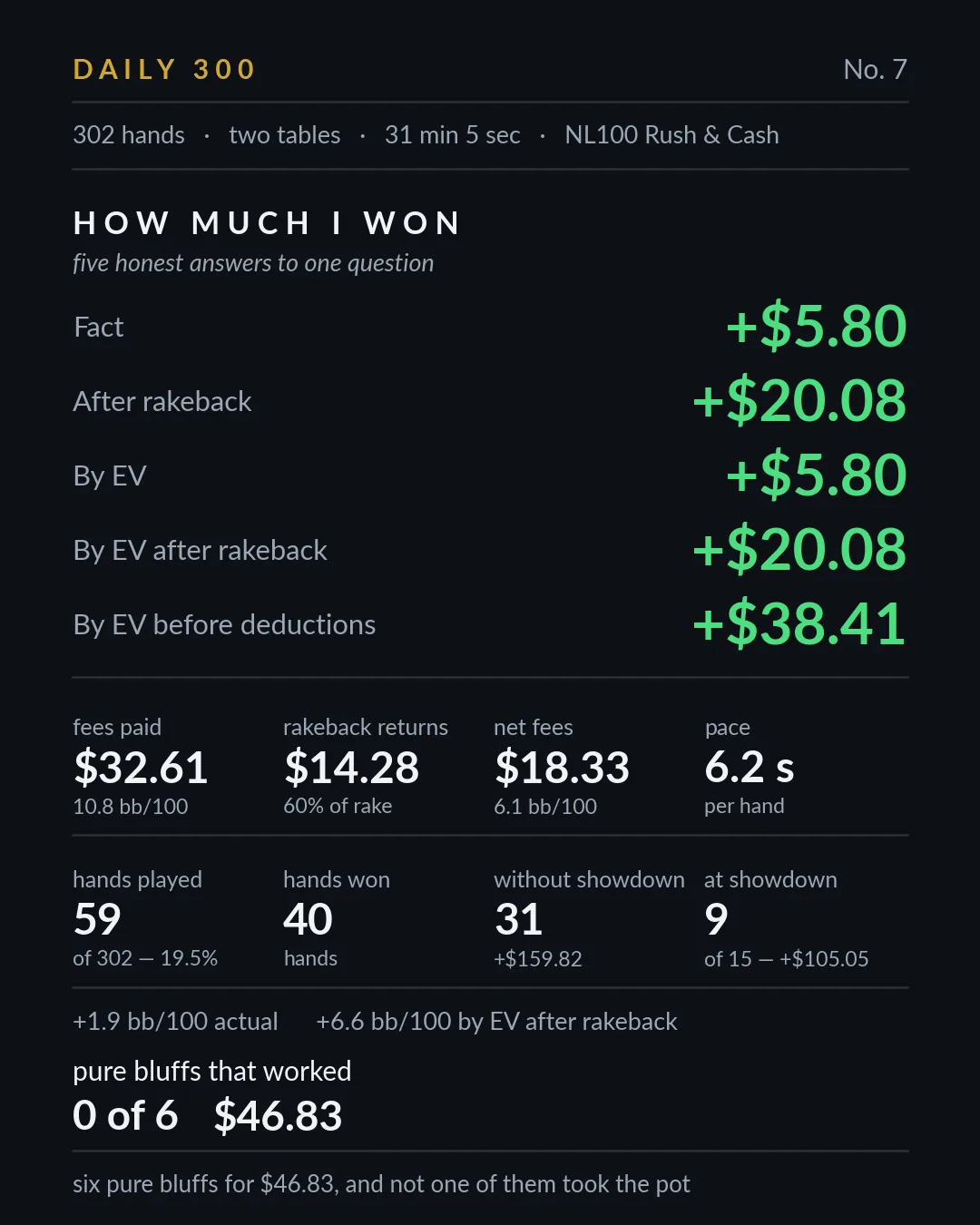
The day came to six dollars; the three hands in it moved a hundred and thirty-one between them. In one, I was offered the answer for six dollars and made it expensive myself. In another, the cheap question cost eleven, and I asked it for twenty-one. In the third, the expensive price was mine, and I named it because I could back it. There isn't always a cheap way to get the answer, but when the other side offers one, there is only one reason to turn it down: knowing for certain that you can pay for the expensive one.
Session cards
The best sessions in your inbox, once a week.