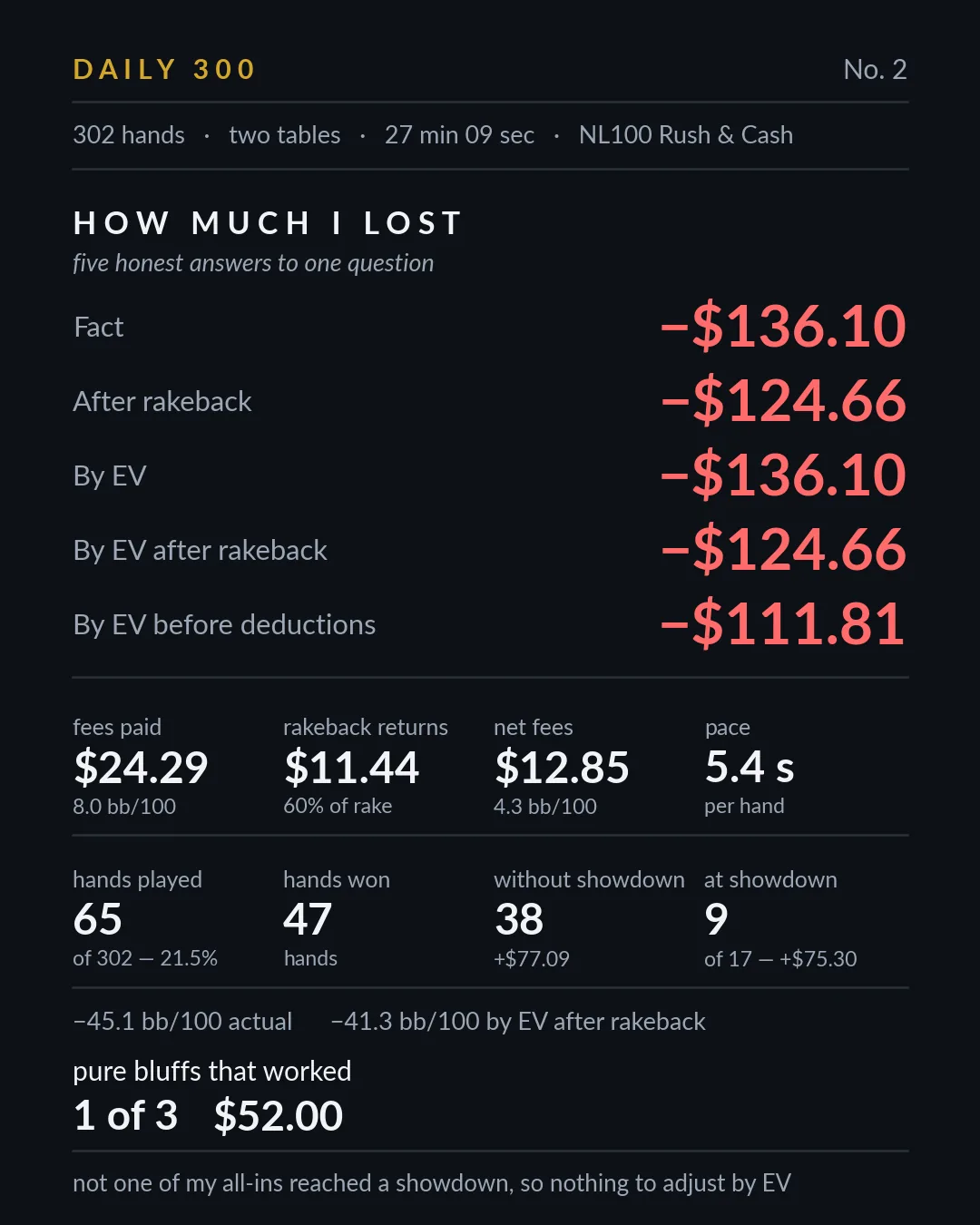
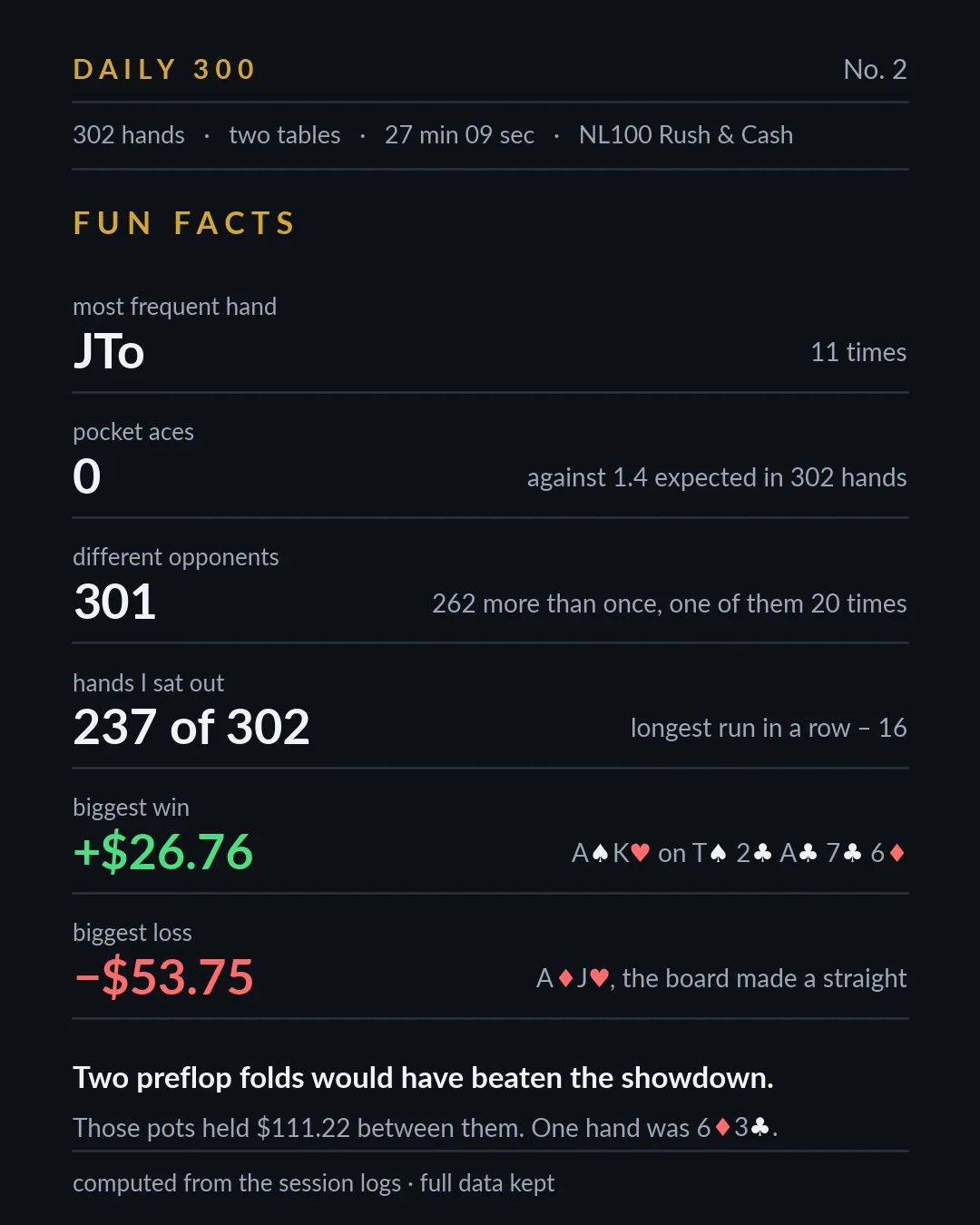
Session 2 · 302 hands · 2 tables · 27:09
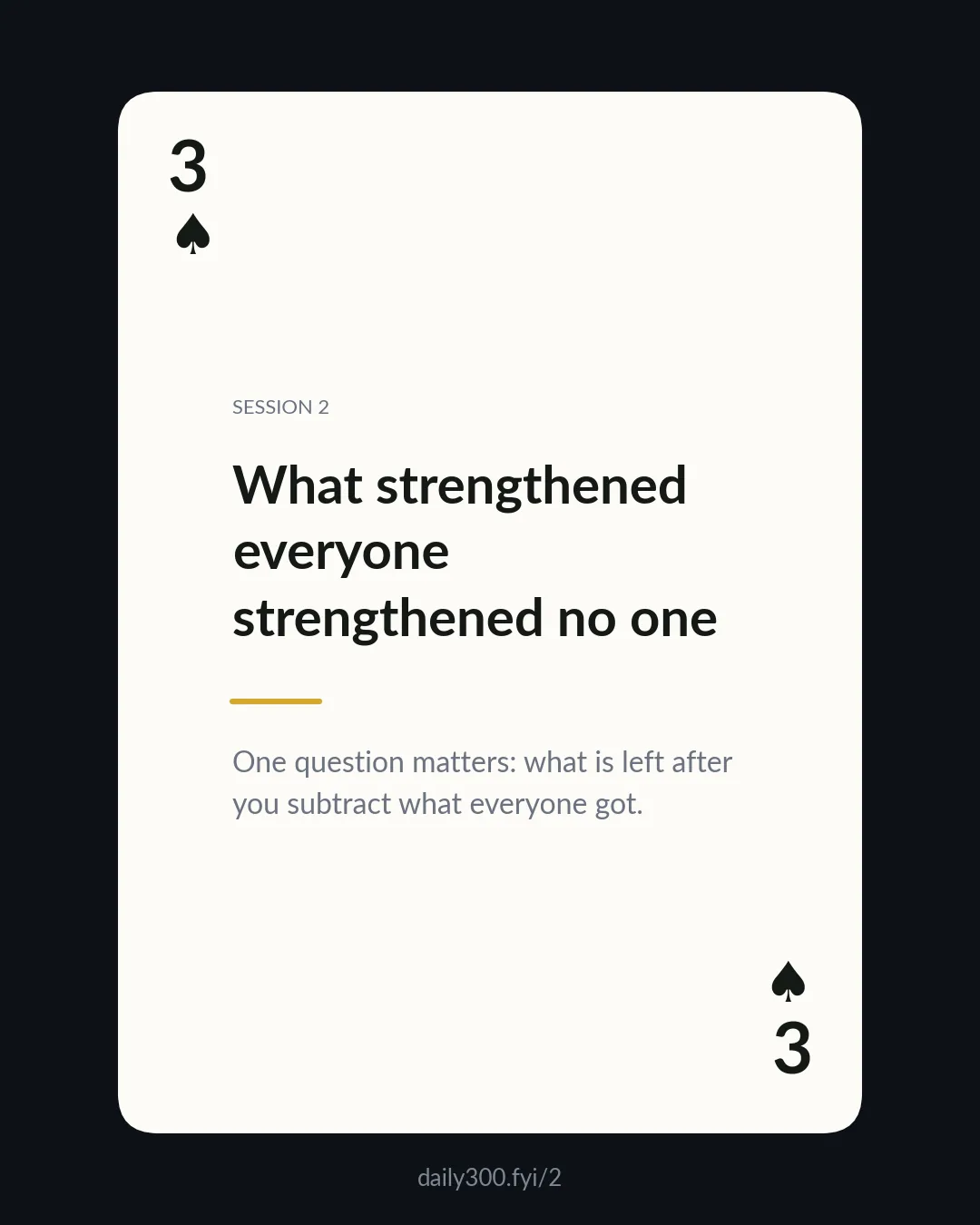
What strengthened everyone strengthened no one

Mark Zavadsky. Launched Alibaba in Russia, ran Sberbank's ecosystem, headed the studio behind Smeshariki and Fixiki, now iGaming and investing.
The idea
This idea cost me $53.75: of the twenty-five cards that strengthened me, twelve strengthened everyone else too, because they landed on the shared board, and I took a shared gain for my own.
In business the shared card is cheaper traffic, a new platform, a rate cut. The feeling of strength is complete, only every competitor got it the same day, and what strengthened everyone, in fact, strengthened no one. One question matters: what is left after you subtract what everyone got.
Below: a case with the same mechanics, and the hands the idea grew out of, with the arithmetic. Poker words are underlined – hover to see what they mean.
The case
In 2021 Peloton announced it would build its first American factory for four hundred million dollars: demand for home exercise machines was growing faster than it could make them. Less than a year later the lines stopped – first for two months, then longer – with thousands of bikes sitting in warehouses and on cargo ships, and the factory never got to open.
The demand was real, only it did not belong to Peloton: it went to the whole home-fitness market, and it went there at once. The company read it as its own strength and ordered a factory against it, and a factory is still there when the demand ends for everyone at the same time.
The analysis
The card that helped everyone
Preflop
Here is the hand. First to act (UTG), A♦J♥. I raise to $2, the big blind calls.
Flop
Pot $4.50Flop 9♥ Q♥ 8♥ – three hearts on the board, one in my hand, the jack. He checks, I bet $2.25, he calls.
Turn
Pot $9Turn J♣. I have a pair of jacks and several ways to improve. The first is a heart flush: I hold four hearts, I need a fifth, and nine cards are hearts. The second is a straight: a ten completes the straight from eight to queen. Two more jacks would give me trips, and two aces would give me two pair. In all, 25 of the 46 unseen cards improve my hand. But twelve of them land on the shared board and belong to everyone rather than to me: three tens lay the whole straight out on the table, and an eight, a nine or a queen pairs the board. Thirteen are mine – 28%. I bet $4.50, he raises to $13.50, I call $9 into a pot of $27: a price that asks me to be right one time in four.
River
Pot $36River T♦. The card I was waiting for arrived. And it completed the straight not for me but for the board: eight, nine, ten, jack, queen now lie in front of everyone. My ace adds nothing to that straight – a higher one needs a king. Neither does the jack: three hearts on the board, one in my hand. At this point there is nothing to guess. Of all 990 combinations possible on this board, not one is a hand I beat. Not "few" and not "by estimate" – not one: my hand is exactly what lies in front of everybody. He bets $36 into $36. My call cannot win the pot – only split it or hand it over. For the call to break even, we would have had to chop more than seven times in ten. And a player who bets the whole pot on the river has someone to get paid by; holding the bare board there is nobody to fold out and nobody to pay you. By my estimate, there is almost none of that in this bet – which makes the call losing against any sensible range. He had K♥T♥, a flush. −$53.75.
A pair from the board
Preflop
The same blindness, cheaper. K♠7♠ in the big blind: he opened on the button, I called.
Flop
Pot $4.50Flop 4♣ 6♦ A♠ – both check.
Turn
Pot $4.50Turn 3♥ – I bet $2.25, he calls.
River
Pot $9River 4♥: the second four pairs the board, and anyone holding a pair of their own now has two. I hold no pair of my own, only the fours on the table. I bet the pot, $9 into $9, which asks him to fold half the time. By my estimate, nine of his hands in ten beat me. He called with T♠A♦. −$13.25.
When my own two cards decided it
Preflop
And the reverse case. K♠K♣. He opens for $2.50, I raise to $8, he re-raises to $21.13, I move all in for $107.71. He folds, +$19.02. What matters is not the fold. Even against the tightest range that calls a bet like that, kings are, by my estimate, ahead 57.19% of the time. However he answers, the decision stays profitable – by $12.63.
What here was mine? With the kings, everything: I put my whole stack at risk and was still ahead of the tightest range that could answer, and there my own two cards decided it. In the other two hands the shared cards decided it, and I still counted both of them as mine. A community card that fits everyone strengthens everyone, and the player who loses is the one who took it for his own.
Session cards
The best sessions in your inbox, once a week.